


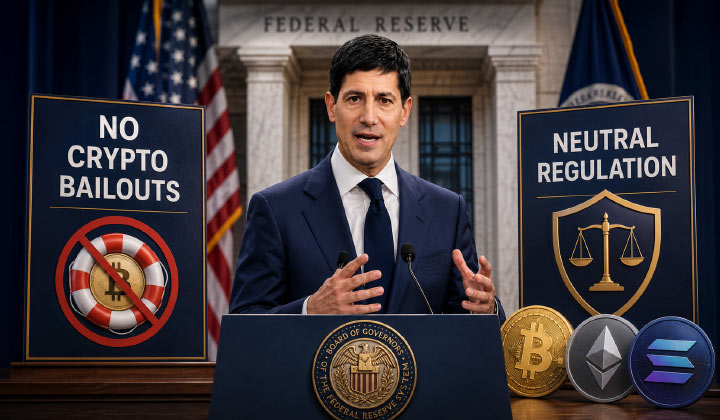
Federal Reserve Chair Kevin Warsh said the U.S. central bank will not bail out crypto or stablecoin companies in future financial crises. He also promised to keep politics out of banking supervision, confirmed the Fed is working to meet the GENIUS Act rulemaking deadline, and announced more regulatory reforms to create a fair and competitive financial system. Warsh made these comments during a House Financial Services Committee hearing on the Fed’s semi-annual monetary policy report.
Warsh explained that the Federal Reserve does not plan to act as a safety net for the digital asset industry. Drawing on his experience from the 2008 financial crisis, he emphasized that the central bank should work to prevent systemic risks instead of stepping in with emergency rescues after issues arise.
His comments make it clear to crypto firms and investors that they should not count on government support during market stress. Instead, companies will need to improve their own liquidity management, transparency, and risk controls as stablecoins become more important in global payments and decentralized finance.
WATCH: @RepLoudermilk on reputation risk at the Fed:
“… Operation Chokepoint 2.0 involved partisan actors at the Fed using is, quote, reputation risk as a means to target and debank firms and individuals in the digital asset ecosystem, the energy industry, and really anyone… pic.twitter.com/XO38u5w6Sd
— Financial Services GOP (@FinancialCmte) July 14, 2026
Warsh also responded to concerns about “Operation Choke Point 2.0,” where some lawmakers say digital asset companies were unfairly denied banking services. He confirmed that “reputational risk” is no longer part of the Federal Reserve’s supervisory framework and said banking oversight should stay free from political influence. He also mentioned that more reforms are coming to make the financial system safer and encourage competition.
Regarding stablecoin regulation, Warsh said the Federal Reserve is working quickly to meet this week’s deadline for publishing proposed rules under the GENIUS Act. He prefers to coordinate rulemaking with other U.S. banking regulators so financial institutions get consistent guidance and the public can take part in a single consultation process.
Warsh also spoke about artificial intelligence, calling it one of the most transformative technologies today. He noted that while AI might disrupt some jobs in the short term, it is more likely to boost productivity and help long-term economic growth. The Federal Reserve has already brought in outside experts to study AI’s wider economic effects.
The hearing marks a clear change in the Fed’s approach under Warsh, combining neutral regulation with clearer oversight of digital assets. It also makes it clear that crypto markets will need to operate independently without expecting central bank bailouts.
Stay informed with the latest trends in Web3, blockchain innovation, and cybersecurity updates at 3verseTV
You need to login in order to Like

















Leave a comment