


- ZachXBT has criticized hardware wallets, calling them “complete garbage” and recommending a dedicated iPhone for experienced crypto users.
- The comments have reignited the debate over Ledger security, hardware wallets, and the best approach to crypto self-custody.
- Recent Ledger-related phishing scams, fake apps, and social engineering attacks have highlighted that users often remain the weakest link in crypto security.
ZachXBT declared that hardware wallets are “complete garbage” for holding digital assets, igniting a new discussion about crypto security. The long-held notion that hardware wallets, especially Ledger devices, are the safest choice for self-custody is directly challenged by his remarks.
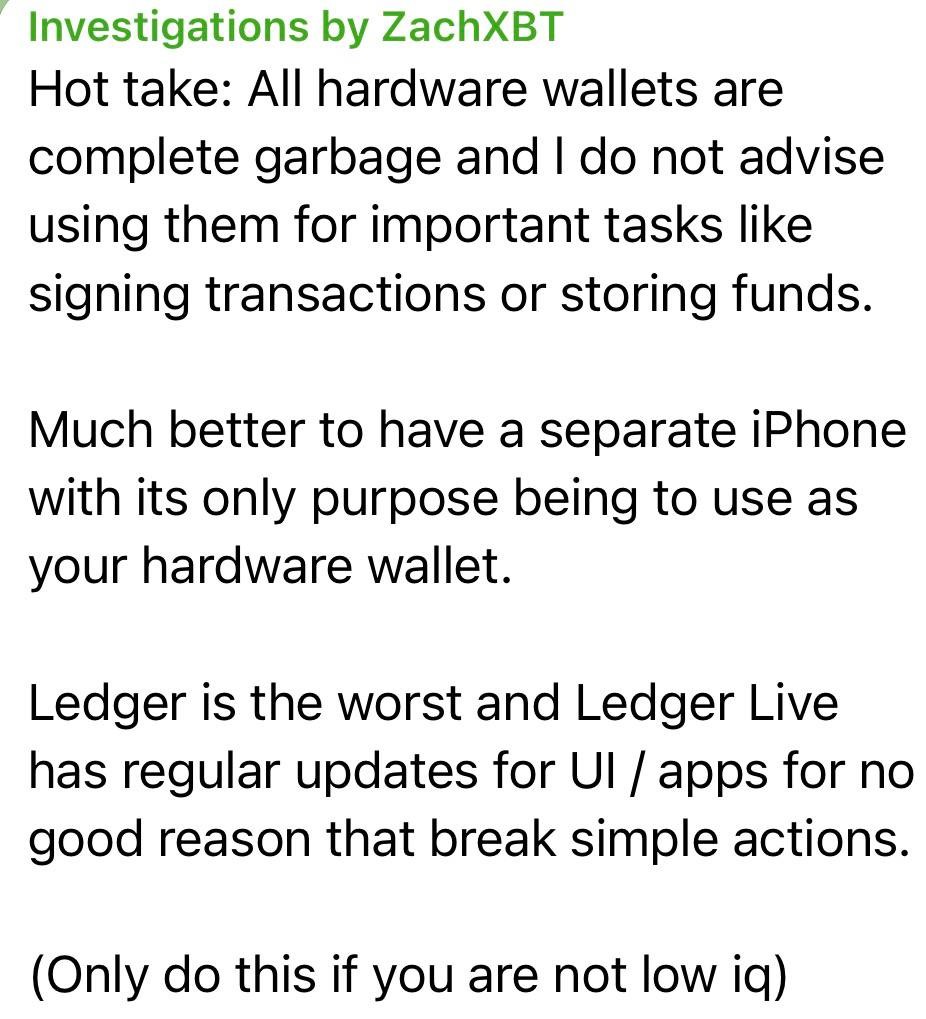
Prominent blockchain investigator and on-chain sleuth ZachXBT, widely known for exposing crypto scams and security breaches, claimed in a Telegram thread on Wednesday that he no longer advises using hardware wallets for crucial functions like holding funds or signing transactions. Instead, he recommended that technically skilled users consider using a dedicated iPhone solely for cryptocurrency wallet applications.
His remarks quickly gained traction across the crypto community, reigniting debates over the advantages and disadvantages of hardware wallets.
He contended that regular changes to Ledger’s wallet app add needless complexity and sometimes interfere with key wallet features. His comments follow Ledger’s rebranding of Ledger Live as Ledger Wallet and the addition of functionality like token swaps, staking, yield services, and cryptocurrency purchases.
Ledger Faces Growing Security Scrutiny After Major Crypto Scams
Adding extra financial services to a wallet application has long been criticized for increasing the attack surface. Although these features make things more convenient, they also increase the likelihood of software flaws, phishing attempts, and user misunderstanding.
The argument has grown in importance as a result of several high-profile instances involving Ledger users in 2026. After victims typed their recovery phrases, a phony Ledger Live app that surfaced on Apple’s App Store in April allegedly took close to $9.5 million.
A similar social engineering attack employing a hardware wallet cost another investment of over $282 million earlier this year. Phishing campaigns, fraudulent mailers, and fraud involving consumer data compromised during Ledger’s 2020 e-commerce breach were among the other occurrences.
The hardware wallets themselves were not compromised by these assaults. Rather, phishing emails, phony programs, misleading websites, and social engineering techniques were used by attackers to take advantage of victims. This distinction is still at the heart of the current debate.
The Security Case For A Dedicated iPhone Crypto Wallet
ZachXBT thinks a factory-reset iPhone used only for cryptocurrency might provide a more transparent security paradigm. Cryptographic keys are safeguarded by Apple’s Secure Enclave in modern iPhones, and additional security measures include biometric authentication, frequent software upgrades, and stringent app sandboxing.
Additionally, using a device exclusively for cryptocurrency transactions may lessen exposure to malware that is frequently present on regular PCs.
A dedicated smartphone cannot fully replace cold storage, according to several security experts. Smartphones are still internet-connected devices, unlike offline hardware wallets, and they could still be at risk from hacked accounts or harmful apps. Mobile ecosystems are not immune to sophisticated scams, as evidenced by the phony Ledger app that made it to Apple’s App Store.
Stay informed with the latest trends in Web3, blockchain innovation, and cybersecurity updates at 3verseTV
You need to login in order to Like














Leave a comment