


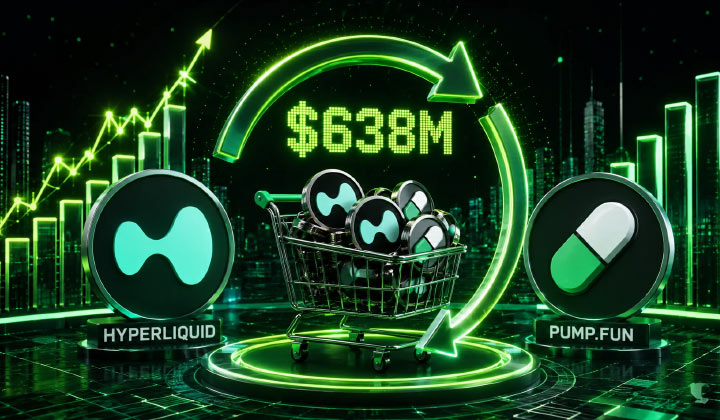
Crypto projects have spent about $638 million buying back their own tokens in 2026, as more blockchain businesses turn to a strategy long associated with traditional stock markets. Hyperliquid and Pump.fun account for nearly 90% of the total buyback activity, according to data from blockchain analytics firm Allium Labs cited by the Financial Times. The figure is already above the $545 million spent during the same period in 2025 and is dramatically higher than the roughly $366,000 recorded across all of 2024.
Token buybacks allow projects to use part of their revenue to purchase their own tokens from the market. Some projects then burn those tokens, permanently reducing the supply in circulation. The idea is similar to companies buying back their own shares, although the impact on crypto tokens can vary considerably.
Hyperliquid is by far the biggest example of this approach. The derivatives trading platform directs about 99% of eligible trading fees towards buying HYPE through its Assistance Fund, with the purchased tokens subsequently burned. Since HYPE launched in late 2024, Hyperliquid has reportedly bought around $1.3 billion worth of the token, although that figure covers a longer period and should not be confused with the $638 million spent across the industry in 2026.
HYPE has also performed strongly. The token was trading at around $63.35 on August 31, according to market data cited in the latest reports. It has gained roughly 70% over the past year, although the price increase cannot be attributed to buybacks alone.
Pump.fun is the other major force behind the 2026 buyback boom. The Solana-based launchpad directs a significant portion of its revenue towards purchasing and burning PUMP tokens. Together, Pump.fun and Hyperliquid account for almost nine out of every ten dollars spent on token repurchases this year.
Other projects are joining the trend, although on a much smaller scale. Sky Protocol, formerly known as MakerDAO, has spent about $26 million on SKY buybacks during the period covered by the Allium data. The project says the programme helps align token holders with the protocol’s long-term performance.
Lido has also announced plans for regular buybacks once certain revenue conditions are met. Its LDO token, however, has continued to struggle despite the proposed mechanism, showing that buybacks do not automatically translate into higher prices.
The same lesson can be seen elsewhere. Jupiter has spent millions of dollars buying back JUP, yet the token has still fallen sharply over the past year. Chainlink has also used buybacks through its onchain reserve programme, but LINK has not escaped the broader weakness in crypto markets.
That has led some analysts to question whether buybacks alone can create lasting value. Elton Shehdula of Allium Labs said repurchases can reduce circulating supply and create an impression of confidence, but they do not necessarily make a project fundamentally stronger.
The trend nevertheless points to a change in how crypto investors are evaluating tokens. Instead of relying entirely on speculation and future promises, investors are increasingly looking at whether protocols generate real revenue and whether some of that revenue actually reaches token holders.
Crypto Projects Buy Back $638 Million in Native Tokens This Year; Hyperliquid and Pumpfun Account for Nearly 90%
According to the Financial Times, digital asset projects have bought back approximately $638 million worth of their own tokens so far this year, up from $545 million… pic.twitter.com/jTWVduwheh
— Wu Blockchain (@WuBlockchain) August 31, 2026
The $638 million buyback figure is therefore significant, but the more important question is whether these programmes can create sustainable value. Hyperliquid’s strong performance suggests they can help in some cases, while the weaker results from several other tokens show that buybacks are no substitute for genuine demand, useful products and healthy protocol revenues.
Stay informed with the latest trends in Web3, blockchain innovation, and cybersecurity updates at 3verseTV
You need to login in order to Like
















Leave a comment