



The U.S. Securities and Exchange Commission, the federal agency tasked with supervising securities markets and safeguarding investors, has sent a proposed rule regarding crypto custody to the White House for official review, signaling new progress in the regulator’s continuing digital-asset rulemaking initiative.
The proposal was submitted to the Office of Management and Budget on August 25, as noted in a federal regulatory filing, starting an inter-agency review procedure before the rule can be released to the public. The rule is designed to spell out how investment advisers and investment companies can hold crypto assets on behalf of clients, while also stripping away certain custody requirements the SEC now views as outdated.
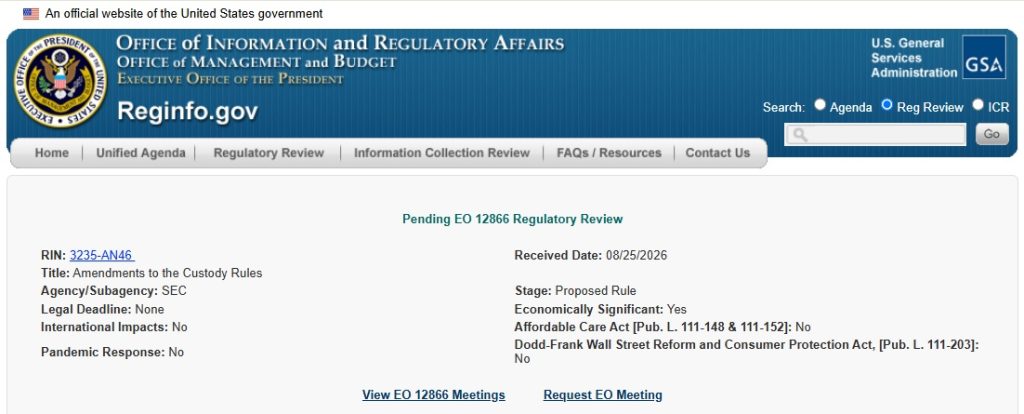
Source: reginfo.gov
Chairman Paul Atkins has tied this effort to his broader push to modernize the agency’s digital-asset framework, though the actual text of the proposal remains under wraps until OMB completes its assessment.
Proposal Targets Crypto Custody Rules
Fundamentally, the plan seeks to provide investment firms with a more defined path for holding digital assets while remaining compliant with current SEC requirements. The agency has recognized that advisers have frequently expressed concerns about how outdated custody regulations, mainly designed for conventional securities, truly apply when cryptocurrency becomes involved.
LATEST: 🇺🇸 The SEC has sent proposed crypto custody rule changes to the White House for review, aiming to clarify how investment advisers can hold digital assets for clients. pic.twitter.com/dL0PVRUr0k
— CoinMarketCap (@CoinMarketCap) August 26, 2026
Beyond just clarifying gray areas, the proposal would also eliminate specific custody provisions the SEC considers stale, arguing they no longer reflect how modern markets actually hold and trade assets today.
White House Review Comes Before SEC Vote
Sending the rule to OMB is only an early checkpoint in a much longer federal process. After the OMB finishes its review of the proposal, perhaps after requesting some changes, the proposal goes to the SEC, where all three of the current commissioners must approve it before it can be published.
If that approval succeeds, the SEC would then invite public comment on the proposal, for at least 60 days, after which the commissioners would consider the comments and decide whether to make the rule final. To become effective, the rule would then need another vote by the commissioners, so this proposal is by no means a done deal.
Crypto Rules Advance As Congress Remains Stalled
This custody push isn’t happening in isolation. The SEC has continued building out crypto-specific regulations even as lawmakers work through broader legislative efforts, most notably the CLARITY Act, which is still being debated in the Senate over how regulatory authority should be split between the SEC and the Commodity Futures Trading Commission.
With that legislative process moving slowly, the SEC appears to be tackling what it can within its existing authority rather than waiting on Congress to settle the bigger jurisdictional questions.
SEC Also Delayed Regulation Crypto Meeting
This newest submission follows another setback in early August, when the SEC suddenly delayed an open meeting that was meant to address a different rulemaking proposal called Regulation Crypto.
That gathering, initially set for August 14, was called off just one day prior, with the agency pointing to an unexpected scheduling issue and vowing to set a new date.
Regulation Crypto covers a distinct framework focused on certain crypto assets sold as part of investment contracts, separate entirely from the custody rule now sitting with OMB.
Details Of Custody Framework Remain Pending
For now, the SEC’s filing offers little beyond a general description of what the custody rule intends to accomplish. Key specifics, including which crypto assets and custody arrangements would actually fall under the new framework, what existing requirements get modified or removed, and how advisers would be expected to safeguard client holdings, remain unavailable until the proposal clears OMB review and becomes public.
Until then, this stage simply represents the next procedural step in a rulemaking process that’s likely to stretch on for months before anything becomes binding.
Stay informed with the latest trends in Web3, blockchain innovation, and cybersecurity updates at 3verseTV
You need to login in order to Like

















Leave a comment