


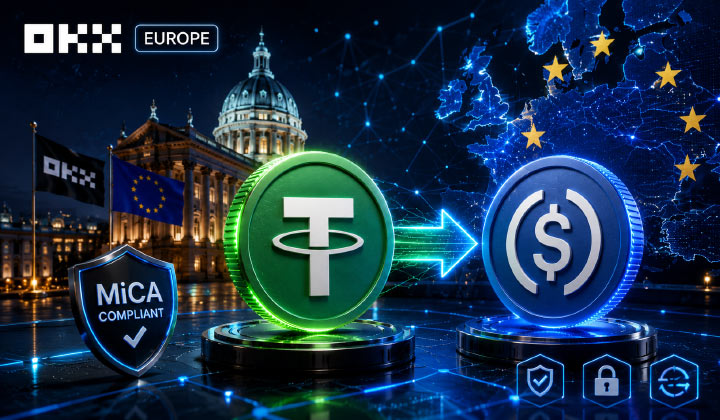
OKX Europe has launched a new feature that allows customers to convert USDT into MiCA-compliant USDC with a single, one-way transaction. The move is aimed at helping users adjust to the new Markets in Crypto-Assets (MiCA) regulations in the European Union, which have made it difficult for exchanges to continue supporting Tether’s USDT.
OKX isn’t setting a deadline for clients to move their funds, but is instead allowing them to convert their holdings at their own pace, allowing for a smoother transition to a regulated stablecoin.
The new service lets customers deposit USDT into their OKX Europe accounts and convert it directly into USDC, one of the largest stablecoins approved under the EU’s MiCA framework.
According to the exchange, the feature is especially useful for users whose current platforms have already stopped accepting USDT or plan to automatically convert customer balances into compliant alternatives.
This launch coincides with the complete implementation of the MiCA framework on July 1, which will alter the stablecoin market in Europe. Many European cryptocurrency exchanges have eliminated USDT trading pairs, restricted deposits, or advised customers to switch to regulated stablecoins because Tether is not permitted to issue USDT under the new regulations.
OKX Europe, which has MiCA licenses in 30 EU and EEA nations, claims it wants to provide clients with greater flexibility throughout this shift. The exchange allows users to choose when to convert their holdings rather than imposing a deadline, allowing them to proceed at their own speed.
Europe’s new rules haven’t stopped USDT from being the world’s largest stablecoin According to DeFiLlama data, Tether is the largest stablecoin by market cap, with nearly 59% of the global market, and its market cap is around $184 billion. By comparison, Circle’s USDC is the second-biggest stablecoin with a market value of about $73 billion.
Tether has consistently defended its decision not to seek MiCA approval. CEO Paolo Ardoino has argued that some of the regulation’s reserve requirements could expose stablecoin issuers to additional risks by requiring part of their reserves to be held with European banks. He has repeatedly said the company believes the framework is not yet suitable for stablecoin issuers.
In recent public statements, Ardoino maintained that Tether would only consider applying for MiCA authorization if the rules become safer for both consumers and stablecoin providers. For now, the company appears committed to continuing its existing strategy outside the EU’s regulatory framework.
Stay informed with the latest trends in Web3, blockchain innovation, and cybersecurity updates at 3verseTV
You need to login in order to Like

















Leave a comment