


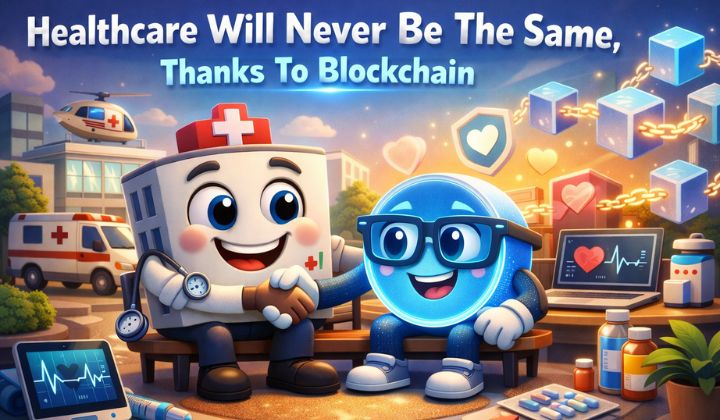
We have all heard this famous saying, “Health is Wealth’. Success, wealth, and accomplishments are meaningless without good health. Nothing is more important when a loved one is unwell than getting the appropriate care when needed most.
However, several factors, including appropriate medication, original medications, accurate diagnosis, accurate medical records etc., are necessary for proper medical aid.
Hospitals that continue to use outdated techniques run the risk of making mistakes and putting lives in danger. Here, blockchain can make a huge difference by resolving the majority of these issues. Blockchain gives the healthcare industry the trust and security it needs by leaving no room for error.
What Is Blockchain?
Distributed across numerous computers, a blockchain is a shared digital record book or digital ledger that is visible and nearly hard to alter. By organizing transactions into “blocks,” which are then connected in a chain, it produces a safe, unchangeable data history that all users on the network can confirm without the assistance of a central authority, such as a bank.
Imagine there’s a book that is circulated between a set of trusted people, where each person must document something in that. No one can tear a page out, and everyone has a copy. That’s blockchain: transparent, traceable, and secure. Blockchain has many features that make them a good choice for healthcare systems.
Why Use Blockchain Technology For Healthcare?
Blockchain technology is especially advantageous for the healthcare sector since it maintains tamper-proof records and safeguards private information as well.
Imagine a medical emergency, where time is critical. With the help of a blockchain based health record system, doctors will be able to quickly access a patient’s verified medical history, medications, prior surgeries, allergies, and insurance details without the hassle of going through a number of medical records on their systems, which are often scattered.
Doctors can make quicker, safer treatment decisions since they may be sure that the records are accurate because they are time stamped and cannot be tampered.
Healthcare Use Cases For Blockchain
The healthcare sector is continuously working to safeguard patients, hospital, insurance, and billing records as a result of the widespread use of electronic medical records. Let’s look at five uses that demonstrate blockchain’s benefits in the healthcare industry.
Drug Supply Chain Management
Blockchain technology’s transparent and unchangeable ledger allows pharmaceutical products to be tracked from production to distribution and eventually to the patient. A safe and unchangeable record of the drug’s journey can be created by using the blockchain to trace each step of the supply chain, from manufacturing to packaging, labelling, and shipping.
This transparency aids in keeping fake medications out of the supply chain since any discrepancy or unauthorized modification would be readily apparent, which is not possible in the current Electronic Medical Record (EMR) system. In the event of a recall, blockchain can quickly identify the tainted batch or product, lower patient risk and saving time and money compared to human recall processes.
Patient Record Management
One of the biggest problems facing all current healthcare systems is data silos. The scattered nature of medical data eventually complicates accurate diagnosis, making it challenging to get a complete picture of a patient’s medical history. The security and comprehensiveness of these documents are greatly enhanced using a blockchain-based system.
Furthermore, to maintain confidentiality and integrity and provide an uninterrupted, comprehensive medical history, medical records and data can only be accessed and decoded with the patient’s consent.
Expedited Credentialing
Expedited credentialing is a process used by hospitals to verify a healthcare provider’s qualifications like license, education, malpractice history faster than the standard, lengthy process.
Blockchain can expedite the medical industry’s credential verification process, guaranteeing that certificates and training are up to date. By doing this, potentially dangerous situations are averted and fraud and inaccuracies are reduced.
Real-time Insurance Information
Blockchain establishes a single source of truth to guarantee accessibility and interoperability, which can give insurance companies and healthcare providers the most recent information.
With the help of blockchain hospitals can instantly verify every little detail of the insurance coverage on the network, which in turn will help reduce approval times from days to minutes.
This minimizes billing disputes, prevents fraud like fake medical bills, improves coordination between providers and insurers, and ultimately speeds up the entire process.
Key Challenges Of Electronic Medical Record (EMR) In Healthcare
EMR systems are useful but not perfect. They often make sharing medical records between hospitals complicated. Blockchain provides answers to such common issues. Let’s look at the key challenges:
Data Security
Electronic medical records are prone to data security threats from malicious cybercriminals. They break into hospital systems to steal medical records compromising personal details.
Hospitals often struggle to keep this sensitive information safe from criminals. When data gets stolen, patients lose trust in the healthcare system.
Privacy Concerns
Patients worry about who can see their records. The reason is they have no control over who views their medical history. Sometimes personal health information gets shared with the wrong people. This makes people afraid to share critical health details with the doctors.
Data Silos
Different healthcare facilities employ different IT systems that do not exchange information seamlessly. When patients visit new doctors, their medical records stay stuck in old systems.
Owing to this, doctors cannot see complete patient records from other hospitals. This creates problems when patients need emergency healthcare.
Fake Medical Records
Some dishonest individuals create false medical records to get medicines illicitly. They also alter their medical history for insurance benefits. Doctors sometimes cannot even tell if patient records are real or fake.
This creates critical situations when treating patients. Moreover, wrong medical information may lead to harmful treatments.
Also Read: Why RWA Is The Future Of Finance?
Benefits Of Blockchain In Healthcare Industry
Blockchain technology is helping the healthcare sector in many ways. Let’s find out how blockchain is transforming healthcare:
Enhanced Privacy
Patients can grant or revoke access with a simple digital signature. Patients need not worry if a provider has your updated medical history.
Data Protection
Tampering the patient records can create problems identifying the disease or problem in the patient by the doctors and hospitals. Blockchain is a tamper-proof, distributed, and incorruptible tool that helps in accessing patient data in a much easier and more secure way.
Improved Supply Chain Management
Medicines or drugs are made in labs and pharmaceutical companies around the world. These drugs are further supplied across the countries according to their needs.
Therefore, the medical supply chain must be tamper-proof and transparent for the importers and exporters. Blockchain fades away from this problem as blockchain has features such as transparency, decentralization, and tamper-proof.
Once a distributed ledger is created for the drug, each transporting point will be entered into the blockchain from point of origin to destination making it transparent across the transportation.
Pharmaceutical Product Authentication
Blockchain is the most reliable, dependable, secure solution to track every drug to its roots. The transactions in blockchain are visible to all authorized parties.
Medicine buyers will be able to ensure the authenticity of the purchased products by scanning the QR code and looking up all the necessary information like manufacturer’s details, etc.
Challenges Of Blockchain In Healthcare
Blockchain is a totally new technology, and it has not been fully effective yet as there are many challenges of blockchain in the Healthcare sector:
Technical Complexity & Skills Gap
Blockchain is a specialized and relatively young technology. Instead of managing decentralized networks, the majority of hospital IT personnel are trained to handle more conventional systems like databases, electronic health records and internal servers.
Blockchain implementation calls for knowledge of smart contracts, cybersecurity, network administration, cryptography, and regulatory compliance. Many healthcare organisations just lack these sophisticated skill sets inside.
Data Storage & Scalability
Blockchain gets heavier every day because of the rising transaction volume. The network may not have sufficient processing capacity to handle and validate data on the blockchain because of the increased storage and computational power demands. Therefore, voluminous data storage and scalability are challenging issues.
Ownership & Governance
The development of suitable rules for global governance rights of ownership relating to medical transactions for the blockchain-based healthcare system is challenging.
It will be hard to convert the current regulatory framework to the new administration’s policy objectives managing blockchain’s digitally documented, automated, and ubiquitous nature.
Careful clarification is required on the ownership of records, access privileges granted, and distributed storage architecture of blockchain.
Blockchain Technology In Hospitals
Here are a few real-world cases of blockchain in healthcare:
- Apollo Hospitals: Apollo Hospitals, a leading private healthcare organization in India, has been researching the application of blockchain technology to the management of patient medical records.
Technology Used: Apollo Hospitals uses the Oracle Blockchain Platform to track and trace pharmaceutical prescriptions as part of a joint pilot venture with Strides Pharma, NITI Aayog, and Oracle.
Benefit: Blockchain ensures that sensitive data is unchangeable while enabling patients at Apollo Hospitals to access their medical records at any time and from any location. The platform has the potential to enhance patient care and save administrative expenses.
- Dr Reddy’s Laboratories: Blockchain technology is being integrated into the supply chain of Dr. Reddy’s, one of the largest pharmaceutical companies in India.
Technology Used: Dr. Reddy’s Laboratories and the University of Hyderabad worked together to develop an Internet of Things (IoT) framework that incorporates blockchain technology. To reduce the risk of fraud, increase operational efficiency, and modernize financial operations,
Dr. Reddy’s has teamed up with businesses such as Citi to implement blockchain-powered treasury solutions.
Benefit: Dr. Reddy’s has reduced shipment delays, improved inventory control, and reduced costs associated with administrative bottlenecks and manual reconciliation by utilizing blockchain technology.
Future Of Blockchain In Healthcare
The future of healthcare looks brighter with blockchain technology. And why not? Blockchain based EMR will make healthcare affordable, trusted and accessible, which means even small clinics will be able to afford it.
Healthcare facilities will spend less money on managing medical records. Blockchain technology has created an advanced electronic health record system that is more dependable and trustworthy.
Therefore, with the help of this groundbreaking invention, hospitals will position themselves at the forefront of modern medical treatment. As such, blockchain technology, no doubt, shall play a significant role in creating a safer, more effective, and improved healthcare ecosystem.
Stay ahead in the digital space with Web3 news, blockchain insights, and cybersecurity analysis from 3verseTV
You need to login in order to Like














Leave a comment