


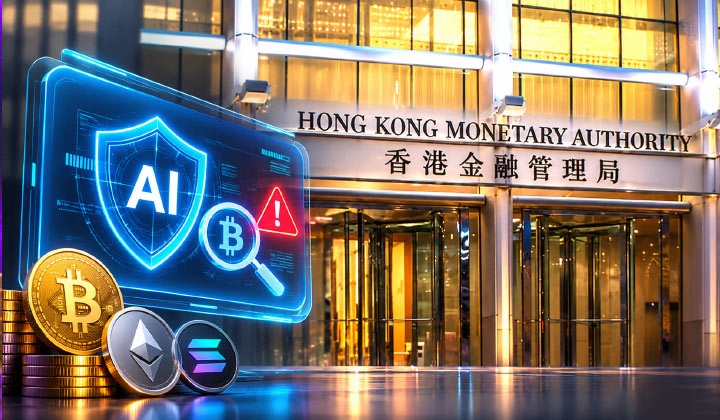
- Hong Kong’s central bank is encouraging financial institutions to use artificial intelligence to detect suspicious cryptocurrency transactions and financial crime.
- Chainalysis estimates that illicit crypto addresses received at least $154 billion in 2025, with stablecoins accounting for 84% of the total.
- AI agents could help banks connect blockchain transactions with customer identities, but human employees must remain responsible for important decisions such as freezing accounts.
Hong Kong Encourages Banks To Adopt AI
In Hong Kong, the Hong Kong Monetary Authority (HKMA) is promoting the use of AI within financial institutions to detect any suspicious transactions using stablecoins and other digital assets.
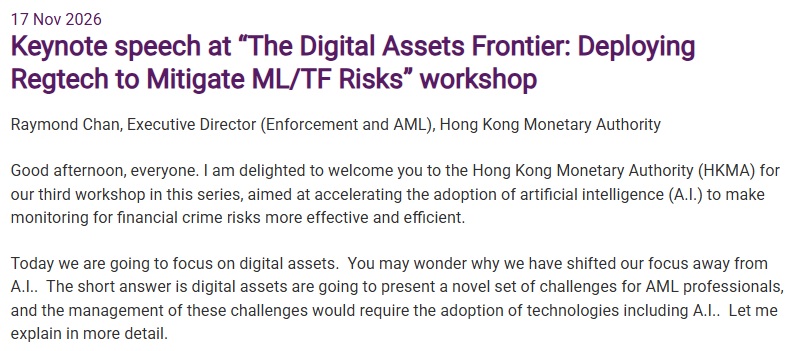
AI tools can allow banks to link transaction information from blockchains with information about customers to detect potentially fraudulent activity, said Raymond Chan, executive director of enforcement and anti-money laundering at the HKMA.
Source: hkma.gov.hk
Research from Chainalysis shows that in 2025, at least $154 billion passed through illicit cryptocurrency addresses. This was an increase of 162% from the previous year. 84% of the total amount came from stablecoins. However, Chainalysis estimates illicit activity within the total volume of transactions covered in the research to be less than 1%.
AI Can Help Track Suspicious Transactions
A major issue for banks detecting suspicious activity in cryptocurrency is knowing which individuals control each wallet. While it is possible to trace the flow of funds from blockchain transactions, tracing the individual controlling a certain wallet is challenging.
AI tools can allow banks to detect suspicious activity by analyzing trends in transactions. For example, if funds have rapidly moved between different cryptocurrencies, and fiat currencies, in order to obscure their origin, AI could highlight this.
Gadit, co-founder of ZIG Finance, suggests that banks begin using AI tools to detect fraud in historical cases. Doing this alongside existing monitoring tools means banks can get a good understanding of what these tools can and cannot detect.
Source: hkma.gov.hk
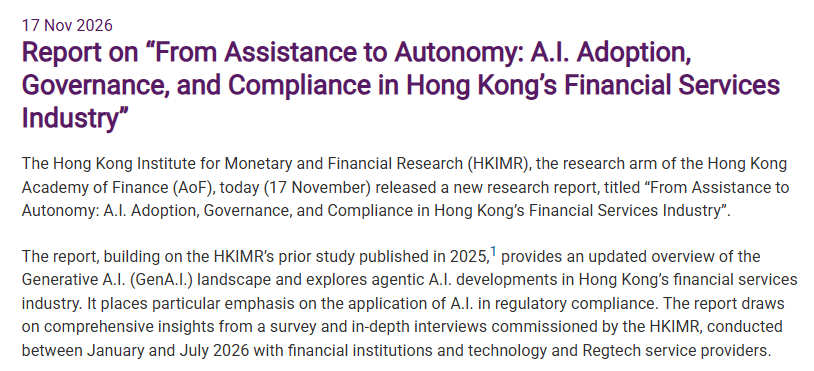
Support and training has been provided by the HKMA in order to allow banks to implement AI tools. According to a report by the Hong Kong Institute for Monetary and Financial Research, 90% of financial institutions in the survey had implemented or planned to implement generative AI.
Human Supervision Remains Important
Despite benefits in efficiency, experts believe it is important to maintain human oversight in making financial decisions. While AI tools can analyze transaction data, search sanctioned lists and produce reports, decisions to freeze accounts, refuse payment and flag suspicious activities should be made by authorized individuals within the bank.
Security & Transparency Issues
Another concern is verifying the identity of individuals approving potentially suspicious transactions. If approvals are given via video calls or remotely, banks must be able to confirm that they are approving transactions with the correct individual.
Project SAGE was launched by the HKMA on 2nd November. Within this project, guidelines will be developed to know how financial AI tools in banks should verify their identity and authority in order to take action. It will also consider who should be held responsible if errors occur with AI tools.
Overall, a concern is that money could be quickly moved without correct authorization from humans. Separately, Governor Michael Barr of the Federal Reserve has warned that AI tools could lead to faster bank runs in banks, if deposits are moved without the consent of customers.
While in Hong Kong, AI tools seem set to play a significant role in securing banking operations in the future, appropriate measures must be put in place to hold AI accountable, define responsibility and maintain human oversight to make sure that customers are protected, not placed at further risk.
Stay informed with the latest trends in Web3, blockchain innovation, and cybersecurity updates at 3verseTV
You need to login in order to Like
















Leave a comment