


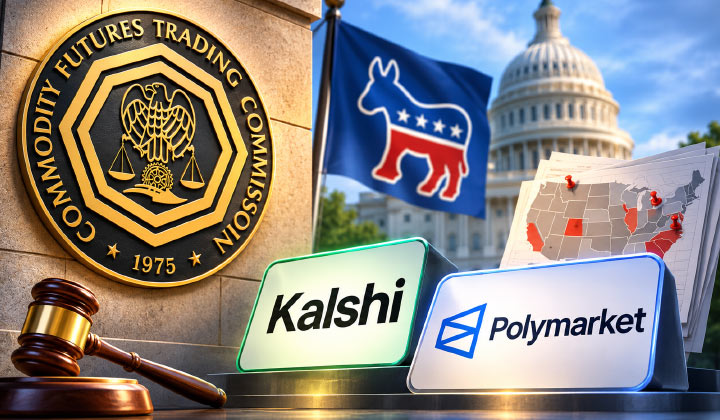
- Nine Democratic senators have asked the US Commodity Futures Trading Commission (CFTC) to withdraw its directive asking prediction market platforms to stop restricting users in certain states.
- The senators argue that the CFTC’s order conflicts with court decisions and state laws targeting sports-related prediction contracts.
- The dispute involves the regulatory authority of federal and state governments over platforms such as Kalshi and Polymarket.
Senators Challenge CFTC’s Prediction Market Directive
Nine Democratic senators in the United States have asked the Commodity Futures Trading Commission (CFTC) to step back from its efforts to establish greater control over prediction markets.
According to a Wall Street Journal report published on November 16, the lawmakers sent a letter to the regulator asking it to withdraw its recent directive concerning platforms such as Kalshi and Polymarket.
The @CFTC wants prediction markets to offer contracts in all 50 states and Tribal lands – in violation of state and federal law, court orders, and Tribal sovereignty.
I’m leading my Senate colleagues in demanding that Chairman Selig reverse this lawless decision. https://t.co/syoqxJudvu
— Senator Adam Schiff (@SenAdamSchiff) November 16, 2026
The letter was signed by nine senators, including Adam Schiff of California, Amy Klobuchar of Minnesota and Elissa Slotkin of Michigan. The dispute centres on whether prediction markets should be regulated mainly by the federal government or by individual states.
Prediction markets allow users to buy and sell contracts based on the outcome of future events. These events may include elections, economic developments, sports matches and other real-world situations.
However, several US states believe that some sports-related contracts offered by these platforms are similar to traditional sports betting. They argue that such activities should come under state gambling laws.
The CFTC, on the other hand, believes that federally regulated prediction market exchanges should be allowed to operate under a common national framework.
CFTC Wants Platforms to Remove Geographic Restrictions
On November 5, the CFTC directed regulated prediction market platforms to stop using geographic restrictions within 30 days or explain why they could not comply.
Geographic restrictions, commonly known as geofencing, prevent users from accessing certain services based on their location. The regulator believes that designated contract markets (DCMs) should provide open and equal access to eligible users across the country.
The @CFTC has exclusive jurisdiction over prediction markets, and I will not allow states to file lawsuits against our exchanges unchecked, especially when charging registrants with criminal activity.
It’s one thing to spar in the courts and hash out arguments on the merits. It’s entirely another to threaten founders and CEOs with jail time. We’ll take this fight all the way to SCOTUS.
— Mike Selig (@ChairmanSelig) November 16, 2026
CFTC Chairman Michael Selig has argued that derivatives markets need to operate under a uniform national system. However, the senators disagree with this approach. They believe that the CFTC’s directive could encourage companies to offer contracts in states where courts have already restricted such activities.
In their letter, the lawmakers argued that the regulator’s decision conflicts with active court orders and weakens state and tribal laws. They have asked the CFTC to withdraw its directive until the ongoing legal disputes are resolved.
States Continue Legal Action Against Kalshi and Other Platforms
Several US states have already taken legal action against prediction market companies. Nevada has secured court orders restricting certain prediction market activities. Louisiana has also pursued legal action against platforms offering sports-related contracts.
Utah has taken a stronger position by filing a lawsuit against Kalshi and two of its market makers. The state wants to stop certain sports-related contracts from being offered to its residents.
Utah also filed criminal charges against Kalshi CEO Tarek Mansour and COO Luana Lopes Lara on October 28. Both executives face 14 felony counts each, according to the material provided.
The state’s case included an investigation in which an investigator opened a Kalshi account using a Utah-based internet address and placed 12 wagers on different sports contracts.
Kalshi has rejected the allegations, describing the charges as an overreach and accusing the state of playing politics. The disagreement could become more important in the coming months. The senators’ letter comes ahead of Democrats taking control of both chambers of Congress next year.
One of the major questions is whether federal derivatives law gives the CFTC exclusive authority over prediction markets or whether states can continue applying their own gambling laws.
The issue may eventually reach the US Supreme Court because different courts have taken different positions on the matter. For prediction market companies, the outcome could determine whether they can offer their services across the United States or must continue restricting access in certain states.
The dispute also highlights a larger challenge for the crypto and digital asset industry: deciding how new financial products should be regulated when they operate across state and national boundaries.
Stay informed with the latest trends in Web3, blockchain innovation, and cybersecurity updates at 3verseTV
You need to login in order to Like
















Leave a comment