


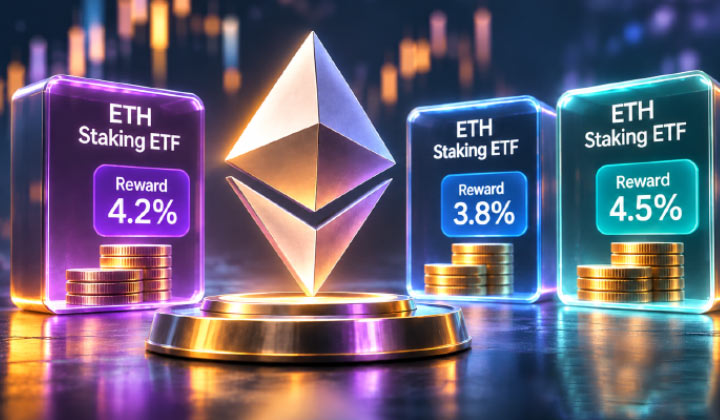
- Ethereum staking ETFs can pay different amounts because they stake different proportions of their ETH holdings and follow different reward-sharing policies.
- Grayscale’s Ethereum Staking Mini ETF passes on approximately 94% of staking rewards, compared with around 77% for its Ethereum Staking ETF.
- Investors should consider management fees, distribution dates, liquidity arrangements and ETH price movements rather than judging a fund only by its cash payouts.
Even though you’re investing in the same crypto, the amount you receive from your investment could differ from fund to fund based on how much they stake, how they distribute the rewards amongst investors, how much they reserve for liquidity, and when they distribute.
For example, the BlackRock iShares Staked Ethereum Trust ETF had a 30-day staking rewards yield of 1.86% (as of 13th November). The distribution for November was $0.044481 per share compared to $0.035466 for October. Grayscale’s Ethereum products have varying reward structures.
Why You Might Receive More/Less From The Same Investment
BlackRock increased the distributions for November by approx. 25.4% over October. An investor who owns 1,000 shares would have received $44.481 compared to $35.466.
However, this is not necessarily a 25.4% return on your investment. The distributions will only form part of your investment return. The price of ETH could move up/down in the market, which could have a far greater effect on your investment.
The amount you receive will depend on how much of the ETH the fund is staking. ETH may be reserved to allow redemptions, cover costs and provide liquidity. This means it won’t be earning staking rewards.
For example, if the fund has 100ETH but only stakes 80ETH, and receives a hypothetical 3% in rewards per year, they will receive 2.4ETH in gross rewards. This equates to 2.4% of the 100ETH portfolio (before fees). The remaining 20ETH may be required for managing withdrawals and won’t receive any staking income.
Reward Distribution & Fees
A key difference between the funds is how much of the rewards are distributed to investors. Grayscale states that approximately 94% of rewards are distributed to investors who hold the Ethereum Staking Mini ETF. Whereas in their Ethereum Staking ETF, they distribute approx. 77%.
This can mean you receive less from the fund. If we take our hypothetical example of 2.4ETH in rewards, 94% would mean we receive 2.256ETH. Whereas 77% would mean we only receive 1.848ETH.
Fees can also play a role. BlackRock state there is a 0.25% sponsor fee for ETHB. However, they have stated there will be a temporary fee discount of 0.12% for the first $2.5 Billion of assets for the initial 12-month period from 12th March 2026. Investors should check the terms and conditions of the fee discounts and when they will expire.
It’s also important to know how the staking rate is calculated. Some products may only calculate the reward on the ETH that is actively being staked, whereas others may calculate it on the whole portfolio or subtract certain fees. Investors should be aware of what they’re receiving.
Timing Of Distributions, Liquidity & ETH Price
You won’t receive your reward straight away. Each fund will have their own distribution dates. For example, BlackRock state the ex-dividend and record date for their distributions in November was 9th November.
The distribution will then be made on 10th November. Investors who purchase after the entitlement date won’t receive the distribution. The fund will usually reduce in value by approx. the distribution per share (taking into consideration any other market movements).
Liquidity can also be an issue. Though the shares can be purchased/sold during market hours, the underlying asset will move according to Ethereum’s staking and withdrawal rules. As assets can’t always be withdrawn from staking, the fund will need to have some ETH not being staked. This can mean investors may want to withdraw their investment.
There are also risks involved with custodians, validators and slashing. Investors should check the fund’s documentation to see what custodians they use, what protections are in place and if there is any insurance or contractual protection. This shouldn’t be seen as a guarantee.
Most importantly, just because you’re earning income from staking doesn’t mean you won’t lose money if the price of ETH goes down. If your investment earns 3% more ETH but the dollar price drops by 20% you would have lost approx. 17.6% from your original investment.
Investors should compare the actual reward rate, percentage of ETH actively earning rewards, reward distribution, fees, distribution dates and liquidity of staking ETFs. Investors should also consider the total return of the fund. Just because one fund has a higher cash distribution, doesn’t mean it’s a better investment.
Stay informed with the latest trends in Web3, blockchain innovation, and cybersecurity updates at 3verseTV
You need to login in order to Like













Leave a comment