



OpenReserve Bank, a blockchain focused banking venture backed by prominent crypto investors like Andreessen Horowitz, Coinbase Ventures and Jump Capital has received a provisional charter from the U.S. Office of the Comptroller of the Currency (OCC), putting it in position to operate as a full-service national bank centered around onchain settlement infrastructure.
The approval announced this Thursday represents a significant shift from the trust-company charters that have been the norm for recent crypto-friendly OCC approvals. Salt Lake City-based OpenReserve still must get final sign-off from the OCC before their charter can be made everlasting, but this initial OK places them alongside several other crypto-native entities in the growing trend of obtaining formal entry into the traditional U.S. banking ecosystem.
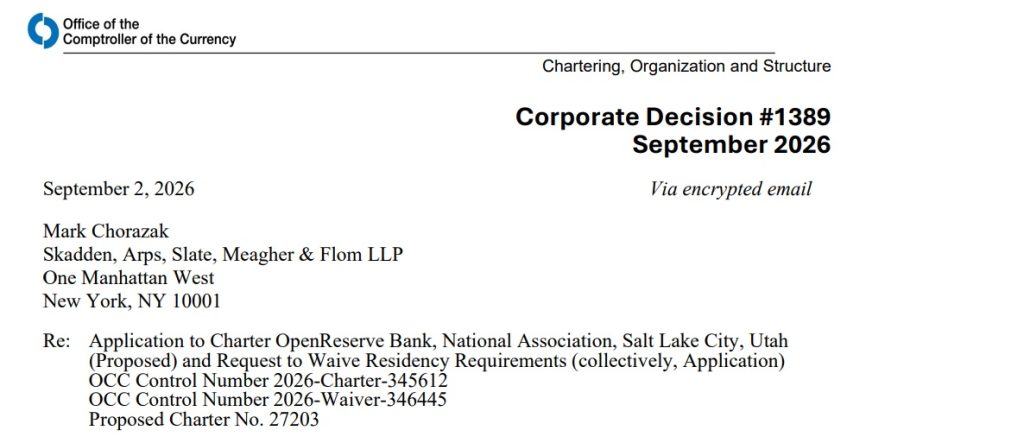
Source: occ.gov
OpenReserve Pursues Full National Bank Charter
What makes OpenReserve unique among their crypto-banking peers is their structural choice. Whereas many digital asset firms have gravitated towards the more limited trust-company structure when applying to the OCC, OpenReserve deliberately selected to pursue a full national bank charter.
Introducing @OpenReserveBank , a blockchain native de-novo digital bank, finally out of stealth. This week the Office of the Comptroller of the Currency (OCC) granted conditional approval of our full-service U.S. national bank charter application.
Preliminary conditional… pic.twitter.com/14XeRh1Q6F
— Dee Choubey (@deechoubey) September 3, 2026
Dee Choubey, the company’s co-founder and chief executive, remarked that supervision, compliance, safety and customer trust were not obstacles to circumvent but the very foundation which the business was designed upon from the outset. This perspective suggests that they are seeking to operate as a genuinely regulated deposit-taking entity rather than a narrow custody or trust entity.
Built Around Treasury, Stablecoins & Tokenized Deposits
OpenReserve has positioned itself to serve institutional clients specifically, with services spanning treasury management, stablecoin issuance, and tokenized deposit products. The bank says its operations are designed to align with the incoming requirements of the GENIUS Act, the federal framework establishing rules for how stablecoins can be issued and managed within the U.S. financial system.
Backing the venture is a notably deep bench of crypto-focused investors beyond its lead backers, including Acrew, Wintermute Ventures, Clocktower, Quona, AAF Management, and Zero Knowledge Ventures. Venture firm a16z crypto, explaining its investment rationale in a public post, described the appeal of a banking institution built to operate continuously, framing it as a bank designed to never fully close its doors.
OpenReserve originally filed its charter application with the OCC back in April, meaning this approval capped roughly five months of regulatory review.
OCC Opens Banking Door Wider For Crypto Firms
This approval doesn’t exist in isolation. The crypto industry has spent the past several years navigating a strained relationship with traditional banking partners, often struggling to secure basic banking services.
That dynamic has shifted meaningfully under the current administration, with OCC chief Jonathan Gould overseeing a noticeably more welcoming stance toward digital asset firms seeking formal banking status.
Reinforcing the trend, the OCC also approved, the same day, a separate conditional banking charter for Revolut, the British fintech company, which is planning to run its U.S. banking business, approved by the OCC, from Connecticut.
The two consecutive approvals are a sign that regulators are becoming more receptive to the idea of allowing mainstream banking infrastructure to be extended to companies built around digital assets, a big change from the attitude of the previous years.
Stay informed with the latest trends in Web3, blockchain innovation, and cybersecurity updates at 3verseTV
You need to login in order to Like

















Leave a comment