



Revolut, a London-based fintech firm providing digital banking, payment and crypto services to customers around the world, has received conditional approval from the U.S. Office of the Comptroller of the Currency (OCC) to open a national bank in America.
Declared September 3, the decision represents a significant step forward in the company’s ambitions to run a full-fledged U.S. banking entity, albeit not entirely achieving its goals.
In order for the proposed bank to actually open its doors, Revolut will also have to obtain separate approvals from the Federal Deposit Insurance Corporation and the Federal Reserve, and then get a final approval from the OCC itself. The company is currently aiming for a 2027 launch, conditioned on passing all remaining regulatory hurdles.
We just received conditional approval from the U.S. OCC for our U.S. national bank charter
— Revolut (@Revolut) September 3, 2026
OCC Approval Moves Revolut’s Application Forward
This conditional green light lets Revolut keep building toward its proposed national bank while the rest of the federal review process plays out in parallel.
Source: Revolut.com
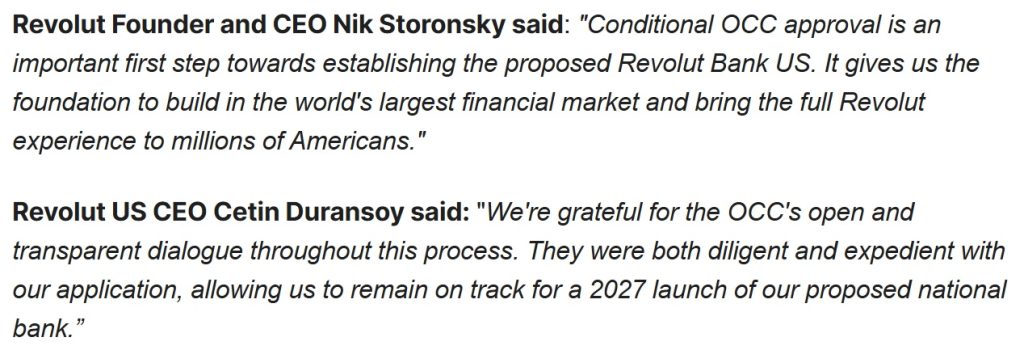
Revolut founder and CEO Nik Storonsky characterized the milestone as an important early step rather than a finish line, while Revolut US CEO Cetin Duransoy acknowledged there’s still substantial work ahead before the bank becomes operational.
In practical terms, conditional approval means the OCC has signed off on the application pending additional requirements, not that Revolut has cleared every regulatory checkpoint.
Crypto & Stablecoins Part Of Planned Offering
Notably, Revolut’s vision for this proposed bank extends well beyond conventional banking products. The company has indicated the entity could eventually offer loans, credit cards, and FDIC-insured deposits alongside cryptocurrency trading and stablecoin services, assuming all necessary approvals come through.
It’s worth being clear, though, that Thursday’s conditional decision doesn’t automatically greenlight those digital-asset offerings; their eventual availability still hinges on Revolut completing the full regulatory process.
The company already provides crypto-related services to U.S. customers through separate regulated entities and partner arrangements, meaning this new bank charter would essentially create a distinct, more integrated regulatory framework for its American operations going forward.
OCC Clarifies Path For Digital Asset Activities
Revolut’s application arrives as the OCC has been actively working to define how digital-asset businesses fit within the national banking system. Back in August, the regulator confirmed that companies engaged in permissible crypto-related activities could pursue national bank charters through the standard application process.
OCC Comptroller Jonathan Gould reinforced this trend during comments at the SALT Conference in Wyoming, noting that digital-asset chartering activity has increased roughly eightfold compared to levels seen during the prior administration. Gould also indicated the agency expects to finalize its implementation rules for the GENIUS Act by November, potentially incorporating further feedback gathered from the broader crypto industry.
Circle Received Final OCC Approval
Revolut isn’t the first crypto-adjacent company to work through this process. Circle, the company behind the USDC stablecoin, already secured final OCC approval back in July to establish a national trust bank, operating under the name Circle National Trust, primarily focused on providing custody services for USDC and other digital assets.
That structure differs meaningfully from what Revolut is pursuing, since Circle’s charter centres narrowly on custody functions, while Revolut is seeking a broader banking license spanning traditional financial products alongside its planned crypto and stablecoin offerings. Together, these two approaches illustrate the different paths digital-asset companies are taking to gain access to federally regulated banking infrastructure.
Revolut Still Faces Regulatory Reviews
To clarify, the decision on Revolut’s application for a U.S. banking charter by the OCC this week does not complete the start-up’s process. The company must still secure approvals from both the FDIC and the Federal Reserve, which the OCC will review before issuing its final approval.
The process for the latter tends to be lengthy, as it analyzes the business model, governance structure, capitalization, and risk management frameworks of the aspiring bank in detail, which means that 2027 is not a definite deadline for the launch of Revolut Bank.
Revolut Looks To Expand Its Reach As A Regulated Financial Service Provider
The U.S. banking push appears to be part of the company’s strategy to build a global presence as a regulated financial service provider. Apart from the U.S., Revolut has banking licenses in France, Australia, and the UK, a payments license from the UAE, and it is looking to get a banking license in South Africa.
The company has entered the Latin American market, launching banking services in Mexico and seeking authorization in Brazil, Colombia, Peru, and Argentina. Overall, Revolut has over 80 million customers and aims to reach 100 million by mid-2027, according to the company’s internal strategy, which positions the U.S. charter as an important step towards achieving its growth objectives.
Stay informed with the latest trends in Web3, blockchain innovation, and cybersecurity updates at 3verseTV
You need to login in order to Like

















Leave a comment