



The U.K. Financial Conduct Authority is discussing standards for tokenized gold with major banks and other market participants, according to an Aug. 10 Financial Times report.
The topic of debate is how digital representations of real gold may be used as collateral in wholesale marketplaces.
A stand-alone FCA guideline tailored to tokenized gold has not yet been developed by the negotiations. They expand upon a joint policy document published on May 18 by the FCA, Bank of England, and Prudential Regulation Authority that specifically mentioned tokenized gold as a potential collateral for uncleared over-the-counter derivatives.
According to the May document, the FCA and PRA are examining the suitability of tokenized collateral and acknowledge the potential advantages of tokenized gold and money market funds. Any usage would be governed by industry-developed norms. Later this year, regulators intend to develop more regulation outlining how tokenized collateral may function under the current regulatory framework.
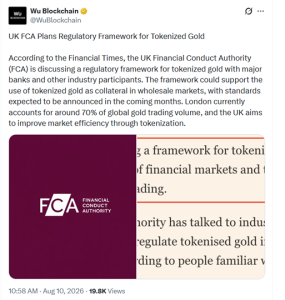
https://x.com/WuBlockchain/status/2086686000319988168?s=20
That suggests toward adjusting current wholesale market norms rather than immediately creating a unique regulatory category for each tokenized asset. Additionally, the PRA has stated that where the legal rights and underlying hazards of tokenized traditional assets are similar, they should be given the same prudential treatment as their conventional counterparts.
The larger plan involves issuance, trading, settlement, collateral, and the infrastructure required to advance tokenized finance beyond pilot projects, as crypto.news previously highlighted in UK regulatory coverage.
Tokenized versions of assets that are now recognized as regulatory collateral may be eligible at central counterparties under UK EMIR, according to the Bank of England’s intentions. Tokenized gold for uncleared derivatives collateral is being examined independently by the PRA and FCA.
A precedent pertaining to funds already exists. A variety of money market funds, including tokenized versions, can be used as collateral for uncleared trades under UK EMIR, according to a policy statement released by the FCA in April. Authorized U.K. funds are not prohibited from investing in tokenized versions of otherwise qualifying assets, according to the same statement.
Therefore, the regulatory effort focuses not only on whether an asset is digital but also on whether its legal rights, custody arrangements, and dangers are still equivalent to those of the conventional asset it represents.
London is responsible for over 70% of the world’s gold market activity, according to the Financial Times. The regulatory talks, it added, are taking place at a time when London is up against more competition from Asian financial hubs vying for a bigger share of the bullion market.
The current London market is rather large. According to LBMA figures, at the end of March, London vaults had 9,339 tons of gold worth around $1.384 trillion. London is the hub of the global bullion market, according to LBMA.
Additionally, the World Gold Council is creating Pooled Gold Interests, a wholesale digital gold framework. Its suggested paradigm, which is mainly targeted at institutional and wholesale participants, blends digital transfer with physical ownership.
You need to login in order to Like

















Leave a comment