


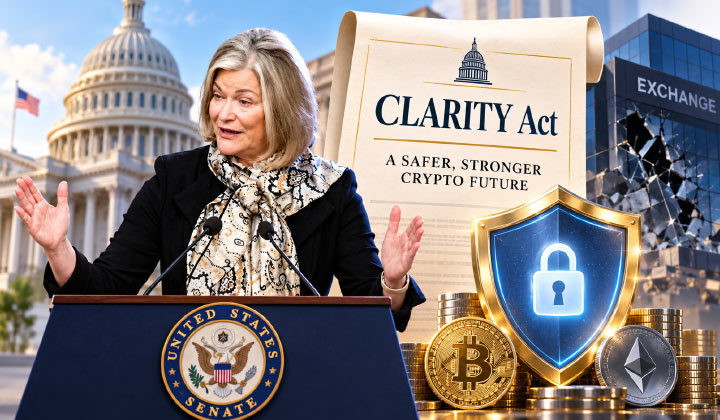
US Senator Cynthia Lummis says the CLARITY Act could better protect crypto users from exchange failures by requiring qualified custodians and keeping customer assets separate from company funds. Her remarks come at a time when the Senate is getting ready for a procedural vote on the measure on September 15. Since FTX’s demise in 2022, Lummis has made a similar claim, claiming that stricter custody and asset-segregation regulations may have averted the catastrophe.
In a September 5 post on X, Lummis again highlighted the importance of protecting customer assets. She pointed to Wyoming’s regulatory framework, which restricts banks and exchanges from relending customers’ digital assets. In her view, keeping customer funds clearly separated from an institution’s own assets provides an important layer of protection if a company runs into financial trouble.
Exchanges have collapsed with no custody rules and no consequences when they fail people. The Clarity Act requires qualified custodians and segregated customer funds so the next collapse doesn’t wipe out the people who trusted the platform.
— Senator Cynthia Lummis (@SenLummis) September 5, 2026
Lummis had earlier raised the same issue in a letter to banking regulators, describing Wyoming’s approach as a possible model for protecting digital-asset customers. Her latest comments connect that position directly to the CLARITY Act, a proposed federal framework for digital-asset markets.
The Act would also split regulatory responsibilities between the Securities and Exchange Commission (SEC) and the Commodity Futures Trading Commission (CFTC). The Senate is currently debating certain provisions of the bill, so it hasn’t yet become law.
The industry is also pushing lawmakers to move ahead. Ripple CEO Brad Garlinghouse said on September 3 that the US was still within reach of becoming the world’s crypto capital and urged lawmakers to “finish the job.” His comments followed a White House meeting with crypto and financial industry executives.
Another notable development came from the National Sheriffs’ Association, which shifted its position on the CLARITY Act from opposition to neutral. The group cited the bill’s complexity and the many issues still being negotiated. Its decision is not an endorsement.
The September 15 vote is particularly important because it is a cloture vote on the motion to proceed, rather than a vote on final passage. If it succeeds, the Senate can move into debate and amendments. If it fails, consideration of the bill under the current motion would end.
House Financial Services Chairman French Hill and SEC Chair Paul Atkins have both expressed confidence that the legislation could advance. But the timetable is tight, with House lawmakers expected to leave Washington after September 17.
Stay informed with the latest trends in Web3, blockchain innovation, and cybersecurity updates at 3verseTV
You need to login in order to Like

















Leave a comment