


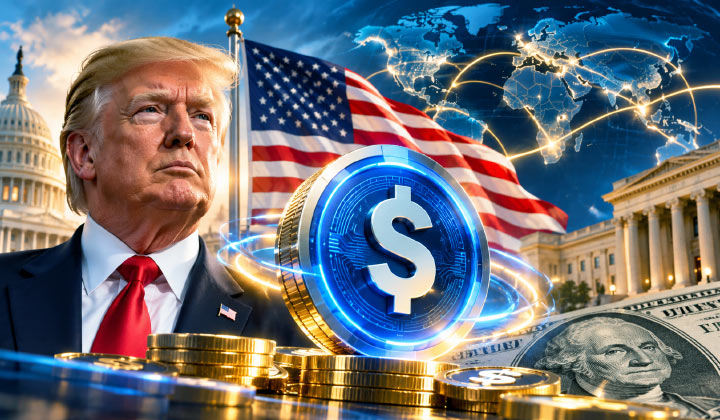
The Trump Administration is reportedly exploring a new initiative to push US dollar-pegged stablecoins into markets outside American borders, targeting to reinforce the greenback’s grip on global reserve currency status while broadening the buyer base for US government debt.
According to Bloomberg report published on September 23, the negotiations centre on potential joint ventures joining federal agencies with private companies, though nothing has been formally decided or announced.
What Washington Is Considering
Bloomberg’s report named the Treasury Department, the State Department, and the DFC as possible participants in whatever structure eventually emerges. The DFC explicitly functions as the federal agency accountable for financing private-sector projects across developing economies, making it a logical vehicle for covering dollar-denominated tokens into emerging markets.
Remarkably, the report stopped short of naming any specific companies or specifying how such ventures might actually be structured, financed, or timed, and the White House has delivered no formal program announcement. It’s also worth noting that the connection to Treasury demand remains the administration’s stated dispute rather than a confirmed market outcome.
Under the GENIUS Act’s reserve requirements, stablecoins permitted for use must be backed one-to-one by high-quality liquid assets, a category where Treasury bills can make up a substantial share, meaning more tokens circulating overseas could theoretically translate into more of those purchases.
From Executive Order To Global Dollar Strategy
This isn’t a brand-new idea suddenly appearing out of nowhere. It builds directly on groundwork the administration laid early in its term. President Trump’s executive order from January 23, 2025, titled Strengthening American Leadership in Digital Financial Technology, formally established U.S. policy around protecting dollar sovereignty by promoting lawful, dollar-backed stablecoins internationally.
That same order also prohibited federal agencies from developing a central bank digital currency, a government-issued digital currency model the administration has consistently opposed. Treasury Secretary Scott Bessent has been similarly vocal about the debt-related rationale, stating in a July 18, 2025 announcement that stablecoins would help reinforce the dollar’s global reserve currency standing, expand broader access to dollar-based finance, and stimulate demand for the Treasury securities backing them.
The GENIUS Act Sets The Rulebook
Any international expansion effort would operate within the framework established by the Guiding and Establishing National Innovation for U.S. Stablecoins Act, commonly known as the GENIUS Act, which President Trump signed into law on July 18, 2025. As the first federal regulatory framework precisely covering payment stablecoins, the law mandates that issuers preserve one-to-one backing using high-quality liquid assets such as cash, bank deposits, and short-term Treasury bills, while openly prohibiting issuers from paying interest or yield to token holders.
The law is set to take full effect on January 18, 2027, or 120 days following the release of final effecting rules, whichever arrives first. Since regulators already missed their original July 18, 2026 deadline for confirming those rules, the January 2027 backstop date is now widely expected to administrate implementation. Rulemaking responsibilities remain splitting across several federal bodies, including the Treasury Department, the Office of the Comptroller of the Currency, and the Federal Deposit Insurance Corporation.
Rising Yields & Slowing Stablecoin Market
The timing of these discussions appears closely tied to mounting pressure in the bond market. The Federal Reserve raised its benchmark interest rate by a quarter percentage point to a range of 3.75% to 4% on September 16, marking its first rate hike since July 2023.
Meanwhile, the benchmark 10-year Treasury yield has climbed past 5% this month, reaching its highest level since 2007, a development that raises the federal government’s overall borrowing costs and increases the appeal of finding fresh sources of demand for its debt.
Stablecoin market growth has simultaneously cooled off. Tether’s second-quarter attestation showed USDT circulation at approximately $184.6 billion as of June 30, up just roughly $446 million from the end of March, with Tether itself acknowledging that the broader stablecoin market actually contracted during that period. Circle, meanwhile, reports around $74.6 billion in USDC currently in circulation as of September 21.
NEW: The Trump administration is exploring an initiative to promote dollar-backed stablecoins abroad, according to Bloomberg.
The US government is looking at supporting stablecoin projects through joint ventures with private firms to reinforce the dollar’s dominance and boost… pic.twitter.com/yv7HSVAx8O
— The Block (@TheBlockCo) September 24, 2026
Wall Street Is Already Building
Private financial institutions aren’t waiting around for government direction. Twenty-one major financial institutions, including Bank of America, Citi, and Goldman Sachs, announced on September 1 plans to jointly establish a new company during the second half of 2026 that will issue its own regulated US dollar stablecoin, with a market launch targeted for the first half of 2027.
Asset managers are simultaneously competing to capture the reserve-management business tied to this growing sector. Fidelity has already launched its Fidelity Reserves Digital Fund, a money market fund specifically built to serve stablecoin issuers, while Morgan Stanley introduced a comparable reserves portfolio earlier this year. Separately, stablecoin issuer Agora recently secured preliminary conditional approval from the OCC to establish a national trust bank dedicated to stablecoin and custody services.
Washington’s Stablecoin Bet Meets Global Regulatory & Economic Scrutiny
Regulators overseas are simultaneously reshaping their own frameworks in ways that could complicate Washington’s ambitions. The European Central Bank, along with the EU’s national central banks, has urged Brussels to eliminate a requirement under the Markets in Crypto-Assets Regulation forcing large stablecoin issuers to hold up to 60% of their reserves in bank deposits. Scepticism isn’t limited to foreign regulators either.
Ousmène Mandeng, writing for the Official Monetary and Financial Institutions Forum, argued that stablecoins may primarily redirect existing money flows rather than genuinely create new net demand for Treasury securities. A separate OMFIF analysis published this month suggested that while the U.S. may capture a real financing benefit from increased reserve demand, the benefit to economies where dollar-backed tokens end up displacing local currencies remains far less clear.
This approach also stands in contrast to how many other nations are handling digital currency, with numerous countries actively testing central bank digital currencies of their own, even as Congress has barred the Federal Reserve from issuing one through December 31, 2030, via the 21st Century ROAD to Housing Act. Washington’s underlying bet, in short, is that privately issued but federally regulated dollar tokens can spread internationally faster than any government-run digital currency alternative.
What Comes Next
For now, nothing about these discussions amounts to a finished, ready-to-launch program. There’s no public list of participating companies, no disclosed budget figures, and no official government confirmation that formal talks are even underway.
What the Bloomberg report does make clear is a notable shift in posture: after spending the past year building out a domestic regulatory framework for stablecoins, Washington now appears to be weighing whether to actively extend that same rulebook into international payment corridors.
Should the initiative move forward, its earliest visible effects would likely surface in stablecoin issuer reserve holdings, alongside a broader ongoing debate over exactly how far the federal government should go in using privately issued digital tokens as an instrument of dollar policy.
Stay informed with the latest trends in Web3, blockchain innovation, and cybersecurity updates at 3verseTV
You need to login in order to Like

















Leave a comment