



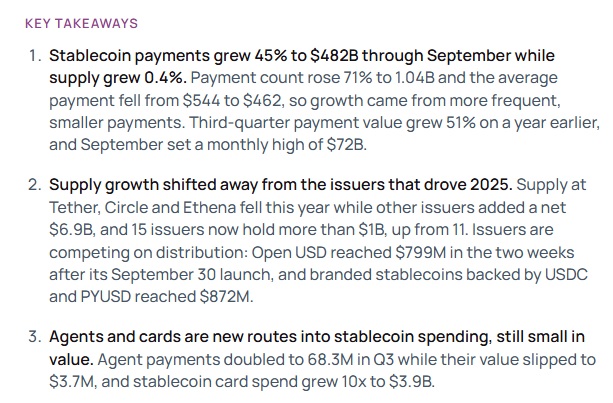
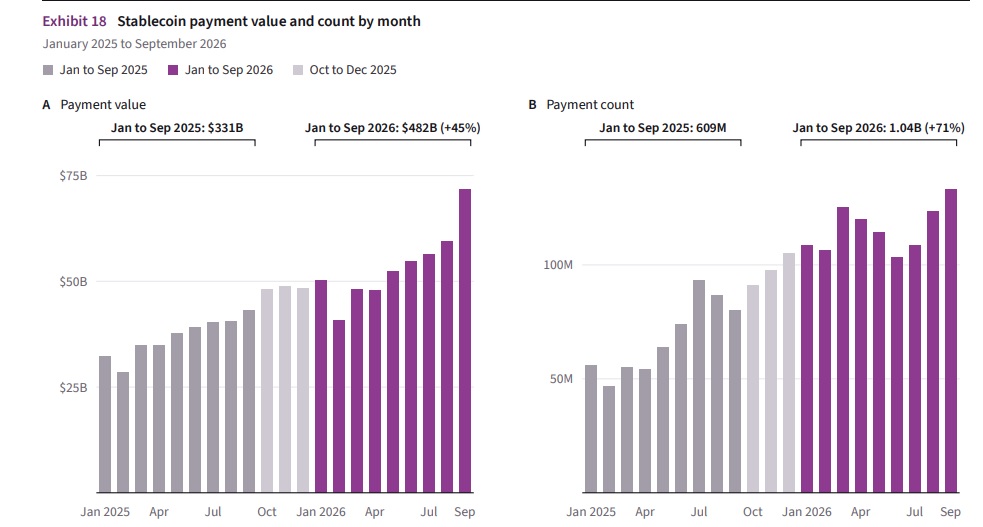
Stablecoin payments rose 45% to $482 billion in the first nine months of 2026, even as the total supply of stablecoins remained almost unchanged. A new report by blockchain analytics firm Allium found that payments using these digital currencies are growing as companies such as Visa, Mastercard and Stripe bring them into their existing payment services.
The total value of stablecoins in circulation reached about $305 billion at the end of September, just 0.4% higher than at the beginning of the year. The number of payments also increased by 71%, crossing one billion transactions.
Source: allium.so
Stablecoins are cryptocurrencies whose value is linked to traditional currencies, such as the US dollar. They are designed to maintain a stable value and can be used to transfer money digitally. The latest figures suggest that people and businesses are using the stablecoins already available more frequently, even though the total supply has not grown much.
Stablecoin-linked cards are also becoming more popular. Spending through these cards reached $3.9 billion by September, around ten times the amount recorded a year earlier. Small purchases of less than $50 accounted for 84% of the increase in card transactions.
Major payment companies are now working to make stablecoins easier to use. Mastercard has introduced a new Global Money Platform with BVNK, a company that provides stablecoin payment services. The platform will connect traditional currency accounts, stablecoin balances, currency conversions, card payments and bank transfers. Payment companies Nuvei and Marqeta are among its first customers.
Stripe is also working with blockchain-based financial services firm Plasma to develop cards that can use balances in US dollars, euros, Brazilian reais and Mexican pesos, as well as certain stablecoins. The aim is to allow customers to pay using the currency that matches their purchase, reducing unnecessary currency conversions. Stripe’s expanded card services currently cover more than 30 countries, with plans to reach over 100 countries by next year.
Visa is focusing on international money transfers. Its Visa Direct stablecoin prefunding service has entered commercial use through Inyo Global, a payment services provider. The service allows payment companies to use USDC, a dollar-linked stablecoin issued by Circle, to fund international payments more quickly. Recipients can still receive money through traditional payment channels.
However, stablecoin payments are still a small part of the overall payments market. Allium estimated that only $2.4 trillion of the $97.9 trillion in total stablecoin transfers recorded through September represented end-user activity after excluding exchange, decentralised finance and automated transactions. Its estimate of actual payments was much smaller, at $482 billion.
Stablecoin-linked cards also account for a tiny share of traditional card spending. In the second quarter, their spending represented only 0.03% of Visa’s $4 trillion payment volume.
Despite these limitations, payment companies see a major opportunity. They believe stablecoins could help businesses move money across countries and currencies more quickly. Rather than building separate systems for crypto and traditional money, companies increasingly want both to work together through the same payment services.
Stay informed with the latest trends in Web3, blockchain innovation, and cybersecurity updates at 3verseTV
You need to login in order to Like

















Leave a comment