


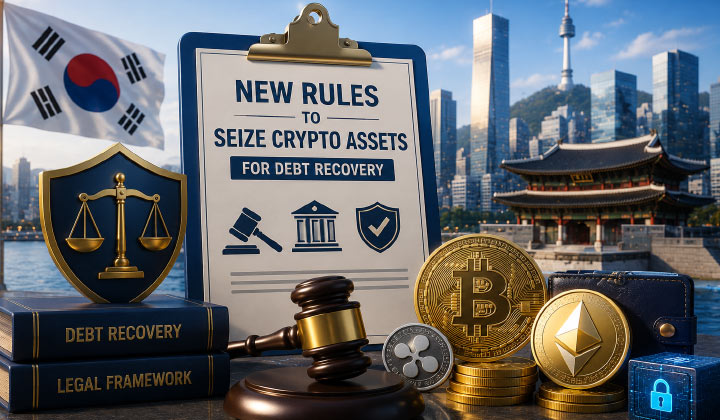
South Korea’s Supreme Court has proposed detailed new rules that would allow cryptocurrencies to be seized, transferred and converted into cash during civil debt recovery proceedings. The draft amendments, released for public consultation, establish formal legal procedures for enforcing claims against digital assets and are scheduled to take effect on October 1, subject to final approval.
The proposals also explain how crypto exchanges should handle seized assets and outline the rights of creditors seeking to recover debts using cryptocurrencies.
This move shows how digital assets are becoming more important in South Korea’s financial system. As more people own cryptocurrencies, courts are seeing more cases involving crypto during civil enforcement.
With the proposed changes, creditors could ask courts to order the seizure of a debtor’s right to receive or transfer digital assets. Once the order is in place, crypto exchanges and others holding the assets can’t transfer them to the debtor. Debtors would also lose the right to use or move those assets while the case is ongoing.
The draft rules would also give creditors more access to information. Courts could make exchanges or custodians reveal if a debtor holds digital assets, what types and how many tokens they have, and whether other creditors have claims on those assets.
The proposals also explain how seized cryptocurrencies could be turned into cash. Enforcement officers could tell exchanges to sell the assets, move them into special enforcement accounts before selling, or swap illiquid tokens for more actively traded ones if needed. These steps are meant to make debt recovery easier when dealing with volatile or rarely traded digital assets.
There are also separate rules for cases where the actual cryptocurrency, not just the right to receive it, is seized. In these cases, the assets would go to an enforcement officer after a court order. Creditors could then get the cryptocurrency directly or have it sold by a licensed virtual asset service provider.
The public can comment on the proposals until August 11. After that, the Supreme Court plans to finalize the changes before they take effect on October 1.
The proposal forms part of South Korea’s broader effort to modernise its digital asset laws. In recent months, regulators have introduced stricter disclosure requirements for cryptocurrency holdings in debt relief applications and have also explored expanding the country’s financial regulatory sandbox to cover crypto-related businesses.
Together, these initiatives demonstrate South Korea’s continuing efforts to integrate digital assets into its legal and financial framework while providing greater certainty for courts, creditors and market participants.
THE BLOCK: The South Korean Supreme Court proposed amendments for a crypto-specific asset seizure and liquidation procedure.
According to local reports, the amendments set a basis to prevent debtors from moving or hiding crypto while litigation is ongoing. pic.twitter.com/aAcw2QKQys
— The Block (@TheBlockCo) July 6, 2026
Stay informed with the latest trends in Web3, blockchain innovation, and cybersecurity updates at 3verseTV
You need to login in order to Like















Leave a comment