


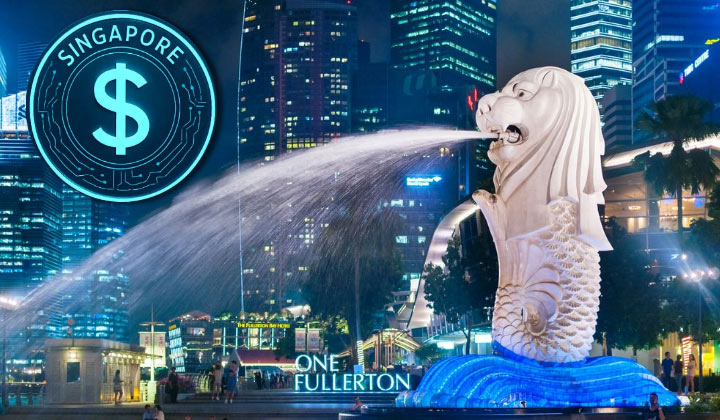
The financial authority of Singapore has suggested new regulations that will prohibit stablecoin issuers from providing interest or yield to investors and force them to maintain 100% reserves against tokens in circulation.
The proposed amendments to the Payment Services Act are intended to enable stablecoins mainly as payment and settlement instruments, according to the Monetary Authority of Singapore (MAS). By mandating that reserve assets be appropriately managed and held by authorized financial institutions, the framework also seeks to improve user safety.
Under the proposed rules, issuers would have to maintain assets equal to at least the full value of all regulated stablecoins in circulation at all times. These reserve assets would have to be kept separately from the issuer’s own funds.
The reserves would also need to be held with licensed financial institutions. This structure is intended to ensure that sufficient assets are available when users want to redeem their stablecoins.
Singapore Proposes Stablecoin License With 100% Reserves, No Holder Interest
The Monetary Authority of Singapore (MAS), the country’s central bank and financial regulator, has proposed amendments to the Payment Services Act creating a dedicated stablecoin issuance license, with… pic.twitter.com/QDWHpvWqXk
— Wu Blockchain (@WuBlockchain) September 1, 2026
MAS said its approach is based on the view that stablecoins can play a useful role in payments while maintaining a clear distinction between payment tokens and investment products.
The proposed framework would also prevent stablecoin issuers from paying interest or other benefits linked to customers’ stablecoin holdings. MAS said this approach is aligned with international regulatory practices. Similar provisions are included in the US GENIUS Act and the European Union’s Markets in Crypto-Assets, or MiCA, regulation.
Ho Hern Shin, MAS deputy managing director for financial supervision, said well-regulated stablecoins could serve as credible settlement assets in tokenised financial markets while supporting protection for users and the wider financial system.
The consultation also considers limited recognition for a small number of foreign stablecoins that operate under comparable overseas regulatory frameworks. However, details about how such recognition would work, how responsibilities would be divided for jointly issued tokens and whether transitional arrangements would apply to existing Singapore-based issuers are still being considered.
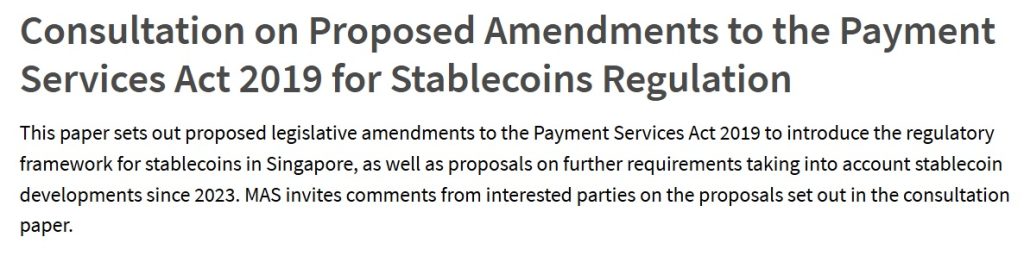
Source: mas.gov.sg
Singapore has been developing its stablecoin framework for several years. MAS first consulted on proposed stablecoin rules in October 2022 and published its response to feedback in August 2023.
The latest consultation is open until October 16. MAS plans to consult separately on subsidiary legislation at a later stage. No implementation date has been announced yet.
The proposed rules come as regulated stablecoins are being explored for use in Singapore’s financial infrastructure. Ripple, for example, is testing whether its RLUSD stablecoin can help streamline cross-border payment processes through Singapore’s central bank sandbox.
The testing is part of BLOOM, an MAS initiative focused on settlement capabilities involving tokenised bank liabilities and regulated stablecoins.
Singapore’s latest consultation therefore adds another layer to the country’s broader digital finance strategy. By setting clear requirements for reserves and stablecoin use, MAS is seeking to create a regulated environment in which stablecoins can support payments and tokenised financial markets.
Stay informed with the latest trends in Web3, blockchain innovation, and cybersecurity updates at 3verseTV
You need to login in order to Like















Leave a comment