

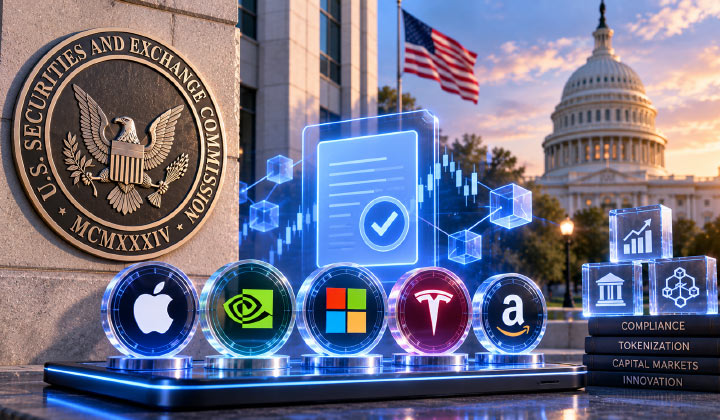
To enable trading in eligible tokenized U.S. stocks, the U.S. Securities and Exchange Commission (SEC) has granted qualifying blockchain-based trading venues a five-year conditional exemption.
In addition to permitting venues to use automated market makers and liquidity pools under stringent guidelines, the measure establishes a temporary regulatory avenue for actual U.S. shares to trade on public blockchains.
The framework covers tokens that represent actual shares and carry shareholder rights such as dividends and voting, but excludes synthetic products that only track stock prices.
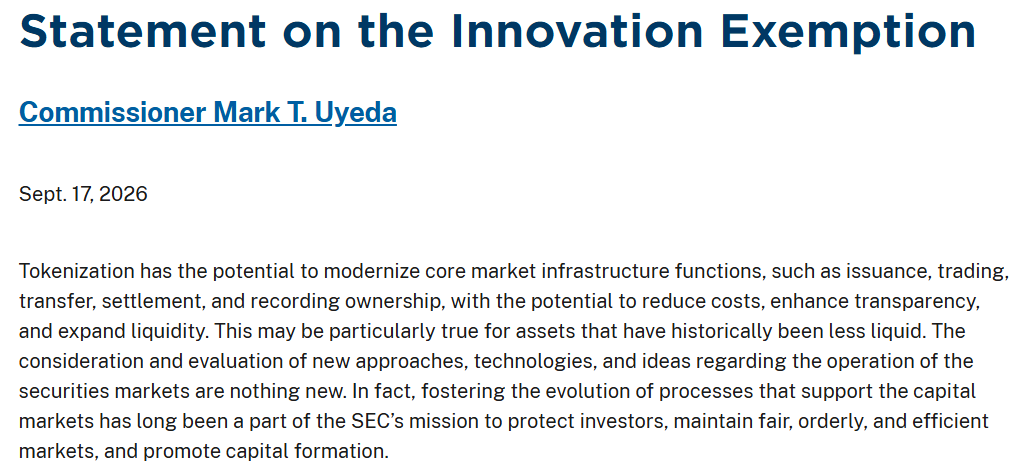
Source: sec.gov
The exemption applies to specialised Tokenized Securities Venues, or TSVs. These platforms can experiment with blockchain-based trading without registering as full national securities exchanges, provided they meet the SEC’s requirements. Their access will remain permissioned, meaning participants must satisfy conditions such as KYC and other trading controls.
One important feature is the role given to companies whose shares are being tokenized. If an unaffiliated third party wants to tokenize a company’s shares, the trading venue must notify the issuer 30 days before the proposed listing. The company can object, in which case the token cannot be traded under the exemption. The token must also provide the same economic and governance rights as the underlying stock.
The SEC is deliberately keeping the experiment small. Depending on the category of stocks, qualifying venues will face limits on the number of securities they can tokenize and the share of overall trading volume they can handle. The agency said the approach will allow it to gather information before considering longer-term rules.
The framework could also create opportunities for crypto and blockchain infrastructure companies. Automated market makers, public blockchains and tokenization platforms may provide the technology supporting these regulated markets. Ethereum, Solana and BNB Chain, along with DeFi applications, could potentially see greater use if tokenized securities gain traction.
However, the exemption does not create a fully open DeFi stock market. The underlying blockchain can be public and permissionless, but access to the trading venue must remain controlled. The framework also does not permit leverage or lending through the TSV.
Today, we are taking a significant step forward, within our statutory authority, to bring America’s capital markets into the digital age by facilitating onchain trading of certain tokenized stocks through the “Innovation Exemption.” 🇺🇸 https://t.co/BQK0cS70lH
— Paul Atkins (@SECPaulSAtkins) September 17, 2026
The SEC’s decision comes shortly after the failure of the CLARITY Act to advance in the Senate. SEC Chair Paul Atkins has said the agency would use its existing authority to provide greater regulatory certainty for digital assets.
Right now, it’s better to think of the five-year exemption as a controlled experiment. While it leaves open questions regarding acceptance, trading volumes, and the potential long-term legal framework, it provides the sector with a clear path for testing actual tokenized equities in the United States.
Stay informed with the latest trends in Web3, blockchain innovation, and cybersecurity updates at 3verseTV
You need to login in order to Like













Leave a comment