


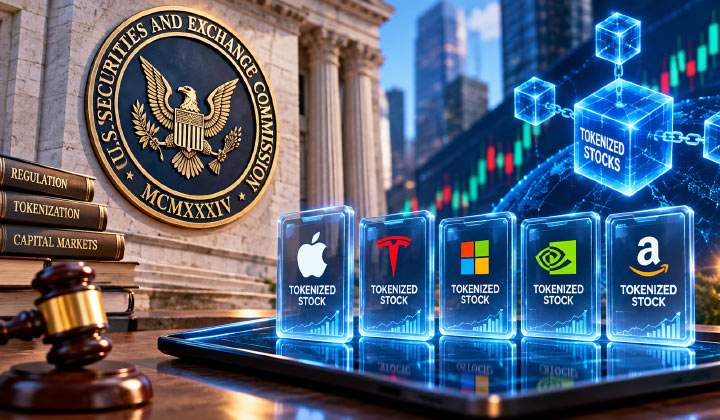
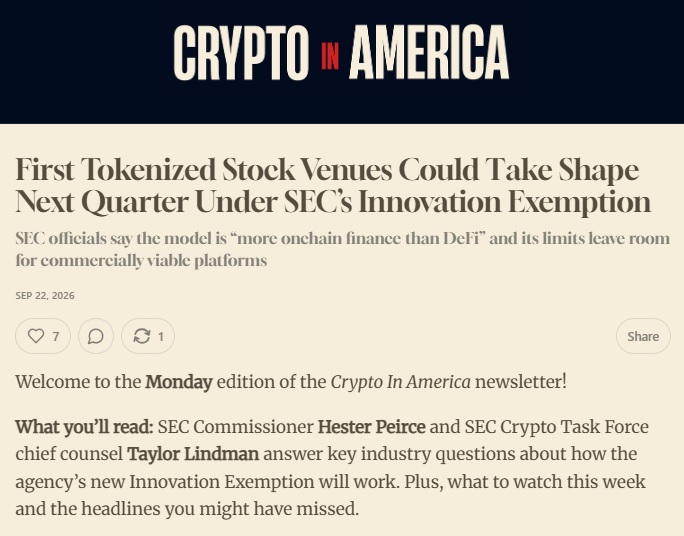
The first regulated venues for onchain trading of tokenized U.S. stocks could begin taking shape as early as next quarter, according to senior U.S. Securities and Exchange Commission officials. SEC Crypto Task Force chief counsel Taylor Lindman said interested firms could begin publishing the required operating notices in the coming months.
🚨🗞️NEW: First Tokenized Stock Venues Could Take Shape Next Quarter Under SEC’s Innovation Exemption@HesterPeirce and @taylor_lindman answer key questions about how the new framework will work. ⬇️https://t.co/baNJYvy4vS
— Eleanor Terrett (@EleanorTerrett) September 22, 2026
These notices would provide the first public indications of which companies intend to operate Tokenized Securities Venues (TSVs). The framework follows the SEC’s September 17 conditional relief order allowing eligible platforms to facilitate permissioned trading of tokenized U.S. stocks on public blockchains.
Lindman made the comments in an interview with Crypto in America alongside SEC Commissioner Hester Peirce. He said there would likely be some delay between the publication of the SEC’s order and the appearance of the first operating notices.
Under the SEC’s temporary framework, qualifying venues can facilitate trading in tokenized versions of U.S.-listed National Market System stocks. The platforms can use automated market makers and liquidity pools operating on public, permissionless blockchains.
Source: cryptoinamerica.com
However, the framework does not create a completely open-ended DeFi market for stocks. Each qualifying venue must have an identifiable operator responsible for running the platform and complying with the conditions of the exemption.
Lindman described the model as closer to onchain finance than traditional decentralized finance, because a clearly identified company or person remains responsible for the venue.
Peirce similarly distinguished the approved structure from peer-to-peer DeFi systems without a central operator. She said fully decentralized stock trading could theoretically be possible, but it would raise regulatory questions that are not addressed by the current order.
The distinction could determine which companies are able to launch the first tokenized stock venues. Platforms must meet requirements covering areas such as anti-fraud protections, sanctions compliance, custody and disclosures.
The SEC’s order also places limits on the number of stocks a venue can list and the trading volume it can handle for individual securities. Some industry participants have questioned whether those limits could restrict commercial viability.
Peirce said she believes the limits leave enough room for meaningful experimentation. She described the five-year relief period as a bridge towards longer-term regulation rather than a permanent framework.
Another important provision gives the issuer of an underlying stock a 30-day opportunity to object when an unaffiliated third party wants to list a tokenized version of that company’s shares. If the issuer objects, the venue cannot list the token.
The SEC framework also requires tokenized securities to represent the actual underlying shares and carry the same economic and governance rights, including dividends and voting rights. Purely synthetic tokens that only track the price of a stock are excluded.
Qualifying venues must also publish transaction data, establish access standards, comply with sanctions requirements and operate within the specified symbol and volume limits. Federal securities anti-fraud rules continue to apply.
Lindman said the SEC is already hearing from companies interested in operating tokenized securities venues. Some of that interest emerged during the SEC’s September 17 roundtable on preparations for 24-hour trading.
The next stage is therefore practical: interested companies will need to publish their operating notices and notify the SEC. If the timeline outlined by Lindman holds, the market could soon get its first public indications of which firms intend to operate these venues and which blockchains they plan to use.
Stay informed with the latest trends in Web3, blockchain innovation, and cybersecurity updates at 3verseTV
You need to login in order to Like















Leave a comment