


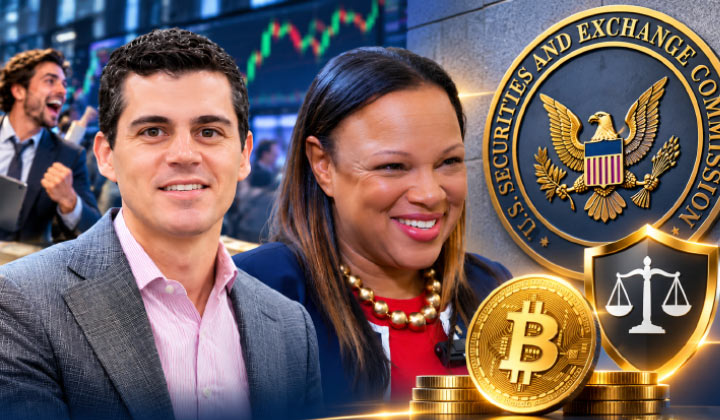
- Steven Levine and Kristin N. Johnson appeared before the US Senate Banking Committee on November 19, 2026, for hearings on their nominations to the SEC.
- Both nominees highlighted investor protection, market transparency and responsible financial innovation as important priorities.
- Johnson specifically pointed to risks involving AI, tokenization, stablecoins and decentralized platforms, while Levine stressed the need to balance innovation with strong investor protection.
Two Nominees Face Senate Questions
Focus on regulating crypto may increase at the SEC after Steven Levine and Kristin N. Johnson were nominated. Both candidates gave evidence to the Senate Banking Committee on 19 November 2026.
The nominations were sent to congress by President Donald Trump on 12 November. Levine, a Republican from Maryland, will serve until 5 June 2030. Johnson, a Democrat from Michigan, will serve until 5 June 2029.
LIVE: Chairman @SenatorTimScott leads a full @BankingGOP Committee executive session, followed by a nomination hearing.
The Committee votes on Jeremy Wiggins (Treasury), Matthew Jones (HUD), and David Slade and Michael Rigas (Export-Import Bank), then considers Mark Aesch (FTA), Hugo Dante, Jr. (OFR), Rebekah Jurata (Treasury), and Kristin N. Johnson and Steven Levine (SEC).
https://t.co/KgIBevmhOS— U.S. Senate Banking Committee GOP (@BankingGOP) November 19, 2026
Both nominations are part of a wider effort to appoint bipartisan candidates to regulatory bodies. These come at a time in which comprehensive legislation is being developed to regulate digital asset markets in the US. Until new legislation is enacted, the SEC and CFTC will apply their current powers to regulate areas of crypto.
Levine Wants Innovation Along With Investor Protection
Levine outlined his background in his evidence, including working in investment advisory services, practicing law, and working in the SEC. Additionally, he has worked with both the White House Council of Economic Advisers and the Department of Labour.
Levine highlighted that the SEC should prioritize fulfilling its main functions of “protecting investors, ensuring fair and orderly markets and facilitating capital formation,” he noted that many products within financial markets, such as ETFs and money market funds, began as innovative products, but have become very important to financial markets.
Whilst the SEC should not hinder innovation in financial services, new products must be appropriately protected for investors. Levine believes that regulation should provide opportunities for businesses, whilst aiming to reduce the costs of capital formation.
Therefore, it appears that Levine seeks to encourage innovation within the regulator, but still prioritise investor protection.
Johnson Highlights Risks From AI, Stablecoins And Tokenization
Johnson has experience in academia and regulation. She is a law professor at George Washington University and was a commissioner at the CFTC in 2022-2025.
At the CFTC, she worked on issues relating to cyber risk, market infrastructure, and third party technology. She also participated in discussions regarding artificial intelligence and other emerging technology with the SEC, Fed and Treasury Department. Johnson stated that investor protection for everyday people saving for the future should be a key focus.
Areas of concern include artificial intelligence, tokenization, stablecoins and decentralized trading platforms. She stated that these can cause conflicts of interest, data management issues and accountability issues. Good governance is very important, alongside measures to prevent conflicts of interest, and separating clients’ assets from business assets.
Johnson stated that investor confidence is key within financial sectors. Investors will only invest savings if they trust the market. Businesses also require trustworthy markets in order to raise capital. If confirmed, Johnson will act according to the law, make independent judgements, and will be accountable to Congress.
What The Nominations Could Mean For Crypto
These nominations are significant. There is currently a lack of clarity in the regulation of digital assets within the US. Concerns around tokenized securities, stablecoins and decentralized finance are influencing the regulation debate.
Both candidates seem to have positive attitudes towards innovation in financial services. However, Johnson highlights that care must be taken to protect customers and investors within new technologies. Levine seems to support innovation within a well-regulated environment.
Neither candidate have explicitly stated any new policies in relation to crypto. However, they do highlight what approach they would take to regulation if confirmed.
As part of their confirmation process, the hearing by the Banking Committee is significant. If both candidates are confirmed, they may influence how the SEC regulates digital assets and other changes in financial markets.
Stay informed with the latest trends in Web3, blockchain innovation, and cybersecurity updates at 3verseTV
You need to login in order to Like
















Leave a comment