


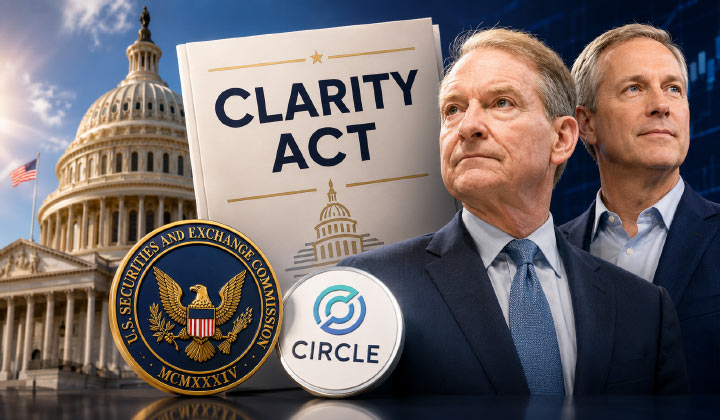
U.S. Securities and Exchange Commission (SEC) Chair Paul Atkins expects the Senate to vote on the CLARITY Act on September 15, while Circle President Heath Tarbert has urged lawmakers to move the legislation forward. Both executives say clearer rules could give crypto companies greater certainty as the U.S. works to strengthen its position in digital assets.
The Regulation Crypto Assets proposal is our most historic step yet to cement America as the Crypto Capital of the World—and is consonant with our belief that Congress should send the CLARITY Act to the President’s desk. pic.twitter.com/Z9Pep2Wvph
— Paul Atkins (@SECPaulSAtkins) September 2, 2026
Speaking to Fox Business, Atkins said he anticipates and hopes the CLARITY Act will pass the Senate and eventually reach the president for signature. He described the SEC’s proposed crypto-asset regulations as the agency’s most significant step so far in supporting the administration’s goal of making the U.S. a centre for crypto activity.
Atkins said the SEC has already released its proposal for public comment so that the agency can prepare rules that are consistent with the CLARITY Act if it becomes law. He noted that the proposal includes exemptions for fundraising and related time limits that broadly mirror provisions in the legislation.
According to Atkins, the SEC wants its final rules to fit within the framework established by Congress. He said the approach is aimed at giving market participants more certainty and allowing innovation, product development and fundraising to take place under U.S. law.
Today, Circle President Heath Tarbert goes before Congress to make the case for protecting the U.S. dollar’s lead and securing American leadership in the next generation of financial infrastructure.
Read more: https://t.co/tESDsK5ygN
— Circle (@circle) September 2, 2026
His comments came shortly after Tarbert appeared before the House Financial Services Committee on September 2 for a hearing titled “Strengthening the American Economy: Promoting Growth, Opportunity, and Prosperity.” The Circle president used the hearing to make a broader case for advancing the CLARITY Act.
Tarbert linked the need for crypto regulation to changes taking place across financial markets, particularly in stablecoins, tokenization and digital payments. He also warned that the dollar’s leading position in global finance should not be taken for granted.
“The dollar’s global role is an economic asset, not a birthright,” Tarbert said. He pointed to the decline in the dollar’s share of global foreign-exchange reserves, from more than 70% in the late 1990s to about 57% today.
Stablecoins were another major focus. Tarbert cited Bank for International Settlements data showing that around 98% of global stablecoin value is denominated in U.S. dollars. However, he cautioned that this dominance could change. “No law of nature requires that the currency of the internet be the dollar,” he said.
Source: Circle.com
Tarbert also discussed tokenized financial assets. He said tokenized Treasury and money-market products had surpassed $16 billion in circulation by August, reflecting growing institutional interest. Companies such as BlackRock and Franklin Templeton have already introduced tokenized investment products.
For Tarbert, the attraction of tokenization is not simply the use of blockchain. He pointed to possible improvements in settlement, custody and collateral management. At the same time, wider adoption will depend on regulation, liquidity, costs and whether these systems provide clear advantages over existing financial infrastructure.
Artificial intelligence also entered the discussion. Tarbert raised the possibility of AI agents carrying out transactions within predefined limits and under compliance controls. If such systems become common, payment networks may increasingly have to handle transactions initiated by software rather than directly by people.
Against this backdrop, Tarbert said he would prefer these developments to operate through U.S.-based infrastructure and under U.S. legal standards. He argued that the CLARITY Act could provide companies with greater certainty when making long-term investments.
At the same time, Tarbert stressed that clearer crypto rules should not be seen as government approval of individual digital assets. “None of that is a subsidy, or a blessing of any asset,” he said.
The CLARITY Act remains part of a wider debate over how digital assets should be classified and which federal regulators should oversee different activities. The GENIUS Act has already created a federal framework for payment stablecoins, while the CLARITY Act is intended to address the broader market structure.
The U.S. discussion is also unfolding as other countries develop their own crypto rules. Russia, for example, recently moved forward with a revised cryptocurrency regulation bill, while a recent G20 chair’s statement called for regulatory frameworks that provide clear pathways for responsible digital-asset innovation.
For Atkins and Tarbert, the message is broadly similar: the crypto industry needs clearer rules if companies are to build and invest with confidence in the U.S. Whether that happens will now depend on the Senate vote, subsequent congressional negotiations and the regulatory process that follows.
Stay informed with the latest trends in Web3, blockchain innovation, and cybersecurity updates at 3verseTV
You need to login in order to Like

















Leave a comment