


- US banking regulator introduces its first supervisory framework for assessing AI risks in banking.
- Fully autonomous payment agents fall into the framework’s highest illustrative risk tier.
- Recommended safeguards include identity verification, transaction limits, monitoring, and access revocation.
The United States Office of the Comptroller of the Currency (OCC) has created its set of rules for artificial intelligence in banking. These rules explain how examiners should check for risks that come from AI systems that work more on their own.
This new advice is happening because more people are worried about third-party AI tools getting into customer bank accounts. These tools might do things that go against what users want. Even though the OCC has not said this framework is because of problems, in banking it is paying attention to these outside AI agents. This is an issue that banks are facing.
OCC Targets AI Risks Beyond Technical Capabilities
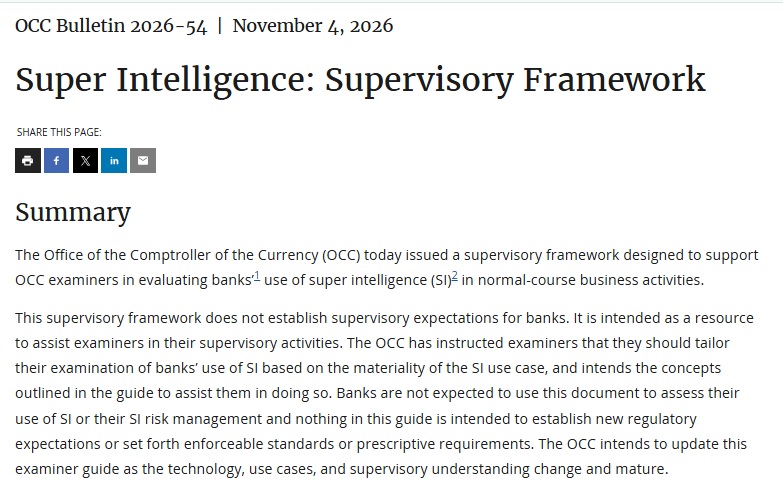
The OCC’s 22-page framework says that AI risk assessments must look at what could happen if a system fails, not just judging how advanced the technology is.
For example, an AI agent that is allowed to start transactions could bring bigger dangers than a very advanced model that can only write internal documents.
Source: occ.gov
The framework shows four risk levels. It puts autonomous payment agents and real‑time credit decision systems in the top level. Simple internal productivity tools are in the lower level.
External AI Agents Put Bank Account Security In Focus
The guidance is meant for agents that customers, fintech firms, and other businesses use to talk to banks using the systems they already have.
The suggested safeguards are to check who the agent is, limit what the agent can do, set limits on how much money can move, watch the agent’s actions all the time, and have ways to stop or take back the agent’s access when it is needed.
These recommendations come after reports that big US banks, JPMorgan, Bank of America, Citi, and Morgan Stanley, have cut back or blocked some third‑party AI agents. They did it because they were worried about how accounts were being used.
Stay informed with the latest trends in Web3, blockchain innovation, and cybersecurity updates at 3verseTV
You need to login in order to Like














Leave a comment