


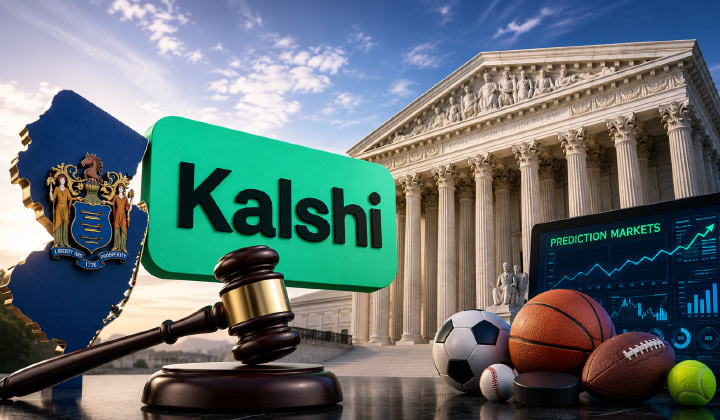
New Jersey has taken its fight with prediction market platform Kalshi to the U.S. Supreme Court, asking the justices to overturn a lower-court ruling that gave the Commodity Futures Trading Commission (CFTC) exclusive authority over sports prediction markets.
The state argues that federal law does not prevent states from regulating sports bets offered within their borders. The case could have major implications for Kalshi and other prediction markets that offer contracts linked to sporting events.
Through a petition for certiorari, New Jersey contested a decision made by the 3rd U.S. Circuit Court of Appeals. The state is asking the Supreme Court to decide whether the Dodd-Frank Act and the 2010 Consumer Protection Act forbid states from controlling sports betting when contracts are traded through exchanges registered with the CFTC.
New Jersey asked the Supreme Court to shut down prediction markets in the state, teeing up a potential landmark case where the justices could decide if the highly popular but controversial industry can survive in its current form. https://t.co/t8hLCtmCRm pic.twitter.com/lAMqWM1EYT
— CNN Politics (@CNNPolitics) September 2, 2026
The dispute comes as several states are increasingly challenging prediction markets that offer sports-related contracts. State regulators argue that these products function like sports betting and should therefore fall under state gambling laws.
The legal uncertainty has grown because another federal appeals court has taken a different position. The 9th U.S. Circuit Court of Appeals has also considered sports prediction markets and concluded that sports contracts can be treated as sports bets.
That leaves the possibility of conflicting interpretations at the federal level. One appellate court has backed the prediction-market industry’s position on federal jurisdiction, while another has sided more closely with the states.
A Supreme Court decision could therefore settle an important question about who has the final say over sports-related prediction markets: federal regulators or individual states.
The stakes are rising as the prediction-market industry attracts more users and investors. Kalshi recently raised capital at a valuation of $22 billion, while Polymarket raised $1 billion at a valuation of nearly $21 billion.
NJ invokes major-questions doctrine:
“Finding that the Act impliedly displaces state sports-gambling laws is an ‘astonishing’ conclusion that has grave ‘economic and political consequences’— and is thus a decision one expects Congress to make clearly.” pic.twitter.com/WK3igRHN9j
— Daniel Wallach (@WALLACHLEGAL) September 2, 2026
Legal expert Daniel Wallach said New Jersey has also invoked the major-questions doctrine in its petition. The state argues that interpreting Dodd-Frank as silently removing state authority over sports gambling would have major economic and political consequences.
New Jersey further argues that such a decision would represent a significant change in the traditional relationship between federal and state authority in an area that has historically been regulated by states.
The state has also pointed to the 9th Circuit’s decision in support of its position.
Kalshi, however, has defended the earlier court ruling. In a statement shared with FOS, the company said the decision supported the principle that CFTC jurisdiction can preempt state law. Kalshi added that the disagreement involved a regulation that is already being rewritten.
“We remain confident in the lower courts’ rulings,” Kalshi said, arguing that New Jersey’s latest filing does not change its position.
The case comes at a critical moment for prediction markets. Platforms such as Kalshi and Polymarket have moved from being niche products into major financial businesses, attracting significant capital and mainstream attention.
At the heart of the dispute is a simple but important question: when a contract involves the outcome of a sporting event, is it a financial product regulated by the CFTC or a sports bet regulated by the states?
The Supreme Court’s decision could determine how these markets develop in the United States. It could also establish a clearer boundary between federal derivatives regulation and state gambling laws at a time when prediction markets are expanding rapidly.
Stay informed with the latest trends in Web3, blockchain innovation, and cybersecurity updates at 3verseTV
You need to login in order to Like
















Leave a comment