



- ECB President Christine Lagarde asked lawmakers to get euro laws approved by the end of 2026.
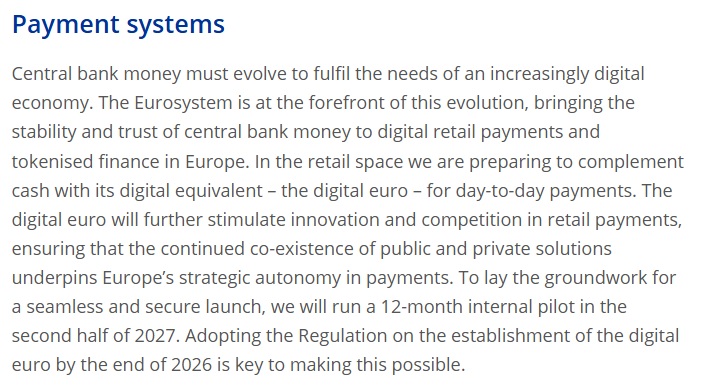
- The ECB is planning a 12-month digital euro test starting in the second half of 2027.
- Pontes started working on September 21, allowing eligible tokenized asset transactions to be settled using central bank money.
European Central Bank President Christine Lagarde has urged lawmakers to approve euro legislation by the end of 2026. Speaking at the IMF’s Annual Meetings on October 17, she also highlighted Pontes, the Eurosystem’s platform for settling tokenized assets using central bank money.
The global economy has proven surprisingly resilient to uncertainty, says President @Lagarde. A return to an international economic order grounded in openness, predictability and the rule of law would help trade and investment. Read the IMFC statement https://t.co/gH41KmaisG https://t.co/dsVWnBuKg8
— European Central Bank (@ecb) October 17, 2026
The ECB plans to run a 12-month pilot for the digital euro in the second half of 2027, subject to progress, on the EU’s legislative framework.
ECB Pushes Digital Euro Law Ahead Of 2027 Pilot
On October 17, Lagarde spoke to the International Monetary and Financial Committee during the IMF’s Meetings. She said that adopting the euro regulation by the end of 2026 is essential to push the project forward.
The ECB plans to run a 12‑month pilot in the second half of 2027. The digital euro has not yet been. Its launch still depends on the EU legislative process.
The proposed central bank digital currency (CBDC) would complement cash by offering a form of central bank money for retail payments.
Pontes Brings Central Bank Money To Tokenized Markets
Alongside the digital euro, Lagarde mentioned Pontes, the Eurosystem’s distributed‑ledger technology (DLT) settlement solution. Said it began working on September 21.
Source: ecb.europa.eu
Pontes links DLT platforms with the Eurosystem settlement system, making it possible for transactions that use assets to settle with central bank money.
Tokenization means showing assets, like government bonds and investment funds, as tokens on a distributed ledger. Settling with central bank money could help build financial markets while still using the established central bank infrastructure.
The ECB is also ready to put a part of its own money into tokenized securities, starting with euro‑denominated debt issued by euro‑area governments, agencies, and supranational institutions.
ECB Highlights Europe’s Strategic Autonomy In Payments
Lagarde connected the Eurosystem’s efforts in finance to Europe’s goal of strategic autonomy in payments. She stressed that central bank money must keep up with changes in the economy.
Her remarks did not directly refer to Bitcoin, cryptocurrencies, or stablecoins. Still, the wider conversation around this topic includes worries about Europe depending too much on non-European payment services. There is also concern about how issued stablecoins might affect the banking system.
At the time, the European Central Bank is working on Appia. This is a long-term project to create a connected financial ecosystem across Europe.
Stay informed with the latest trends in Web3, blockchain innovation, and cybersecurity updates at 3verseTV
You need to login in order to Like














Leave a comment