



In a single week, three firms in India raised over ₹1,025 crore using blockchain-based infrastructure, marking the country’s first significant move toward tokenized corporate bonds. The Reserve Bank of India’s wholesale digital rupee was used to settle the bonds, which were issued on a distributed ledger with approval.
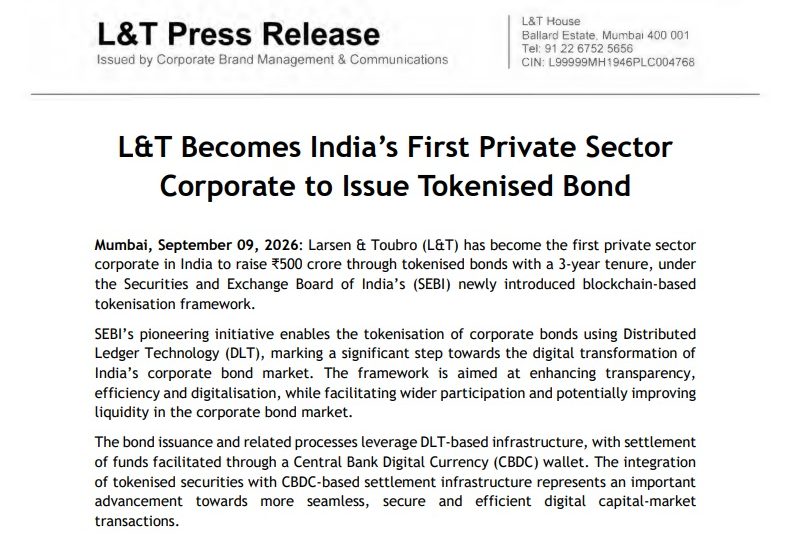
Larsen & Toubro issued an additional ₹500 crore, IIFL Finance issued ₹25 crore, while state-owned REC initiated the pilot with a ₹500 crore issuance. Retail investors are unable to access the bonds while they are active, and there is currently no operational secondary market for exchanging tokenized bonds.
Source: bseindia.com
The development marks a significant change in how corporate debt can be issued and settled in India. Importantly, the bonds themselves remain conventional corporate debt. Their credit risk, coupon obligations, maturity and investor rights have not changed. What has changed is the technology used to record ownership and settle the transactions.
REC completed the first pilot issuance on September 7 under SEBI’s Regulatory Sandbox Framework. The notes matured in May 2028 and raised ₹500 crore at an annual yield of 7.30% for a tenor of one year and nine months. There was a ₹400-crore green-shoe option and a ₹100-crore base issue.
Two days later, Larsen & Toubro sold the first tokenized corporate bond in the private sector. It used three-year non-convertible debentures with a stated 7.40% coupon to fund ₹500 crore. Additionally, IIFL Finance became the first non-PSU NBFC to successfully conduct a tokenized bond offering, raising ₹25 crore at a 9.10% yield for two years.
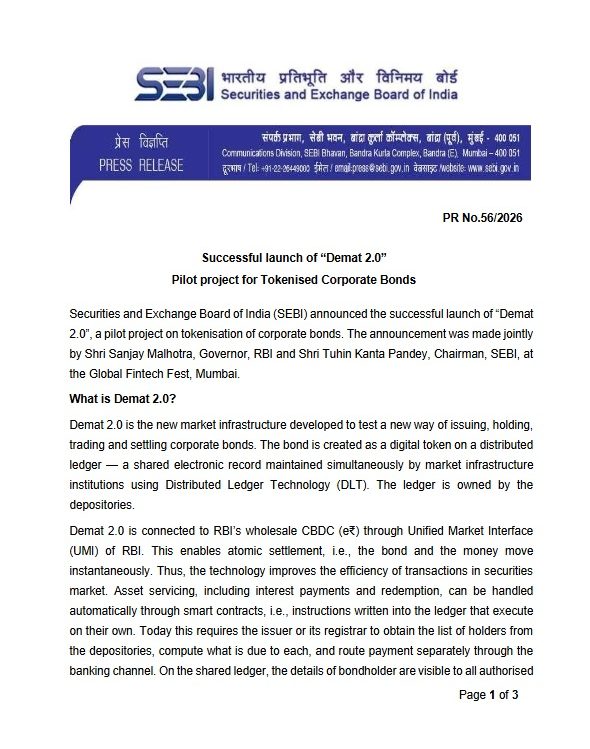
The bidding process itself has not been replaced by blockchain. Investors continued to place bids through the National Stock Exchange’s Electronic Bidding Platform. The major change came after allotment. Instead of being recorded in conventional demat accounts, the securities were recorded through Demat 2.0, a permissioned distributed-ledger system being developed by NSDL and CDSL.
Source: sebi.gov.in
The payment side also moved onto digital infrastructure. Participating institutions used wholesale CBDC wallets to make payments in e₹-W, the institutional version of India’s digital rupee. The bond and payment were designed to move together through what is known as atomic Delivery-versus-Payment, or DvP. In simple terms, the bond changes hands only when the corresponding money moves.
This can reduce settlement risk because the security and cash legs do not have to wait for separate systems to complete their respective processes. The pilot has also reduced the settlement timeline for these transactions, with the deals completed on the same day.
But there is an important limitation. Tokenization has not yet created a new trading market for these bonds. Although the REC bonds are listed on NSE and BSE, a mechanism for actively trading the tokenized securities is not yet operational. Reports have indicated that an initial lock-in period may apply, with exchanges expected to develop a trading venue later in 2026.
Chairman, SEBI, and Governor, RBI, jointly launched the Demat 2.0 pilot for tokenized corporate bonds, enabling faster settlement through CBDC and automating coupon and redemption. Three issuances have already been completed, led by MIIs and supported by banks.
Link to the… pic.twitter.com/7apG8Aers7
— SecuritiesandExchangeBoardofIndia (@SEBI_updates) September 10, 2026
Retail investors are also outside the current system. Participants need both a Demat 2.0 securities wallet and a wholesale CBDC wallet. This keeps the experiment within a controlled group of institutional participants rather than creating an open market similar to cryptocurrency exchanges.
The next phase will therefore be closely watched. If a secondary market develops and more private companies begin issuing tokenized debt, India will have a better test of whether blockchain can deliver benefits beyond faster settlement.
For now, the achievement is more modest but still important. India has successfully put ordinary corporate bonds onto a permissioned blockchain and settled them using central-bank digital money. The bonds are live. The wider market around them is not yet.
Stay informed with the latest trends in Web3, blockchain innovation, and cybersecurity updates at 3verseTV
You need to login in order to Like
















Leave a comment