



Hong Kong is planning to expand its regulated stablecoin trading and tokenized real-world asset markets, while also developing digital bond infrastructure and round-the-clock central bank digital currency settlement.
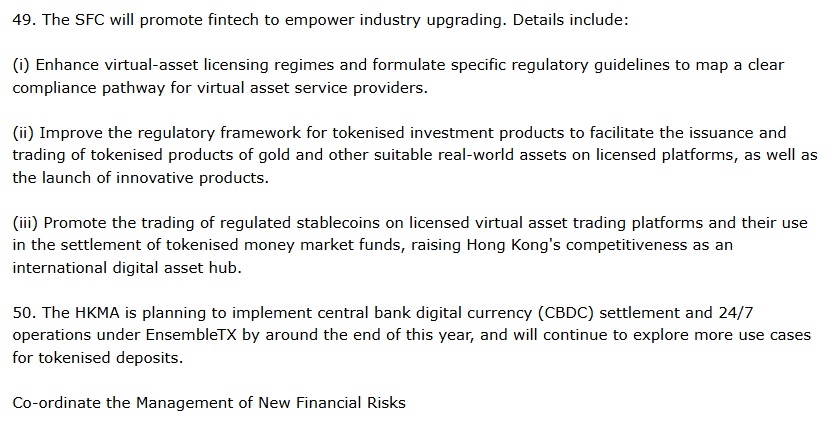
Under its 2026 Policy Address, the government said regulators would strengthen virtual-asset licensing rules, allow regulated stablecoins to trade on licensed platforms and support the tokenization of assets such as gold.
The Hong Kong Monetary Authority is also preparing EnsembleTX for CBDC settlement and 24-hour operations around the end of 2026, adding another layer to the city’s growing digital-asset infrastructure.
The plans build on Hong Kong’s existing push to develop a regulated digital-asset market. The Securities and Futures Commission is expected to improve its rules for virtual-asset service providers and develop more detailed regulatory guidance.
Stablecoins are a major part of the plan. The government wants regulated stablecoins to be available for trading on licensed virtual-asset platforms. They could also be used to settle tokenized money market funds.
Hong Kong has already introduced a regulatory framework for stablecoin issuers, with the first licences granted earlier in 2026. Licensed issuers are required to maintain eligible reserve assets and operate under regulatory supervision.
One of the licensed issuers, Anchorpoint Financial, backed by Standard Chartered, has started rolling out the Hong Kong dollar-backed HKDAP stablecoin. The token initially focuses on areas such as cross-border payments, fiat conversion and settlement involving tokenized real-world assets.
Standard Chartered later became the first bank distributor for HKDAP. The bank has said it plans to introduce subscription and settlement services for tokenized money market funds during the fourth quarter of 2026.
Tokenization is another central part of Hong Kong’s plans. The government wants to make it easier for suitable real-world assets, including gold, to be issued and traded in tokenized form through licensed platforms.
Digital bonds are already an important part of this strategy. According to the Policy Address, digital bonds issued in Hong Kong between 2025 and the first half of 2026 represented nearly half of the global market during that period.
In June, the Hong Kong Mortgage Corporation priced a HK$12 billion digital bond, worth roughly US$1.5 billion. The transaction attracted orders of around HK$24 billion from more than 100 institutional accounts.
The government now wants to develop a more regular framework for digital bond issuance. It is also examining how digital currencies could be used throughout the life of a bond, including settlement, dividend payments and redemption.
Another test involving tokenized Exchange Fund Bills is scheduled before the end of 2026. More than HK$1.3 trillion of Exchange Fund Bills could potentially be used in the programme as authorities examine how tokenization might support banks’ asset and liability management around the clock.
The Hong Kong Monetary Authority’s Tokenized Bond Expert Group will also conduct a second phase of legal review. The group is examining how distributed ledger technology can be applied to capital markets.
The initiative involves major financial and technology companies, including JPMorgan Securities, HSBC, Standard Chartered Bank, UBS, Ant Digital and HashKey Group.
Hong Kong’s 2026 Policy Address sets out plans for stablecoins and tokenized RWAs 🇭🇰
– More regulated stablecoin trading
– Tokenized real world assets and digital bond infrastructure
– 24/7 CBDC settlement through EnsembleTX, targeted for the end of the year pic.twitter.com/oObR1K64xH
— RWA Foundation (@RWAFoundation_) September 17, 2026
Hong Kong is also building infrastructure for digital-asset custody and settlement. CMU OmniClear is expected to establish a digital-asset platform during 2026 covering areas such as digital bond issuance and settlement.
At the same time, regulators are increasing surveillance. The SFC plans to begin operating a digital-asset custody surveillance system during the second half of 2026. Its CrypTech initiative is expected to add big-data market surveillance and anti-money-laundering surveillance capabilities in 2027.
EnsembleTX is another important piece of the infrastructure. The HKMA plans to introduce CBDC settlement and 24-hour operations around the end of 2026 while continuing to examine applications for tokenized deposits.
Taken together, the measures show Hong Kong building several parts of a digital financial system at the same time — from stablecoins and tokenized assets to digital bonds, CBDC settlement and custody oversight. The focus remains on bringing these activities within regulated financial-market infrastructure rather than treating them as separate from the existing system.
Stay informed with the latest trends in Web3, blockchain innovation, and cybersecurity updates at 3verseTV
You need to login in order to Like
















Leave a comment