

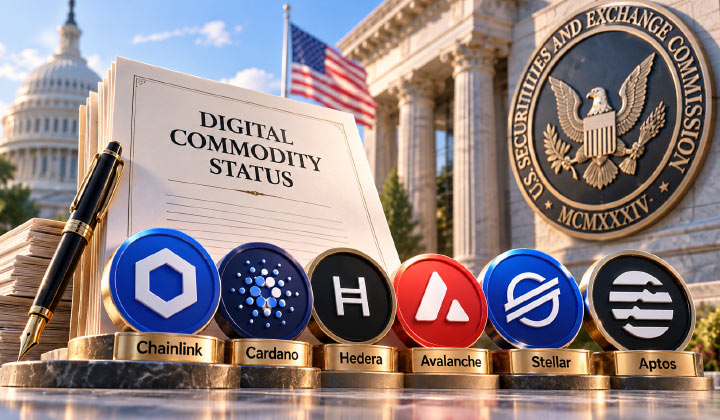
Six blockchain infrastructure companies behind Chainlink, Cardano, Hedera, Avalanche, Stellar and Aptos have requested the U.S. Securities and Exchange Commission to incorporate its “digital commodity” definition into the proposed crypto regulations as a condition for qualifying digital assets, seeking to exclude securities status for the tokens.
The request, signed by Chainlink Labs, the Cardano Foundation, Hedera, Ava Labs, the Stellar Development Foundation and Aptos Labs, was made on October 20, 2026, a day before the close of the public comment period for the proposed rules. The groups argued that such a condition will provide appropriate certainty to U.S. crypto businesses and promote the U.S. as a favorable jurisdiction for the industry.
We just sent the SEC our comment letter on Regulation Crypto Assets.
Our goal is to give every token one current, public record to make onchain compliance cheaper and faster.
Our asks:
1) Let projects file disclosures through Qualified Onchain Disclosure Agents
2) Let third parties file on behalf of projects
It’s time we protect investors so we can protect this industry.
https://t.co/VNIuskoN7T
— Yano 🟪 (@JasonYanowitz) October 20, 2026
In particular, the signatories requested the SEC to formally state that qualifying digital commodities are not securities in the Commission’s rules, not the guidance. On March 8, 2026, the SEC published an interpretation defining a digital commodity as a crypto asset, the value of which derives primarily from the operations of the blockchain network and the demand for the token itself, rather than projected income from the efforts of others.
According to the March 2026 interpretation, the SEC has clarified the scope of application of existing securities laws to various crypto assets. Nevertheless, the groups want the definition to be included in the rules as a standalone entry, whereas now it is in the guidance section, which serves to describe the thinking but does not carry the force of law.
🌩️ BREAKING: New partnership announced between Chainlink, Hedera, Stellar, Aptos, Avalanche and Cardano urging the SEC to codify digital commodity status: $LINK $HBAR $XLM $APT $AVAX $ADA https://t.co/3gUhkQqRrG
— King Solomon (Ryan Solomon) (@IOV_OWL) October 21, 2026
The key point is that the latter stage, a regulation statement, creates more durable and legally binding rules and obligations. At the same time, the groups have asked the SEC to explicitly note in the document that digital commodities lack the characteristics of a security, namely: rights of any kind related to anticipated income, rights of ownership or similar rights in rem.
The request notes that the tokens of the six blockchain networks are primarily used to pay fees, participate in the consensus algorithm of the network through staking, and generally provide liquidity and facilitate decentralized governance. As noted in the filing, the SEC’s proposed rules would create a regulatory framework designed to foster “innovation and growth in the digital asset industry” while still protecting investors.
The proposed Regulation Crypto Assets incorporates a framework which creates a safe harbor exemption for crypto offerings of at least 1, but no more than $5 million over four years and another for offerings of up to $75 million raised in any 12-month period from the registration requirements under the Securities Act. It was also proposed to adopt a conditional safe harbor provision for certain crypto assets to cease being a part of an investment contract.
The March interpretation classified crypto assets into five categories: digital commodities, digital collectibles, digital tools, stablecoins, and digital securities. In addition, the Commodity Futures Trading Commission, the derivatives regulator, indicated that it would apply its laws in a manner consistent with the SEC’s interpretation.
.@chainlink is proud to partner with @hedera, @Aptos, @AvaLabs, and @StellarOrg in urging the SEC to codify its digital commodity framework.
Builders need lasting certainty. Codifying this progress would be a meaningful step toward keeping America the home of digital asset innovation.
H/t @jackson_mueller for leading this effort 🫡
— Taylor Barr (@taylorjbarr) October 20, 2026
Taylor Barr, the head of policy at Chainlink Labs, tweeted on October 20, that the request for clarification reflects the companies’ belief that definitive, durable crypto regulations would enable developers and promote the U.S. as the leading nation for digital asset innovation. In addition, the letter noted the recent defeat of the CLARITY Act, a proposed law aimed at regulating the crypto industry, in the Senate Committee on Banking, Housing and Urban Affairs earlier last month.
Notably, several industry participants have also voiced concerns about the SEC’s proposal, with Ripple, another major blockchain infrastructure provider, arguing in its comment letter that an investment contract, rather than the token itself, constitutes a security. The regulator will consider the comments and possibly revise the proposals before finalizing the rules, which would significantly impact the classification and, consequently, the regulation of the qualifying tokens, including LINK, ADA, HBAR, AVAX, XLM, APT and others. For the six crypto firms, classifying digital commodities as non-securities is of particular importance.
Stay informed with the latest trends in Web3, blockchain innovation, and cybersecurity updates at 3verseTV
You need to login in order to Like













Leave a comment