



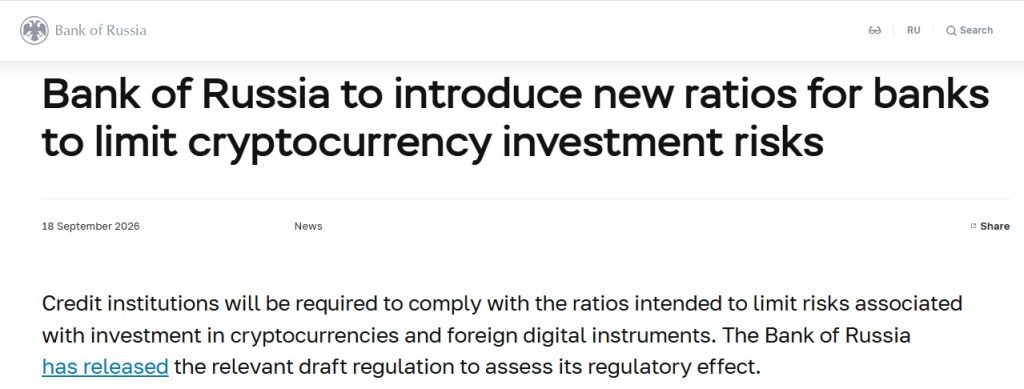
The Bank of Russia has proposed a 1% limit on banks’ total exposure to cryptocurrencies and foreign digital instruments as the country brings crypto trading and related services under a regulated framework. The draft rules would apply the 1% ceiling to both individual banks and banking groups. The proposed limits would cover not only direct crypto holdings but also loans, derivatives, bonds, guarantees, repo transactions and other instruments linked to the value or payments of crypto assets.
The proposed framework introduces two risk ratios, known as N31 for individual credit institutions and N32 for banking groups on a consolidated basis. Both ratios would be capped at 1% of the institution’s own funds.
Banks would need to remain within the limit on every operating day. A breach could lead to action by the central bank if the limit is exceeded on six or more operating days during any 30 consecutive operating days.
Source: cbr.ru
The draft divides crypto-related transactions into two groups, based partly on sanctions and physical liquidity risks. Group 1 includes certain exchange-traded cash-settled derivatives, qualifying over-the-counter derivatives and transactions involving counterparties that meet specified credit standards. Some transactions involving cryptocurrency miners may also qualify under certain conditions.
Group 2 covers direct investments in cryptocurrencies and foreign digital instruments, along with some crypto-settled loans, repo transactions and derivatives that do not meet the requirements for Group 1. For this category, banks would not be able to completely offset long and short positions. The central bank would use the larger position when calculating exposure.
The proposed capital treatment is also significant. Banks would face a 1,250% risk weight on aggregate crypto exposure and certain client positions for which they take responsibility. Crypto assets and foreign digital instruments could not be used as collateral when banks calculate provisions for potential losses. Crypto-related derivatives would carry a 36% risk factor under the proposed rules.
The framework also distinguishes between client assets for which a bank is responsible for losses caused by seizure or sanctions-related restrictions and those for which it is not responsible. The former would be included in the relevant exposure calculations, while some client positions without such responsibility would receive different capital treatment.
The proposed rules come shortly after Russia’s regulated cryptocurrency framework took effect on September 1. The new system brings crypto trading, custody and cross-border transactions under formal oversight by the Bank of Russia.
Russian banks are already preparing for the regulated market. Sberbank has set a December 1 target for launching crypto trading infrastructure covering trading, custody, settlement and digital depository services for eligible customers. Alfa Bank has also been testing crypto trading through its brokerage application with a limited group of qualified investors.
The Bank of Russia plans to introduce reporting on turnover in covered instruments and the N31 and N32 ratios from January 2027. The regulation is expected to be officially published in the fourth quarter of 2026 and would take effect 10 days after publication.
The proposal shows that Russia is allowing regulated crypto activity to develop while placing strict limits on how much risk banks can take from the sector.
Stay informed with the latest trends in Web3, blockchain innovation, and cybersecurity updates at 3verseTV
You need to login in order to Like

















Leave a comment