

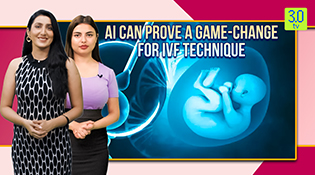
AI Can Prove A Game-Change For IVF Technique
By Kapil Rajyaguru
Today, infertility is growing insanely almost at the rate of an epidemic. Consider this: One in four couples in developing countries is impacted by infertility. Worldwide, a whopping number of 48.5 million couples experience infertility. And the Covid pandemic seems to have made it worse.
Post-Covid, doctors are noticing a decrease in the egg quality in women as young as 27 years of age. In males, too, the quality of the sperm has deteriorated.
Delayed marriages and lifestyle diseases like blood pressure, diabetes, thyroid have already led to high-risk pregnancies, if not an outright case of infertility.
Luckily though, scientific techniques like the In vitro fertilization (IVF) have come to the aid of couples seeking babies. IVF is a process wherein an egg is removed from a woman’s ovaries and fertilized with her man’s sperm in a laboratory. The successfully fertilized egg–an embryo–is then implanted into her uterus to grow.
Today, 40 years after its heavily criticized clinical introduction, IVF is available as a successful treatment for infertility almost all over the world. Over 8 million IVF children have been born, and over 2.5 million cycles are being performed every year, resulting in over 500,000 deliveries annually.
The global IVF market is set to reach around $36 billion by 2026, per an industry report. In India, IVF is currently a USD 746 Million industry and expected to double in the next 5 years.
IVF is indeed a ray of hope but not a full-proof solution to infertility.
To make matters worse, access to fertility care is abysmal. Even in a developed market like the United States, just 2% of people suffering from infertility have tapped into IVF.
Also, the success rate of IVF globally is merely in the range of 35-45% varying depending on women’s age, BMI, quality of egg and sperm to name a few.
This low success rate means that there is still a lot of opportunity to improve success rates where a small advancement in technology can lead to a higher chance of starting a family. And that is where Artificial Intelligence steps in.
The use of AI in IVF clinics holds great promise for addressing the challenges faced by couples struggling with infertility.
You need to login in order to Like