

NFTs Transforming Real Estate World
Real estate is widely recognized as a fundamental element in wealth generation and stability, still its conventional investment models can present significant obstacles to entrance and liquidity issues.
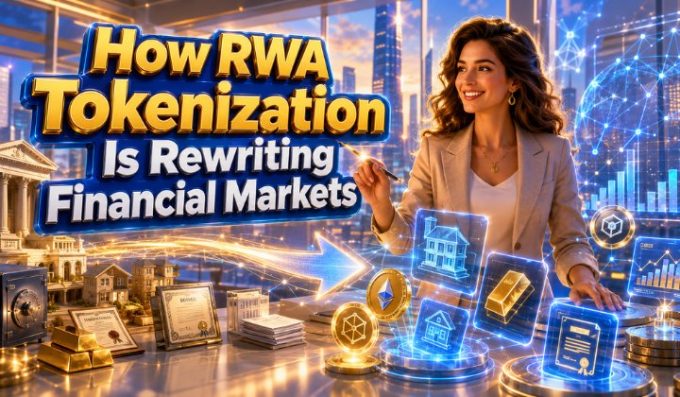
This is why NFTs and blockchain technology came in as a revolutionary method, which brought about real estate tokenization. In order to allow fractional ownership and simplify trade, ownership rights of real estate assets are converted into digital tokens on a blockchain.
NFTs act as a proof of ownership and authenticity for real world assets. These coins offer an unchangeable, transparent, and traceable record of real estate transactions by utilizing decentralized ledger technology.
In addition to improving the provenance and accuracy of property ownership records, this opens the door for fractionalized real estate investments, allowing several investors to possess individual NFTs that represent “shares” of a property.
Furthermore, the combination of real estate and NFTs has opportunities for improved liquidity, less middlemen, and creative asset tokenization; yet, it also calls for a thorough comprehension of the regulatory and technological nuances involved.
Virtual Real Estate Vs Physical Real Estate NFTs
First of all, it’s critical to avoid becoming lost in the jargon. Developers are building virtual worlds where we may explore cities, engage in new social settings, and even buy and sell as the metaverse grows.
You can purchase land or other property within these virtual worlds or video games. These virtual worlds are created with NFT houses, just like in the real world, or you can purchase a single NFT apartment in an NFT building.
Certain NFTs related to virtual real estate are connected to actual physical properties. Furthermore, the digital world and its spaces are frequently copies of real-world locales when it comes to well-known companies and organizations.
These digital assets are exchanged as blockchain-registered NFTs at auction. The process of creating a physical real estate NFT involves registering a physical asset on a blockchain, such as your home, place of business, or workplace.
Benefits of Tokenized Real Estate
Tokenizing real estate assets, whether they are single or several properties, entire or fractional, have several advantages.
Increased Liquidity: The ultimate purpose of tokenization is to remove the restrictions that presently impede real estate transactions by reducing entry barriers, eliminating needless middlemen, and expediting operations.
When assets become more accessible and easier to trade, more buyers and sellers may enter the market and close deals, which can increase liquidity.
Better Price Discovery: Tokens for fractionalized real estate can assist the broader market in determining the fair market value of various real estate holdings. A reasonable price for any property is now determined by real estate specialists using a range of data sources, and estimates from different experts can differ.
In a similar vein, offers received by sellers after they post their home for sale might vary greatly. However, the price discovery on a portion of the house can offer more information on the fair market value of the entire property if separate properties were fractionalized.
Lower Costs: Tokenized real estate, which predates fractionalization, has no effect on the actual cost of real estate. However, it can simplify the permissions and procedures related to real estate transactions.
Smart contracts, which operate on the terms of transfer and automatically carry out authorized transactions, enable low-cost and reliable coordination amongst mortgage lenders, notaries, escrow businesses, and other entities through the use of tokens.
Reduced Fraud: Real estate fraud can take many different forms. It is possible to falsify information about a property to give prospective purchasers incorrect impressions of important measurements like square footage. Purchasers may be tricked into committing fraud by offering phony real estate titles.
Smart contracts, blockchain technology, and decentralized oracle networks such as Chainlink can offer enhanced authentication, greater trust-minimization, and verifiable data that lessens information asymmetry, which is frequently the main driver of successful fraud efforts.
Disadvantages of Tokenized Real Estate
There are certain challenges associated with tokenizing real estate, despite it being a rapidly gaining breakthrough technology in the real estate sector.
Government Acceptance & Regulatory Compliance: The concept is reliant on government endorsement because uniformity and legalization across nations are required for NFT real estate to become the norm.
This also applies to getting blockchain approved and aligned with government regulations, as these are major obstacles in the form of legally accepted documents.
Complex: Tokenizing real estate is a relatively new notion that might be confusing and lead to misinterpretations due to its complexity. A lack of knowledge may discourage potential investors and act as a barrier to adoption.
Technology Risks: Any blockchain-based system has an inherent risk of hackers and cyber threats. Loss of private keys will result in loss of Asset.
Valuation Challenges:
Since cryptocurrency market fluctuates a lot, it’s very difficult to estimate the exact value of the tokenized property
Both buyers and sellers may be at danger from these varying token values, but stablecoins could help to mitigate the issue of cryptocurrency price volatility.
Risk of frauds: Since the tokenization of real-world assets is still evolving it is subject to more chances of fraud.
Tax Implications:
Tax rules regarding transactions of tokenized real estate are not clear as of now in a lot of jurisdictions; this will result in unanticipated tax obligations.
Future of NFT Real estate
NFTed properties, which suit the tastes and lifestyles of Millennials and Gen Z, who value security and are familiar with blockchain technology, will be the future as society continues to advance into the digital era.
Using smart contracts, this novel approach to real estate offers tamper-proof, safe transactions and a digitalized, efficient purchasing experience that is in line with the cashless purchases of the younger generation.
As purchases are stored on an immutable blockchain, buyers may easily access legal ownership documents and participate in international real estate investments, satisfying the needs of the growing number of remote workers and digital nomads who are looking for quick and simple ways to invest.
You need to login in order to Like