


DEXs Vs CEXs: Which Crypto Exchange is Best?
Of late, investors in virtual digital assets (VDAs), more popularly known as cryptocurrencies, have realised the importance of choosing crypto exchanges/trading platforms that offer security against trade execution and most importantly protecting coins/tokens.
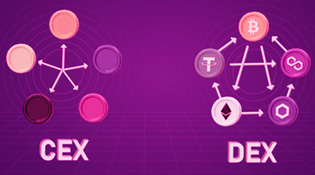
As we know, there are two broad types of exchanges: a centralised and a decentralized one. Few investors are unaware of what differentiates a centralised and a decentralized crypto exchange. Here, we try to understand the salient features of the exchanges and the pros & cons of both.
There are numerous factors an investor must consider before picking up a crypto exchange, and here, security should come before all else.
After all, crypto exchanges are handling your funds, so you want to be sure that they’re being protected to the highest degree.
So, let’s get into the specifics of centralized and decentralised exchanges and understand the difference in security integrity.
Let’s start with centralised exchanges (CEXs).
We know, CEXs are platforms that facilitate buying and selling of cryptocurrency, either for fiat currencies, like the US dollar, or between digital assets, like BTC and ETH.
One of the key defining features of centralized exchanges is that they are custodial.
Binance, Coinbase, and Kraken are all popular examples of centralized crypto exchanges.
Talking about the safety parameters of CEXs, they come with best options such as: two-factor authentication, login alerts, cold storage vaults, address whitelisting, withdrawal confirmations, multi-approval withdrawals, KYC (Know Your Customer) and AML (Anti-Money Laundering) protocols.
As mentioned earlier, the centralized crypto exchanges offer custodial wallets, meaning you entrust your private keys to the exchange. Some see this as a benefit, while others believe it is a security risk.
Many reputable CEXs are safe to use (though no platform is 100% secure). But there are certain issues that necessitate adoption of the centralised structure.
A CEX crypto exchange is constructed in a way that gives one central entity control of the entire platform. Platforms like Meta (Facebook), Instagram, and X (Twitter) are centralised.
Primarily, CEXs are based on a centralized data storage model. If one of these data centres is hacked, a lot of sensitive information stands exposed.
Further, using centralised servers increases the chance of crashes and other issues, as there is a single, central point of failure present that can be exploited.
Now, let’s move to decentralized exchanges (DEXs) – a peer-to-peer (P2P) marketplace. A user can trade cryptocurrencies in a non-custodial manner without the need for an intermediary to facilitate the transfer and custody of funds.
Talking about safety points, DEX crypto exchanges can offer some useful security features, such as: KYC verification, Smart contract verification, Multi-signature transactions, Open-source code, and non-custodial wallets.
DEXs are less vulnerable to some of the shortcomings of CEXs. For instance, a DEXs spreads all data and power across multiple connection points, known as nodes. This forms a web of devices that contribute to the network.
A decentralized structure makes launching an attack difficult for a malicious actor. If one node is hacked, it can be shut down, leaving all other nodes to perform as usual.
Even if 50% of all nodes are hacked, which is very tricky to achieve, the attacker still can’t gain control of the entire platform.
Spreading data and power out like this cuts out single points of failure and makes decentralized exchanges resistant to certain types of attacks.
DEX also allows users to participate in developments and decisions via governance, which involves users putting forward tokens to vote on disputes or proposals. This ensures participation of all community members, avoiding concentration of power in the hands of a single group of powerful individuals.
Let’s understand the financial risks in CEXs & DEXs
Both centralised and decentralised exchanges pose financial risks that an investor should know before trading or investing.
For the beginners, decentralised and centralised exchanges deal with many of the same cryptocurrencies.
Many of these assets are highly volatile, meaning they are subject to constant price fluctuations. This is no fault of the exchange itself but is the nature of the crypto industry.
Whether you’re using a centralised or decentralized crypto exchange, asset price crashes can result in financial losses.
If you buy Crypto A at $5 apiece and then the price halves, you won’t be able to make a profit via sale until the price recovers.
Both kinds of exchanges can also run into liquidity issues, which, in severe cases, may result in you not being able to access or withdraw your deposited funds.
Are Decentralised Exchanges Cheaper to Use?
Decentralised crypto exchanges are generally safer. Further, the overall costs involved in DEXs are cheaper than their centralized contemporaries.
This is partly because decentralised exchanges are largely automated and don’t require the presence of intermediaries and third parties.
The use of smart contracts also allows decentralised exchanges to execute transactions automatically without the need for human intervention.
Hence, lower overhead costs, which allow decentralised exchanges to charge their users lower fees.
For example, dYdX users incur a 0.02% maker fee and a 0.05% taker fee.
Curve Finance, on the other hand, charges a 0.04% swap fee for Ethereum-based trades and a 0.1% fee for Polygon-based trades.
Numerous other centralised exchanges take a bigger cut.
Crypto Exchange with More Features
Every exchange offers unique feature aimed at engaging the customer. While certain exchanges are rich with features, others keep things simple.
Binance, for example, is probably one of the most feature-dense centralized exchanges out there.
Coinbase and Kraken also have a lot to offer. But other centralised exchanges, like Bitfinex and eToro, are more limited in what they offer.
On the other hand, decentralised exchanges cannot offer features that require a centralized structure, such as crypto payment cards, custodial wallets, and off-chain staking.
Investors can expect to find trading, swaps, NFTs, and staking on both centralised and decentralised exchanges.
One can also access an array of decentralized apps (DApps) on decentralised exchanges.
So, for an investor familiar using DApps, a decentralised exchange will be a suitable option.
Using CEXs and CEXs Crypto Exchanges
Almost all CEXs have simple user interfaces where you can easily navigate from page to page without being a crypto veteran.
They are best suited to beginners needs and often have how-to sections and blog posts to help understand intricacies of crypto trade.
A beginner crypto trader or less tech-savvy investor, may find DEXs challenging.
Some can be overwhelming, with walls of statistics, order books, and graphs.
But this isn’t the case across the board. Many newer and more popular DEXs, such as Uniswap, have worked to make their interface easier on the eyes and simpler to understand.
Pros and Cons of DEXs and CEXs
Neither DEXs nor CEXs are perfect, and neither stands out as the worse option.
Choosing which kind of exchange to use depends on your preferences.
For those seeking high security above all else, DEXs might be better. Those looking for lots of features and a simple interface, then CEX remains the best option.
An investor should ensure, above all, that the platform is safe and legitimate.
You need to login in order to Like