


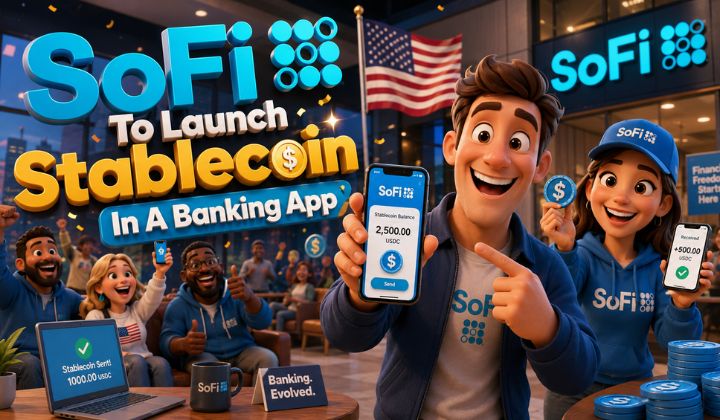
- SoFiUSD is now available to almost 15 million customers, making it the first national bank in the United States to introduce a stablecoin via a retail banking app.
- Redeemable 1:1 for US dollars through SoFi Bank, the dollar-backed stablecoin is based on Ethereum and Solana.
- With this action, SoFi hopes to advance stablecoins beyond DeFi and cryptocurrency trading, focusing on practical applications like B2B and cross-border payments.
- In contrast to crypto-native issuers like USDT and USDC, the company says that its advantage stems from the trust, regulation, and security of a nationally chartered bank.
Could SoFiUSD Push Crypto Into Mainstream Banking? SoFi became the first national bank in the United States to offer a stablecoin directly to retail consumers on a public blockchain when it introduced SoFiUSD, a dollar-backed stablecoin, to users of its banking app.
Almost 15 million users will be able to purchase, sell, hold, and convert SoFiUSD through the SoFi app, the business announced on Wednesday.
The stablecoin can be redeemed 1:1 for US dollars through SoFi Bank and is accessible on Ethereum (ETH) and Solana (SOL). According to SoFi, there is more potential outside of cryptocurrency markets.
The launch represents a bigger push by banks into blockchain-based payments, as politicians and regulators in the United States work to implement stablecoin laws.
Digital tokens with a set value that is typically tied to the dollar are called stablecoins. Crypto-native issuers Tether’s USDT and Circle’s USDC, which are extensively utilized in cryptocurrency trading and decentralized finance, presently control the market.
Say “hi” to SoFiUSD (SoFiD) 👋
The first stablecoin issued by a U.S. national bank and redeemable 1:1 for cash or cash equivalents. Rolling out now, it’s built for how money moves today: fast, flexible, 24/7. pic.twitter.com/I0eHIxDR50
— SoFi (@SoFi) May 27, 2026
Could Stablecoins Finally Transform B2B & Cross-border Payments?
According to a SoFi representative, “stablecoin use in traditional finance is still incredibly small today.” “Stablecoins have historically been used for DeFi and cryptocurrency trading, but not for use cases like B2B or cross-border payments.”
The representative went on to say that as banks enter the market, institutional governance and regulation may become important advantages.
According to the spokesman, “SoFiUSD competes by offering what crypto-native issuers cannot: the trust, security, and oversight that comes with being a nationally chartered bank.”
According to Anthony Noto, CEO of SoFi, the company aims to integrate regulated banking services with blockchain-based payments on a single platform.
Could SoFiUSD Earn Interest?
“People no longer have to choose between regulated banking products and blockchain technology,” Noto said in a statement released in December in conjunction with the introduction of SoFiUSD.
As subscribers upgrade the most recent version of the SoFi app, full availability is anticipated by early June.
Future improvements, according to SoFi, will enable customers to convert SoFiUSD into tokenized deposits that, subject to different account rules, may earn interest and be eligible for FDIC insurance.
Additionally, the company intends to provide cross-border transfers around-the-clock and provide institutional clients with trading access through the cryptocurrency exchange Bullish.
Stay informed with the latest trends in Web3, blockchain innovation, and cybersecurity updates at 3verseTV
You need to login in order to Like
















Leave a comment