

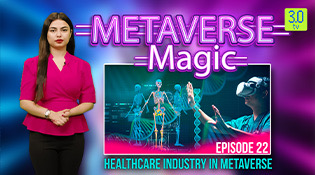
Metaverse To Transform HealthCare Industry
By Vishakha Thakur
Metaverse is all set to bring a revolution in many aspects of life and the healthcare industry is no exception.
Stethoscopes and X-ray machines took some time to become extensively used, but now medical diagnoses cannot be done without them. Similarly, AR/VR technology and devices will be as ubiquitous.
Metaverse implementations transform medical education by providing a realistic environment to learn from experience and apply knowledge. VR-based medical education has been shown to be more effective than traditional techniques while also being safer for students and patients.
For example,Microsoft’s HoloLens software, HoloAnatomy, has the ability to display the human body in an accessible and appealing manner. Students will be able to experience the human body in 3D rather than the typical working style of written descriptions in books.
Similarly, one can explore highly realistic 3D models of bones, organs, tissues, blood vessels and muscles at any angle and significantly improve anatomy understanding. For example, Curiscope, based in the United Kingdom, creates immersive learning experiences in virtual and augmented reality. They have created a Virtuali-tee T-shirt, which allows you to see the inner parts of the human body through realistic holograms.
Doctors and even patients understand that when it comes to surgery, precision is critical. AR can now assist surgeons in becoming more efficient during procedures. AR healthcare apps can help save lives and treat patients effortlessly, whether they are performing a minimally invasive treatment or identifying a tumour in the liver.
For example, Sync AR has developed a software programme by fusing digitally enhanced images directly into the microscope of a surgical device.
SyncAR is a collaboration between the Los Angeles-based health IT innovators Surgical Theater and the Irish medical equipment manufacturer Medtronic. While surgeons normally have to glance up at screens to acquire patient data or enhanced visuals, which adds time and hinders surgical flow, this technology provides access to all of that information in one location.
You need to login in order to Like