


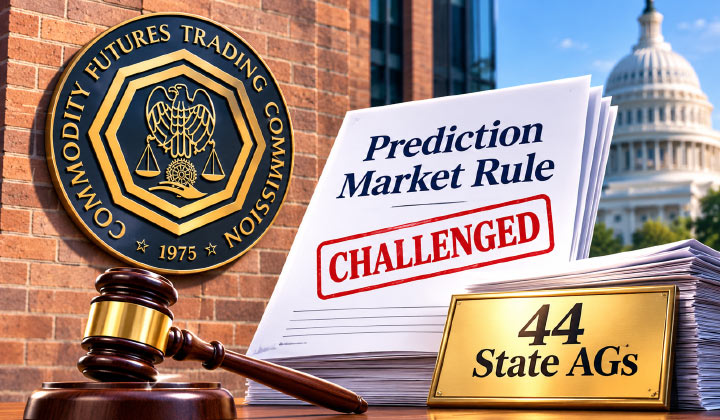
- 44 State Attorneys General (led by Andy Wilson of Ohio) wrote a letter to the CFTC asking them to cancel and re-draft their proposed rules, as they believe that the rules go beyond the authority of the CFTC under the Commodity Exchange Act.
- The states argue the CFTC’s proposal would “drastically expand federal regulatory authority” into gambling a domain states have traditionally controlled.
- A ban on prediction markets in Minnesota has been overturned, allowing Kalshi and Polymarket to operate. However, New York has not banned prediction markets in Kalshi. In contrast, Michigan and Washington have issued rulings to restrict Kalshi’s sports contracts.
- North Carolina has passed legislation recognizing the exclusivity of the CFTC’s authority. Federally registered prediction market platforms will be allowed to operate in North Carolina from 2027, and a 6% tax will be applied to the revenues generated in trading fees from residents in North Carolina.
The 44 State Letter & What It Demands
A group of 44 state attorneys general has submitted a letter commenting on the Commodity Futures Trading Commission’s (CFTC) proposal to amend Rule 40.11. The group was headed by Ohio Attorney General Andy Wilson.
The AGs claim that the CFTC is overstepping its jurisdiction under the Commodity Exchange Act by proposing to set up a formal public interest inquiry into event contracts relating to gaming, war, terrorism, assassination and illegal matters.
THE BLOCK: A coalition of 44 attorneys general is pushing back against the CFTC’s rulemakings on prediction markets, saying that the federal agency does not have the legal power to address consumer harm associated with gambling.
“These actions seek to override states’ longstanding authority to regulate gambling within our borders, which would allow prediction markets to operate without complying with state gambling regulations and safeguards to ensure responsible gaming,” said New Jersey Attorney General Jennifer Davenport, who co-led the effort, in a statement on Friday.
— The Block (@TheBlockCo) November 20, 2026
They say the rule would drastically expand federal regulatory reach into sports betting an area that states have historically governed and urged the CFTC to withdraw the proposal entirely and start from scratch with a more limited scope.
Any product will be checked to see if it qualifies as an event contract, and, if so, whether it is based on a restricted activity. If both criteria are met, a public interest test will be carried out before it can be listed.
Courts At War With Each Other
Contradictory decisions have been made at state and federal levels on regulating prediction markets. A federal judge in Minnesota ruled that the state’s new legislation banning prediction markets is invalid.
As a result, Kalshi and Polymarket can operate as litigation occurs. However, in New York, a federal judge ruled that Kalshi should not be prevented from being prosecuted by the state’s gambling laws.
Finally, in Michigan, a state judge granted Kalshi a temporary restraining order, preventing them from offering contracts on sports related events as it is likely to constitute illegal gambling within the state.
A Washington court similarly blocked Kalshi’s sports contracts. The CFTC has argued in these cases that federally listed derivatives fall under its exclusive jurisdiction under the Commodity Exchange Act and cannot be blocked by conflicting state gambling laws a position the states flatly reject in their letter.
North Carolina’s Alternative Path & The NFL’s Push
However, North Carolina has taken the opposite approach to most states. In July 2026 it passed legislation explicitly granting exclusive federal jurisdiction to the CFTC.
From January 2027, prediction markets which are registered under federal regulation may be offered in North Carolina. However, a 6% tax must be paid on trading fees generated from trading by individuals in North Carolina.
This could be a useful model for states wishing to regulate the economic aspects of prediction markets without getting into legal conflict with federal regulators.
Additionally, the NFL has sent a letter to CFTC Chair Michael Selig requesting additional regulation. It requests that contracts should be limited to prevent manipulation by participants or officials, limit access to material insider knowledge, prohibit margin trading for sports contracts, limit advertising and impose a minimum age of 21 for trading.
Stay informed with the latest trends in Web3, blockchain innovation, and cybersecurity updates at 3verseTV
You need to login in order to Like
















Leave a comment