


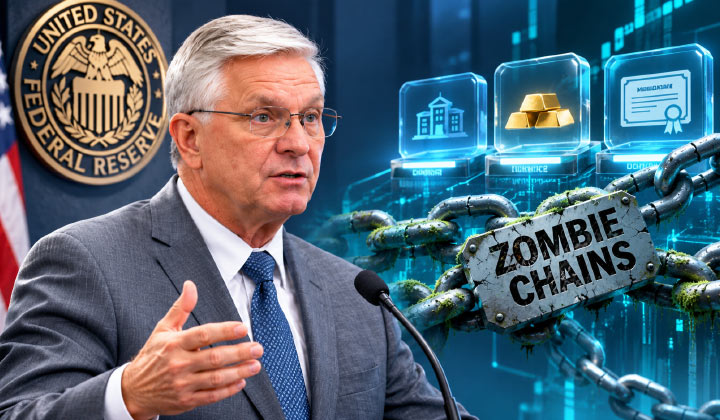
- Federal Reserve Governor Christopher Waller has warned that failed blockchains could leave tokenized financial assets stranded, describing them as “zombie chains.”
- He stressed the need for clear rules, legal protection and common standards as traditional financial assets move onto blockchain networks.
- Waller believes traditional payment systems and central bank money will continue to play an important role even as tokenization and stablecoins expand.
Waller Warns About The Risks Of Failed Blockchains
Waller highlights the potential issues caused by failing blockchain technologies. If a blockchain fails, digital assets may become ‘stuck’ in that chain. In a speech at The Clearing House Annual Conference in New York, Waller outlined key questions around the tokenisation of financial assets including questions around ownership, security and liability.

Source: federalreserve.gov
He stressed that traditional payment infrastructure and central bank money will also be very important within financial markets as blockchains are adopted in the industry.
Tokenization creates digital versions of traditional financial assets (such as equities, debt and commodities). This can increase efficiency and ease asset transfer. However, there are new risks to consider.
If a blockchain fails, and financial assets are stored in that blockchain, who will be responsible for those assets? If there is an error in a transaction through a smart contract, or a user’s private key is lost, what happens? These are issues that financial institutions and regulators will have to consider.
Tokenized Assets Need Clear Rules & Protection
In addition to the technological innovations required, clear governance, regulations and common standards will also be vital, according to Waller. Waller stressed that tokenized financial assets must maintain clear legal identities, ownership rights and value, across multiple blockchains.
🚨NEW: Fed Governor Chris Waller says the bank monopoly in payments is “breaking down” as blockchain and tokenization push traditional finance to compete with new entrants.
In prepared remarks at The Clearing House’s annual conference this morning, Waller said he sees stablecoins, tokenized deposits and traditional payment rails coexisting, with the private sector driving innovation.
But he says scaling tokenization will require clear answers on who’s responsible when things go wrong like lost keys, smart contract exploits and assets stranded on “zombie chains.”
— Eleanor Terrett (@EleanorTerrett) November 17, 2026
If shares are tokenized, they should provide the same rights as before tokenization, as well as any other benefits. Additionally, the same regulatory requirements and liquidity should be maintained.
Growing Number of Blockchains. Many financial institutions and crypto organizations in banks are building new blockchains. Some institutions have set up private blockchains, whereas others are collaborating with industry groups, or working with blockchain companies already in operation. Waller believes that different systems may be created, and that the whole financial market may not move to one common blockchain.
As a result, common standards are even more important, as are robust links between blockchains. Waller also highlighted that there is increasing consumer demand for crypto services in America. A report by the National Cryptocurrency Association in October found that 42% of adults in the U.S. were more likely to bank with a company that offered crypto services. This indicates that traditional banks may see increasing demand to offer services related to digital assets.
Fed Wants Traditional Payment Systems To Remain Important
Despite advances in blockchain technologies, Waller believes that traditional payment systems within the financial system will remain key.
Traditional payment systems have built a level of trust in the market, as they have provided reliable services within different market conditions. They also provide access to central bank money, which is seen as some of the most secure money in the market.
Although central bank money may not be utilized in every transaction, it is important for it to form part of the base of the financial market. Waller also outlined that stable coins, tokenized deposits and tokenized money market funds can be used to facilitate payments using tokenized assets.
For example, if an individual wishes to purchase tokenized shares on a Saturday, they may be able to pay instantly through digital currency, without having to wait for traditional banking services to be available.
This can improve efficiency in settlement processes and reduce the risk of an individual sending an asset without receiving payment for it. However, Waller has expressed caution around using atomic settlement methods in all cases. Within large markets, net and batch settlement methods may still be useful so that good liquidity management can occur.
AI & Tokenization Could Develop Together
Waller has also discussed how tokenization could be combined with artificial intelligence. Waller believes that these two technologies could complement each other as businesses look to implement AI agents which can perform autonomous payments and financial transactions.
However, similar issues exist in terms of trust, security, common standards and whether open or closed networks should be used. Overall, the comments made by Waller clearly indicate that the Fed is not against innovation in the financial industry. However, it is important that reliable payment mechanisms and appropriate precautions are implemented within new systems.
Tokenization may change the way financial assets are issued, traded and settled in financial markets. However, risks within the industry must be addressed first. Risks include failure in networks, lack of clarity in ownership, and poor governance.
Within crypto, Waller’s comments are very significant. They highlight that, in order for tokenized finance to be successful in the future, trust, legal protections and secure financial infrastructure must be prioritized in addition to improvements in efficiency.
Stay informed with the latest trends in Web3, blockchain innovation, and cybersecurity updates at 3verseTV
You need to login in order to Like

















Leave a comment