


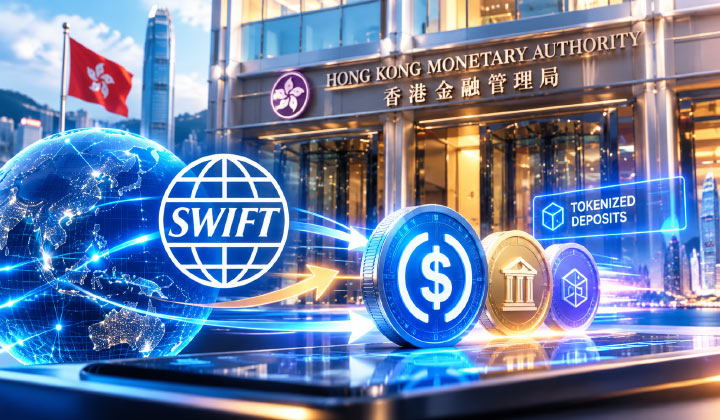
- The Hong Kong Monetary Authority (HKMA) and Swift are working with HSBC, Standard Chartered and Bank of China to test cross-border payments using tokenized deposits in multiple currencies.
- The exploratory project would link Swift’s blockchain-based ledger with Project Ensemble, Hong Kong’s platform for settling tokenized assets and deposits.
- Tokenized deposits represent money held in bank accounts, so lenders can offer blockchain-style payment speed without giving up their deposit relationships.
- The work builds on CBDC interoperability trials that Hong Kong and Swift began in 2023.
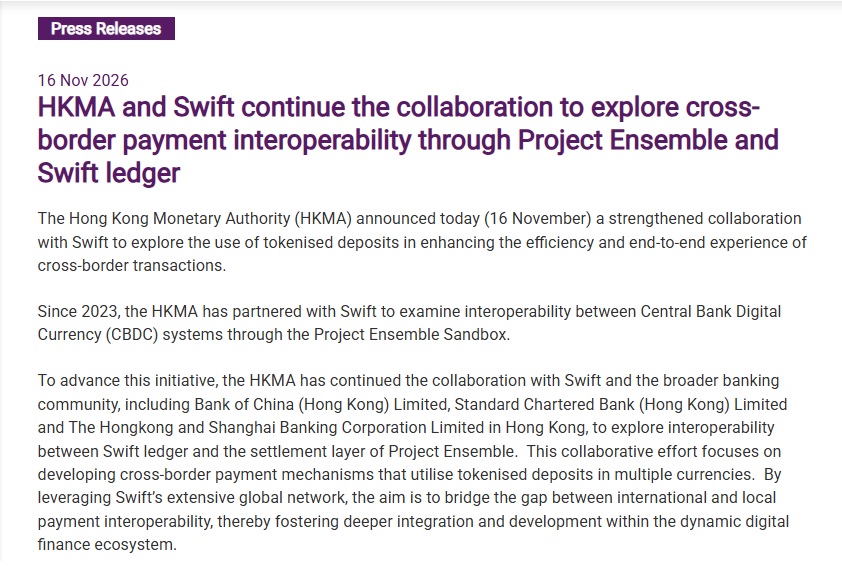
Hong Kong’s central bank and Swift are joining forces with three major banks to trial cross-border payments using tokenized deposits in multiple currencies.
The HKMA said on Monday that HSBC, Standard Chartered and Bank of China are taking part in efforts to connect Swift’s blockchain-based ledger with Project Ensemble.
Source: hkma.gov.hk
If it works, banks could move money across borders at any hour, a feature that has helped stablecoins gain ground in global payments. The project remains exploratory.
Hong Kong & Swift Bring Banks Together
This new project, in partnership with the central bank in Hong Kong and Swift, means that cross-border payments can be made much faster. This can be done at any point in time, meaning not just on business days.
The partners in the project are HSBC, Standard Chartered and Bank of China. The project links Swift’s blockchain ledger with a system in Hong Kong called Project Ensemble. This project means banks can make fast payments like with stablecoins but keep payments within regulated bank systems.
On the 16th November, this new initiative was announced by the Hong Kong Monetary Authority (HKMA). It is part of a push by financial institutions to improve cross-border payments.
Swift is a global messaging platform, connecting over 11,500 financial institutions. It allows banks to complete cross-border payments with ease. This new project aims to see how the blockchain system can link with the financial systems in Hong Kong.
Since 2023, the two organizations have been working in collaboration. This project takes that collaboration further, so that commercial payments can occur.
How Tokenized Deposits Differ From Stablecoins
Differences between tokenized deposits and stablecoins although tokenized deposits seem very similar to stablecoins, they are very different when comparing how they work.
Stablecoins (such as USDC) are issued by private companies and generally maintain a stable price relative to a currency, such as USD. Tokenized deposits are just regular deposits, held within your bank account, however they are recorded on a blockchain.
Traditional banks want to be able to make fast digital payments, while maintaining control of customer deposits and banking relationships.
“Stablecoins have shown that cross-border payments can be made at any time. Now banks want to be able to get the same speed in payments through tokenized deposits (potentially central bank digital currencies)”, said Wish Wu, CEO of blockchain network Pharos.
“This project will look into how tokenized deposits can allow continuous cross-border payments”, said Howard Lee, Deputy Chief Executive at the HKMA.
Banks Increase Their Focus On Blockchain Payments
Banks increasingly using blockchain payment systems. This project in Hong Kong is part of a wider trend in banking to create payment systems based around blockchains.
On the 16th November, JPMorgan and DBS announced they had linked their blockchain deposit systems, allowing approved customers to make continuous transfers of tokenized USD between Singapore and the US.
In Singapore and Germany, a trial was successfully completed. The trial used central bank digital currencies to allow conversions between Euros and Singapore Dollars. The system ensured that neither bank would send out currency unless they received the other currency from the other bank.
An experiment was also carried out between the central banks of the UK, Singapore and Thailand. This showed how traditional payment systems and blockchain payment systems can work together with currencies.
This shows that banks in general are not looking to replace stablecoin payment systems but are experimenting with their own digital payment systems to compete with the quick and continuous payments offered by crypto-based payment systems.
At present, this project is still in the experimental phase. Whether this project is successful depends heavily on how easily different banking systems and block chains can communicate. If this communication works well, tokenized deposits could be a key feature of future international banking.
Stay informed with the latest trends in Web3, blockchain innovation, and cybersecurity updates at 3verseTV
You need to login in order to Like

















Leave a comment