


- The US Commodity Futures Trading Commission (CFTC) will hold an industry roundtable on December 15 to examine the possibility of round-the-clock derivatives trading.
- The discussions will explore how tokenization, stablecoins and blockchain technology could support continuous clearing and payments.
- The regulator will also examine risks involving weekend liquidity, market manipulation, cybersecurity and the technology needed to operate markets throughout the day.
CFTC Plans Discussion On 24/7 Trading
The US Commodity Futures Trading Commission (CFTC) is hosting a round-table discussion on 15 December to consider how tokenization, stablecoins and blockchain technology could facilitate continuous trading for derivatives.
@CFTC Announces Agenda for December Roundtable on 24/7 Trading: https://t.co/0p1CFj1dII
— CFTC (@CFTC) November 17, 2026
However, it is not clear yet whether 24/7 trading will be implemented across derivatives markets. The discussion, hosted with industry members, will also consider risks associated with continuous trading, such as liquidity over weekends, market manipulation and cyber security threats.
Source: cftc.gov
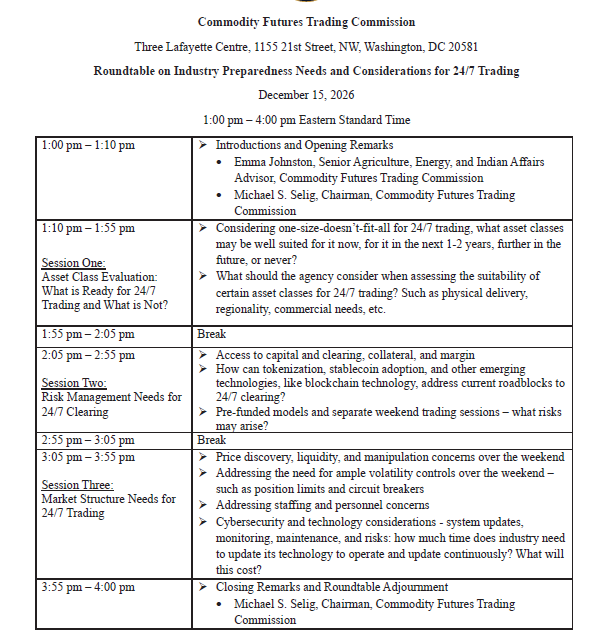
The agenda was published on 17 November. The meeting will take place at the CFTC’s headquarters in Washington D.C from 1pm to 4pm (Eastern Time).
The first part of the discussion will consider which products would be suitable for continuous trading. It will look at whether products in a particular asset class could be traded continuously immediately, within the next one to two years, or at a later date. It will consider variations in market requirements. Physical products may differ to digital financial instruments.
Stablecoins & Tokenization Could Support Continuous Clearing
A key point of discussion will be how blockchain technology, tokenization and stablecoins could overcome challenges currently preventing continuous clearing.
Traditionally, financial markets rely on banking systems which operate only during regular business hours. As a result, settling trades may be delayed over the weekend.
However, tokenization and stablecoins may provide an alternative solution. Blockchain systems can be operated 24/7, meaning that financial institutions may be able to move money and make trades outside of normal banking hours. However, risks will also be considered, including pre-funding requirements in clearing systems and separate trading over the weekend.
Although stablecoins are being discussed, it is unclear from the agenda whether they will become a standard form of payment. It is still to be considered by the industry.
Weekend Liquidity & Market Safety Remain Important
The last part of discussion will consider issues presented by continuous trading in financial markets. A key issue is liquidity. If fewer traders are present over the weekend, price discovery may be impacted. Markets may therefore be more volatile.
Market manipulation, and measures to reduce this risk, such as position limits and circuit-breakers, will also be discussed. Security and technological preparedness will be key considerations. To ensure trading can happen safely without regular market close-downs, more personnel may be required, and systems must constantly be monitored and regularly updated.
“We seek to better understand the impact of 24/7 trading on various financial products and business models. We aim to promote innovation in this area, but want to consider the particular requirements of different markets,” said CFTC Chairman Michael S. Selig.
From the outset of my chairmanship, I have been clear that the @CFTC will promote innovation in our derivatives markets in a manner attentive to the nuances of these markets and the varied asset classes that underpin them.
I look forward to hearing directly from industry stakeholders on the ways 24/7 trading would impact their respective business models to ensure the Commission is appropriately tailoring its regulatory regime for all market participants.
— Mike Selig (@ChairmanSelig) November 17, 2026
This follows previous work from the CFTC. In May, CFTC staff issued an advisory to registered exchanges, clearing organizations and futures commission merchants, requesting that they consult the CFTC before increasing trading and clearing hours. The meeting will be open to the public and will be live streamed on the CFTC’s website.
For the crypto industry, this discussion is important as stablecoins and tokenised products could be used as infrastructure to enable future financial markets. However, for them to be widely adopted, they must be able to meet security, liquidity and regulatory requirements set in traditional financial institutions.
Stay informed with the latest trends in Web3, blockchain innovation, and cybersecurity updates at 3verseTV
You need to login in order to Like

















Leave a comment