


- The World Bank Group has partnered with Circle and Citi to explore the use of USDC stablecoins for faster and cheaper international development payments.
- Circle will provide the infrastructure for issuing and settling USDC, while Citi will connect the transactions to traditional banking networks.
- The initiative is still in the testing and exploration stage, with the first phase limited to countries where digital assets are legally permitted.
World Bank Group partners with Circle and Citi to improve efficiency in international development payments using USDC. The World Bank Group has partnered with Circle and Citi with a view to improve efficiency in international development payments using USDC.
The pilot, announced on 17th November 2026, will investigate whether stablecoins pegged to the US dollar can improve the distribution of development funding internationally.
Circle and Citi will respectively provide USDC issuance and settlement infrastructure and link the transactions to traditional banking. At present, however, this pilot is still in early investigations and does not indicate that all payments made by the World Bank Group will be conducted via stablecoins.
World Bank Pilot To Bridge Digital Assets & Banking
This pilot project will create a system which enables seamless payments between digital assets and traditional banking. Initially, it will only be available in borrowing countries which support digital assets and have legal permission to do so. Further banks may be added to the network at a later date.
Source: worldbank.org
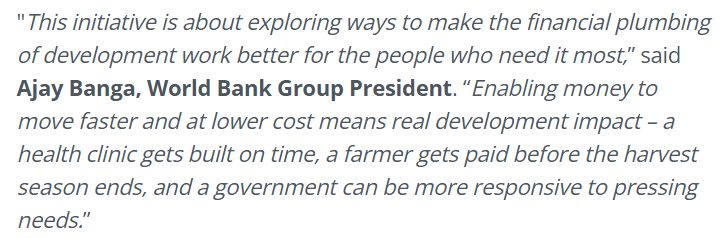
Ajay Banga, President of the World Bank Group said: “This project will aim to improve financial systems supporting development. By improving the speed and reducing costs of international payments, we can help ensure timely funding for critical developments such as healthcare and agriculture.”
Circle & Citi To Power Stablecoin Payment Network
Collaboration between Circle and Citi will enable this project. USDC (second largest in terms of market value) will be issued and settled by Circle. As it is pegged to the USD, it aims to be valued very closely to $1. This means it can be valuable for making payments, as it avoids the volatility associated with cryptocurrencies like Bitcoin.
Transactions will be linked to international banking via Citi. Citi operates in over 180 jurisdictions meaning this project can access a wide variety of financial markets.
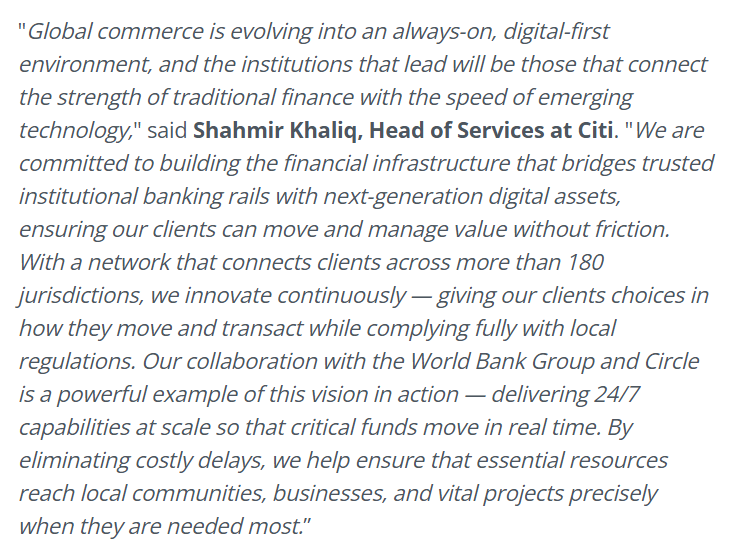
Shahmir Khaliq, head of services at Citi, has said that this collaboration will enable 24/7 payments, with critical funds being transferred in real-time. It is also important to combine reliable traditional banking platforms with new digital assets.
Today, the @WorldBankGroup announced work with @circle and @Citi to bring the benefits of USDC to global funds distribution. A big step towards a more efficient and inclusive financial system.
https://t.co/hq436tA5IR— Jeremy Allaire (@jerallaire) November 17, 2026
Jeremy Allaire, CEO of Circle, said “Fast digital currency payments should be accessible to everyone, not just large banks and corporates. It is great to see organisations like World Bank Group exploring the responsible use of stablecoins.”
FundsChain Platform To Anchor Faster Cross-border Payments
This new project will be built upon the World Bank’s current blockchain platform, FundsChain. The platform is currently used to monitor the flow of funds into development projects in emerging economies.
Over 350 projects in 96 countries are in this system, meaning fund allocation within projects can be viewed by various stakeholders and improves transparency.
With tighter budgets at development institutions, and increasing financial demands, improving payment processes may become increasingly significant. Traditional international payments can take several days to complete due to going through various intermediary banks. Fees may also be charged by each of these banks.
Payments using stablecoins could save time and money. However, the challenge will be ensuring that the payments comply with banking and regulations in different countries.
Major Banks Deepen Their Stablecoin & Crypto Push
This partnership shows that traditional financial institutions are becoming increasingly interested in digital assets. A consortium of major banks (Goldman Sachs, Citi, Santander and Deutsche Bank) have invested approximately $270 million into a collaborative stablecoin project. Recently, Deutsche Bank has also moved into crypto custody.
For Circle, partnering with World Bank Group could be an important step in gaining greater institutional acceptance for USDC. However, for World Bank Group, the key question is whether stablecoins can be used efficiently in international development payments, without compromising security and regulation.
This project may be significant in providing an example of how traditional banking and blockchain can collaborate to improve cross-border money flows.
Stay informed with the latest trends in Web3, blockchain innovation, and cybersecurity updates at 3verseTV
You need to login in order to Like

















Leave a comment