


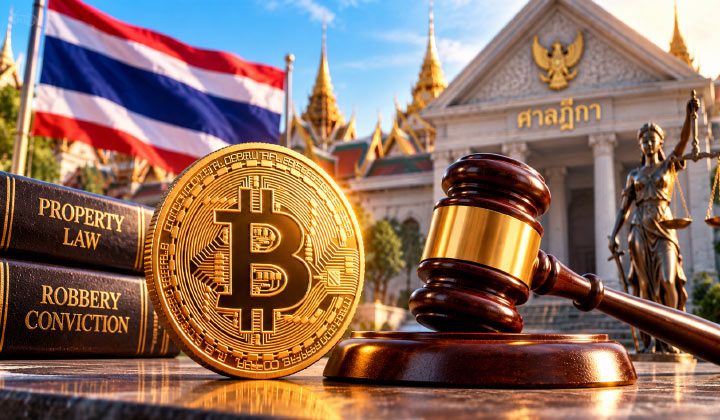
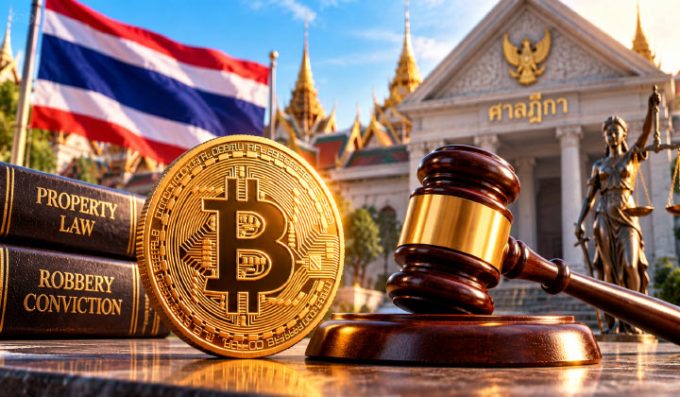
- Cryptocurrency has been declared property under the Thai criminal code and can therefore be the subject of robbery according to judgment number 4929/2569 by Thailand’s Supreme Court.
- The court agreed with the conviction and sentenced the accused to 10 years imprisonment. The accused was also ordered to return 2.480801 BTC to the victim or pay the equivalent value of 1,878,000 baht.
- This was an en banc plenary decision which means it is binding on all lower courts in Thailand.
- The decision concerns victim protection under criminal law, not trading rules or market oversight.
Thailand’s Supreme Court has ruled that cryptocurrency is a form of property under Thailand’s criminal code, after a defendant denied being able to rob someone of their Bitcoin. The court upheld a 10-year sentence for the defendant’s part in a 2022 robbery where the victim was forced to purchase 2.480801 BTC, worth around $50,000 at the time.
🇹🇭 Thailand’s supreme court rules Bitcoin as legal property.
• Clearer status for contracts and disputes.
• Crypto has been regulated since May 2018.
• 0% capital gains unchanged, valid until 2028. https://t.co/gKpzbgn5Rq
— Bitcoin Archive (@BitcoinArchive) October 28, 2026
The Robbery Behind the Case
According to Siam Blockchain’s reporting, the case dates to September 2022. Defendant Mr. A borrowed a van from an owner of a car rental company in Chonburi Province. He then took two other men and travelled to Koh Samui. They checked into a resort and rented motorbikes.
🇹🇭 THAILAND’S SUPREME COURT RULES BITCOIN CAN BE STOLEN PROPERTY
Thailand’s Supreme Court upheld a robbery conviction over Bitcoin a tourist was forced to hand over on Koh Samui, ruling that the coins count as property under the country’s Civil and Commercial Code.
The victim was beaten and made to buy 2.480801 BTC, then worth about $50,000, and send it to the gang’s wallet in September 2022. The defendant’s 10-year sentence stands, along with an order to return the Bitcoin or pay its value.
The full court said Bitcoin has a market value, can be turned into cash and can be held. It also said Bitcoin isn’t legal tender, citing the Bank of Thailand.
The ruling was published Oct. 28 and binds lower courts in future cases.
— Bitcoin News (@BitcoinNewsCom) October 28, 2026
On 15 September 2022, the 5 men approached a foreign victim and his Russian wife at a café. They threatened them, punched the victim on the face and ears and took his phone. They then forced him to purchase 2.480801 BTC (approximately 1,878,000 baht) using his phone and sent it to a wallet owned by another gang member. The defendant allegedly arranged the group’s escape ferry tickets.
How the Court Reached Its Decision
The trial court convicted him of joint robbery using a vehicle and sentenced him to 15 years. The term was cut to 10 for cooperation under Section 78 of the Criminal Code. On appeal, he argued that crypto has no intrinsic value once transferred and so cannot be “property” belonging to someone else.
The Supreme Court disagreed. Under Section 138 of Thailand’s Civil and Commercial Code, property includes intangible objects that can have value and be acquired. The court noted that the 2018 Digital Asset Business Decree treats cryptocurrency as an electronic data unit used as a medium of exchange, regulated by the Securities and Exchange Commission.
It acknowledged the Bank of Thailand’s position that crypto is not legal tender and that prices are volatile. Even so, it found crypto has a checkable market value, can be converted to cash when a buyer exists, and can be held by ordinary people.
Binding Precedent for Thai Courts
The court found the testimony of the victim, his wife and café witnesses consistent and credible. It upheld the finding that the defendant was a joint principal in an organised operation.
Because the ruling comes from the court’s en banc plenary, lower Thai courts must follow it in similar cases. It closes off the defence that digital assets cannot be stolen, robbed or extorted. Courts elsewhere, including in the UK, have also confirmed Bitcoin’s property status in civil cases. The ruling is not expected to move Bitcoin’s price.
Other Jurisdictions Reach Similar Conclusions
In South Korea, the Supreme Court ruled on December 11, 2025, that Bitcoin held on exchanges such as Upbit and Bithumb can be seized. It reasoned that holders keep practical control through their private keys.
The Madras High Court in India ruled on October 25, 2025, that crypto can be regarded as property which can be put into a trust. The case was centred around a user of an Indian crypto-exchange called WazirX who had their XRP wallet frozen after a cyber-attack and restructuring at the parent company.
Russia’s State Duma approved legislation in second and third reading on July 21, 2026, which will see crypto recognised as “legal property”. However, it will still prohibit their use in local payments.
Stay informed with the latest trends in Web3, blockchain innovation, and cybersecurity updates at 3verseTV
You need to login in order to Like















Leave a comment