


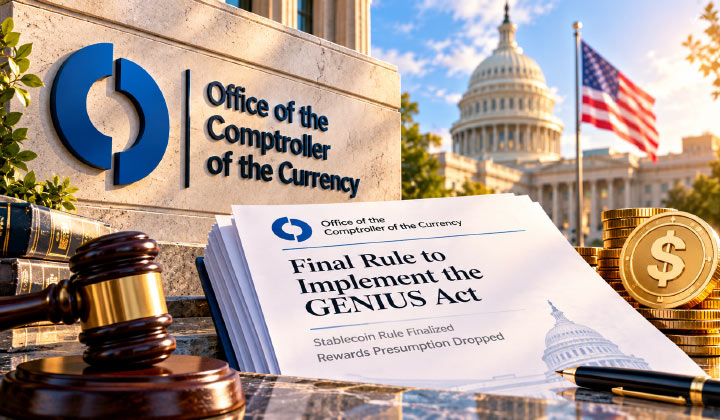
The US Office of the Comptroller of the Currency (OCC) has adopted its first final rule under the GENIUS Act, a law that creates federal standards for stablecoins. The new rules will take effect on January 18, 2027, and will address reserves of stablecoins, customer redemptions, risk management and custodial activities.
.@USComptroller Jonathan V. Gould: Today’s final rule advances @POTUS Trump’s and @SecScottBessent’s vision for American leadership in digital assets. We are providing a clear, practical framework for payment stablecoin innovation, with strong standards for reserve backing, redemption, and risk management. The OCC is drawing on its longstanding supervisory expertise to support responsible growth and innovation for this new industry. https://t.co/IWuIHnQQ0f
— OCC (@USOCC) October 21, 2026
In addition, the final rule rescinds the proposed rule on safe harbor regarding third-party rewards for stablecoins. This means that instead of being presumed unlawful, such programs will be evaluated on a case-by-case basis to determine whether they violate the law.
The new rules clarify that payment stablecoins in the US, which have the value of a currency, should be subject to a regulatory framework. Specifically, the GENIUS Act of 2025 will apply to national banks, state-licensed entities, eligible foreign issuers and firms seeking to become a federally-licensed payment stablecoin issuer.
At the @USOCC, we have worked diligently and expeditiously to deliver the GENIUS Act final rule ahead of schedule to support President Trump’s vision and @SecScottBessent’s leadership to grow the economy and lead the global digital currency revolution.
Today marks the birth of a new industry having a federal framework for payment stablecoins in the digital age. It also brings us back to our original mission when the OCC was charged with the responsibility for organizing and administering a system of nationally chartered banks and a uniform national currency.
— Comptroller Jonathan V. Gould (@USComptroller) October 21, 2026
The new standards require that any issuing entity maintain appropriate reserves to support the stablecoins and allow redemptions of the coins by customers. Additionally, they require that they meet standards in relation to risk, audit and reporting. The oversight of complying with the rules falls on the OCC, which will review and examine entities that become eligible to participate in the program. Moreover, securitization by a special purpose vehicle will be covered by the framework.
The most notable rule relates to rewards in the context of stablecoins. The new law explicitly prohibits any federal payment stablecoin issuer from paying interest or providing any other reward for holding their coins.
Meanwhile, the proposed rule from the OCC, which was in force before the adoption of the final regulations, provided that similar third-party reward programs would be considered unlawful by default, regardless of whether they violated the law.
The new rules no longer apply, which gives more flexibility to exchanges and other platforms to offer rewards, but not explicitly allow it either. The two options are now being considered on a case-by-case basis. However, it should be borne in mind that in either case, older reward programs will not be approved.
The OCC received over 328 comments from cryptocurrency companies, banks, industry groups, academia, and others. Regarding the new rules, it appears that the opinions of market participants were divided regarding the appropriateness of applying restrictions to third-party rewards.
The new rules also bring more flexibility to the management of reserve assets, while at the same time maintaining key restrictions. The new rules create a framework within which special purpose vehicles (SPVs) can operate.
However, the requirements related to anti-money laundering and customer due diligence, as well as the imposition of sanctions, will be implemented by the Treasury and other bodies through separate regulations.
Finally, the new law adopts recommendations that require companies to apply for permission to be a payment stablecoin issuer in the US, under the new rules, by January 2027. If an organization has submitted a complete request for eligibility for a SPV before this time, it can request an exception from the OCC.
The approval of the new rules marks the beginning of the end of the proceedings relating to the adoption of the GENIUS law. The process of drawing up regulations is now expected to start in other US regulators. For the companies that operate in the stablecoin space and the banks that buy them, the next stage will be the initiation of the application process, as well as decisions regarding the application of rules to individual rewards.
Stay informed with the latest trends in Web3, blockchain innovation, and cybersecurity updates at 3verseTV
You need to login in order to Like

















Leave a comment