


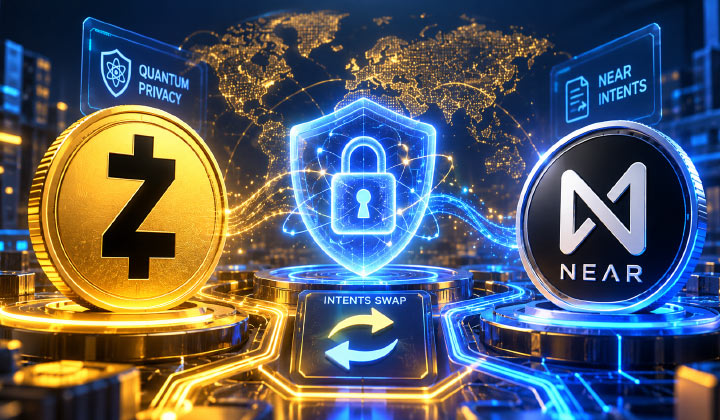
Zcash infrastructure developer Zakura has proposed a new security feature to protect users’ transaction privacy from possible future quantum computer attacks. The proposal would give every ZEC swap through NEAR Intents a separate incoming viewing key, making it harder for an attacker to uncover a user’s wider payment history from one publicly exposed address.
The feature would not change the wallet’s spending key, which controls the funds. Zakura says wallets built with its open-source software libraries could begin adding the feature in the coming weeks.
If your Zcash wallet uses NEAR Intents, each swap you make adds your shielded address to a public ledger. A quantum computer could use this to link all your payments that share the same key.
In Vizor, each swap will get its own key to prevent this.
https://t.co/csxjUwcOTz
— Adam 🇺🇸 (@adamleetucker17) October 18, 2026
NEAR Intents allows users to exchange digital assets across different blockchains without having to manage every step themselves. However, Zakura says the service can permanently publish certain Zcash addresses on NEAR’s public blockchain. These addresses may remain visible even when a swap succeeds and no refund is needed.
Zcash normally allows users to make private transactions through shielded addresses. Although several addresses may look unrelated to outside observers, they can share an incoming viewing key. This key allows a wallet to identify and read payments received by the account.
How we’re making Zcash quantum unlinkable through the use of one-time IVKs!
In this video, I talk about how sharing your shielded address opens you up to a specific quantum attack, and how we solved this linkage for a common feature you probably exposed yourself to already. https://t.co/VubhDsXy10
— Adam 🇺🇸 (@adamleetucker17) October 18, 2026
Zakura developer Adam Tucker warned that a powerful enough quantum computer could one day use public information from an exposed address to recover the shared viewing key. An attacker could then identify payments received by the account, including their amounts and private memos.
This would be a threat to privacy, but not necessarily to the funds themselves. Zcash uses separate keys to authorize spending. Recovering an incoming viewing key would not, by itself, allow an attacker to transfer the user’s ZEC.
The proposed solution is to create a different incoming viewing key for each swap. This would limit the information exposed if one address were compromised. The wallet’s original spending key would remain unchanged, so users could continue to control their funds through the normal process.
Post-quantum unlinkable swaps for Zcash, no network upgrades required.
https://t.co/hzBkdo1AHJ
— Zakura (@ZakuraZcash) October 18, 2026
Zakura says creating a completely separate wallet account for every swap could offer similar privacy benefits, but it may cause problems for some hardware wallets. Its proposed method aims to provide better separation without forcing users to manage many different accounts.
The team is also considering how to make wallet recovery practical. If every swap has its own viewing key, restoring a wallet could become slower because the software might need to check many keys against blockchain transactions. Zakura has proposed using a technique called private information retrieval to find relevant transactions without revealing a user’s addresses to the database operator.
The proposal comes as crypto developers pay more attention to possible quantum computing risks. Researchers are exploring ways to protect blockchain systems against future attacks, but no publicly demonstrated quantum computer can currently recover the elliptic-curve keys used by Zcash.
Zakura has not announced a confirmed release date for the new feature. The proposed one-time viewing keys would address transaction privacy, while other planned upgrades would focus on protecting the keys that authorize spending. Both areas may become important as blockchain developers prepare for advances in quantum computing.
Stay informed with the latest trends in Web3, blockchain innovation, and cybersecurity updates at 3verseTV
You need to login in order to Like
















Leave a comment