



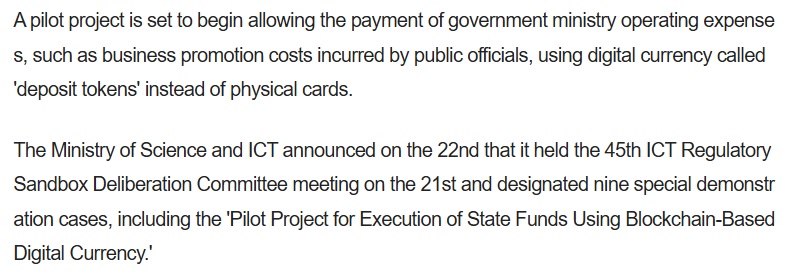
South Korea is preparing to test blockchain-based deposit tokens for government payments, allowing public officials to make certain work-related purchases using smartphones and QR codes instead of physical government cards.
The pilot was approved on September 21 and announced on September 22 by the Ministry of Science and ICT under the country’s regulatory sandbox programme. Six banks will participate: KB Kookmin, NH NongHyup, Shinhan, Woori, IBK Industrial Bank of Korea and Hana Bank. The project is one of nine special demonstration cases approved by the ministry’s 45th ICT Regulatory Sandbox Deliberation Committee.
Source: chosun.com
Under the pilot, officials will be able to scan a QR code with a smartphone and make an approved payment using a deposit token. The transaction will then be recorded through a blockchain-based system.
The deposit tokens are part of Project Hangang, a digital-currency payment project being tested by the Bank of Korea together with commercial banks. Participating commercial banks issue the deposit tokens, while the Bank of Korea’s central bank digital currency, or CBDC, is used when banks settle transactions with one another.
This means the government-payment pilot does not involve officials directly receiving or spending CBDC issued by the central bank. Instead, the payment instrument is a deposit token issued by a participating commercial bank and linked to bank deposits.
The pilot is also intended to work within existing restrictions on government operating expenses. Such spending has generally been handled through government purchase cards or bank transfers under the National Treasury Management Act. The regulatory sandbox provides an exception under which the new payment method can be tested.
The system will include controls over how the money can be spent. Certain goods, services or business sectors that are not permitted for government expenses can be blocked before the tokens are used. This could prevent an official from making a payment that falls outside approved spending categories.
Blockchain technology will also be used to record and settle transactions. According to the ministry, this could allow payment and settlement to happen together and make it easier to track how government funds are used.
The ministry expects the system could also benefit small businesses. It says eligible merchants could face lower payment fees and receive funds immediately after qualifying transactions. Blockchain records could also make government spending easier to verify.
The pilot comes as South Korea continues to debate the wider use of digital currencies. On September 13, People Power Party leader Jang Dong-hyuk raised concerns about introducing a CBDC without stronger legal and institutional safeguards, including questions about transaction privacy and the potential use of digital money to influence how funds are spent.
Project Hangang has a different structure from a retail CBDC system. Consumers using the project’s deposit tokens hold digital representations of commercial-bank deposits, while the central bank’s digital currency is used for settlement between banks.
The government-payment trial now gives the same type of deposit-token infrastructure another use case. Rather than replacing traditional government cards immediately, the pilot will test whether blockchain-based bank deposits can work for selected public expenses.
The results could provide another piece of evidence for South Korea as it considers how deposit tokens, CBDCs and blockchain-based payments might fit into its financial system.
Stay informed with the latest trends in Web3, blockchain innovation, and cybersecurity updates at 3verseTV
You need to login in order to Like
















Leave a comment