



Bolivia has pledged to construct a formal regulatory and supervisory structure for cryptocurrencies as part of its larger economic reform package agreed with the International Monetary Fund, a global lender that provides financial support and policy guidance to member countries facing economic distress.
The assurance, laid out in a Memorandum of Economic and Financial Policies dated September 10 and issued by Bolivia’s Ministry of Economy and Public Finance, ties digital asset supervision directly to the government’s push to curb illegitimate capital leaving the country through crypto markets.
The plan sits together with parallel reforms touching monetary policy, foreign exchange systems, pension risk, and anti-money laundering controls, all forming part of a 36-month Extended Fund Facility program Bolivian officials negotiated with IMF staff back in July.
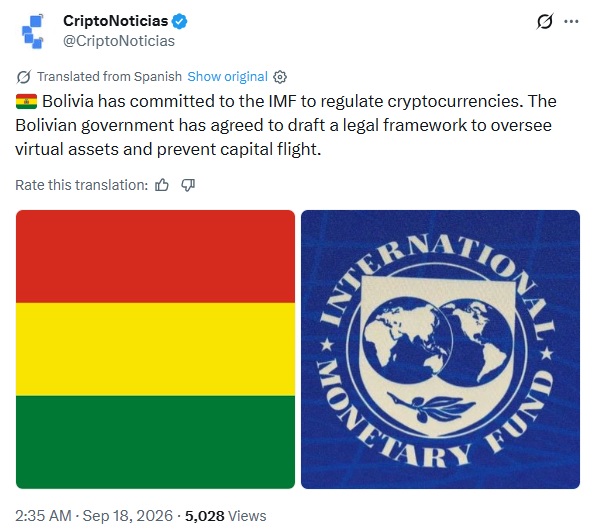
Source: x.com
Bolivia Crypto Regulation Targets Capital Outflows
Per the memorandum, authorities intend to tighten oversight of virtual assets in tandem with broader changes to the country’s monetary and exchange rate systems. The government has framed this crypto framework as a tool for preventing inadequate capital flight through digital asset channels while consecutively reinforcing overall financial stability.
What is notably missing, however, are details, as the document does not specify licensing requirements, reporting obligations or rules for crypto exchanges and other service providers. Nor have the officials stated whether the next framework would come in the form of a new law, an executive decree or through regulations, or who would be the main regulator over virtual assets.
These pledges come as Bolivia grapples with what government officials have called the most severe financial crisis in the country since the 1980s, exacerbated by a growing strain on public finances and access to hard currency.
USDT Use Has Grown During Bolivia’s Dollar Shortage
Crypto adoption in Bolivia has enhanced as the country continues facing a persistent shortage of U.S. dollars and growing strain on its foreign currency reserves. Tether’s USDT stablecoin has become especially prominent, with residents and businesses increasingly turning to it as a dollar-denominated alternative when predictable currency access grows difficult.
Tether CEO Paolo Ardoino noted in August that stablecoin usage has been climbing in Bolivia alongside several other economies experiencing similar monetary instability. Bolivia’s central bank has responded by issuing a reference USDT exchange rate imitative from weighted peer-to-peer trading activity on Binance, while Chainalysis data cited in earlier reporting estimated the country recorded roughly $14.8 billion in crypto activity between July 2022 and June 2025.
Bolivian officials have also been weighing a more formal role for the stablecoin, evaluating proposals that would let USDT function within the national payment system alongside the boliviano and U.S. dollar, with domestic lenders Banco Unión and Banco FIE already offering stablecoin-linked services. State-level crypto participation predates this payment discussion too: back in March 2025, state-owned energy company YPFB received government authorization to use crypto for fuel imports as dollar shortages complex traditional payment methods.
Capital Controls Face Pressure From Stablecoins
Bolivia’s concerns around capital movement echo a broader pattern international financial institutions have been investigative, specifically how dollar-backed stablecoins interact with foreign exchange restrictions across initial economies.
Research from the Bank for International Settlements, examining flows across more than 130 economies, found that stablecoin inflows showed little compassion to conventional capital controls, with growing usage focused in countries facing inflation, currency weakness, or limited access to foreign exchange, largely because stablecoins move through blockchain networks rather than traditional banking channels.
The IMF separately warned in August that locally issued stablecoins could make access to digital dollars even easier if users can freely convert between domestic tokens and dollar-backed assets onchain, noting that nearly 99% of all stablecoins in circulation remain denominated in U.S. dollars.
For Bolivia precisely, the planned virtual asset framework sits alongside its foreign exchange and financial supervision commitments, though the government hasn’t clarified whether future crypto rules will restrict stablecoin transactions, cap conversions, or present transfer reporting requirements.
Bolivia Faces FATF Monitoring Over Financial Controls
Anti-money laundering reform epitomizes another core piece of Bolivia’s financial sector commitments under the IMF program. The country currently remains under increased monitoring by the Financial Action Task Force, an international body that sets global standards for combating money laundering and terrorism financing, commonly mentioned to as the FATF grey list.
Bolivia made a high-level political commitment back in June 2025 to work alongside FATF and its Latin American counterpart to address gaps in its anti-money laundering and counter-terrorism financing systems.
FATF’s June 2026 review recognized progress but flagged several uncompleted measures, calling on authorities to strengthen risk-based supervision across chosen non-financial sectors, enforce penalties for beneficial ownership violations, and increase money laundering investigations and prosecutions proportional to the country’s risk profile.
FATF’s broader standards specifically require member countries to identify and address money laundering and terrorism financing risks tied to virtual assets, and Bolivia’s communication reflects that expectation by calling for improved helpfulness of its anti-money laundering system alongside strengthened oversight of digital assets. As of now, the government has yet to publish the institutional structure, legislative pathway, or application timeline for its planned crypto regulatory framework.
Stay informed with the latest trends in Web3, blockchain innovation, and cybersecurity updates at 3verseTV
You need to login in order to Like















Leave a comment