


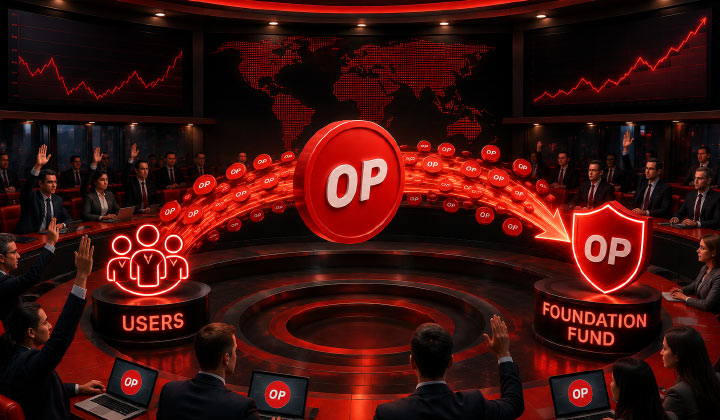
An Optimism-funded core development team cast a decisive vote that helped move 546.9 million OP tokens, worth about $49.7 million, away from a user airdrop allocation and into a Strategic Ecosystem Fund controlled by the Optimism Foundation. The proposal passed after the team known as Test in Prod voted 8.486 million OP in favour with just minutes left in the ballot. The idea would not have gotten enough support to succeed without that vote.
The ruling has sparked a discussion over how decentralized Optimism’s governance actually is and how much control ecosystem-funded organizations should have over significant token-allocation choices.
The approved proposal redesignates 546.9 million OP, equivalent to 12.7% of the token’s total supply, from the user airdrop allocation to a new Strategic Ecosystem Fund. The Foundation says the money can be used to support adoption and growth of OP Mainnet and Optimism’s enterprise business.
The final vote ended with about 17.974 million OP in favour and 10.931 million against. But the result looked very different shortly before voting closed.
With 16 minutes and 52 seconds remaining, Test in Prod cast its 8.486 million OP vote in favour. A likely rejection was essentially turned into an approval when the approval rate increased from 45.77% to 61.84%. Final support would have been about 46.47% in the absence of that stance.
Test in Prod is described as a core development team of the Optimism Collective. The team has also said it is fully funded by the Collective and has held a seat on the Optimism Security Council.
That relationship has become central to the criticism surrounding the vote. Opponents argue that a team receiving funding from the Optimism ecosystem should not have such a decisive role in a vote that moves a large amount of money into a Foundation-controlled fund.
The Optimism Foundation has defended the proposal by arguing that the remaining user airdrop allocation no longer fits the network’s current strategy. Optimism is increasingly targeting institutional and enterprise adoption, and the Foundation believes the tokens could be more useful for partnerships, incentives and business deals.
Critics, however, have questioned the lack of detailed controls over how the new fund will be spent. Ethereum scaling research platform L2BEAT raised concerns about the Foundation’s broad authority, the unclear connection between spending and tokenholder value, and the absence of a detailed review of earlier partnership spending.
Test in Prod argued that Optimism needs to move quickly because enterprise competition is expensive and opportunities may not remain open indefinitely. The team also supported reporting on aggregate spending and outcomes after the fund is used.
The controversy highlights a familiar challenge for decentralised organisations. Token-based voting can make decisions transparent, but voting power is not necessarily distributed equally. A relatively small number of large holders or organised teams can sometimes have an outsized influence.
In this case, one large vote changed the outcome of a proposal involving nearly $50 million worth of tokens.
For OP holders, the decision means that tokens originally intended for future user airdrops will instead be available for ecosystem development under the Foundation. For Optimism itself, the vote represents a bet that spending those tokens on enterprise growth and partnerships will create more long-term value than distributing them to users.
Whether that bet pays off will ultimately depend on how the new fund is used and whether the Foundation can demonstrate clear results to the wider Optimism community.
LATEST: ⚡ Optimism’s governance approved redirecting 546.9M OP, worth about $49.7M, from future user airdrops to a Strategic Ecosystem Fund focused on network and enterprise growth. pic.twitter.com/KxQF3UPOPt
— CoinMarketCap (@CoinMarketCap) August 20, 2026
Stay informed with the latest trends in Web3, blockchain innovation, and cybersecurity updates at 3verseTV
You need to login in order to Like

















Leave a comment