


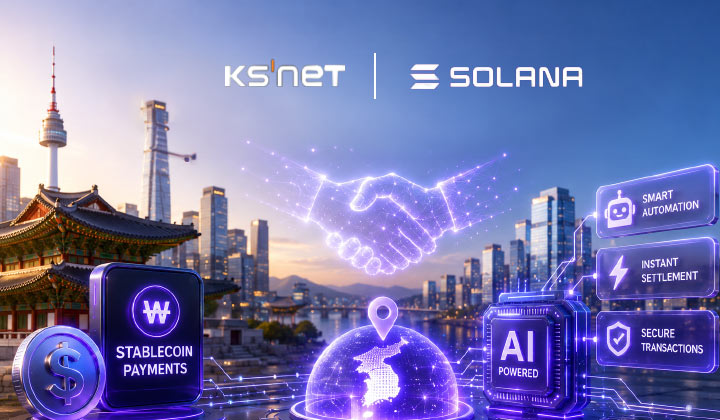
South Korea’s blockchain payments ecosystem continues to expand as KSNet, one of the country’s largest merchant payment processors, has partnered with the Solana Foundation to test stablecoin-based merchant payments and AI-native payment infrastructure.
According to a local report, the memorandum of understanding (MoU), signed at KSNet’s headquarters in Seoul, outlines two separate proof-of-concept (PoC) projects. The company will first integrate Solana Pay into its merchant payment network before evaluating x402, an emerging payment protocol designed for autonomous AI transactions.
BREAKING: Korean fintech giant KSNET is bringing payments on Solana to its network of 330,000+ merchants 🔥
As part of an MOU with Solana Foundation, KSNET will integrate Solana Pay into a payment network processing $4B in monthly volume. pic.twitter.com/XYcccF3H3Q
— Solana (@solana) July 30, 2026
The first phase focuses on integrating Solana Pay into KSNet’s payment infrastructure, which has served Korean merchants for more than 26 years across online and offline channels. The companies claim that the pilot will adhere to domestic anti-money laundering (AML) regulations while integrating blockchain-based payments with the nation’s current Korean won (KRW) settlement network.
The research will also explore techniques to mitigate exchange-rate volatility and liquidity problems that retailers might encounter while accepting stablecoin payments.
According to Park Han-han, CEO of KSNet, the company plans to integrate blockchain technology with decades of settlement expertise. He stated, “Based on the payment and settlement know-how accumulated in the market, we will try to provide the safest payment infrastructure to users.”
KSNet intends to start testing x402, a protocol intended to allow autonomous payments between AI agents and internet services, when the Solana Pay pilot is finished.
In contrast to conventional payment rails that depend on credit cards or user authentication, x402 uses the HTTP 402 status code to embed payments directly into regular internet requests, enabling software agents to automatically make small-value payments.
In order to ascertain whether the protocol can facilitate machine-to-machine payment flows, KSNet stated that it plans to integrate it with its in-house AI payment platform. The business pointed out that because sub-won payments are economically unfeasible due to numerous levels of acquiring, interchange, and settlement costs, standard card technology is ill-suited for ultra-small transactions.
The deal represents a further development in Solana’s expanding influence in the banking industry of South Korea.
Shinhan Card and Solana collaborated earlier this year to investigate blockchain-based payment infrastructure. In order to test stablecoin-powered cross-border remittances and determine if blockchain-based settlement may make international money transfers quicker and less expensive than conventional payment rails, Toss Bank and Solana also inked a Memorandum of Understanding in June.
As one of the first Korean payment companies to formally assess autonomous machine-to-machine payments, KSNet’s partnership goes beyond stablecoin settlements by introducing AI-native payment infrastructure through x402.
Solana’s fast transaction throughput and very cheap network costs have helped it establish itself as a blockchain that is geared for payments. Because of these features, payment providers experimenting with tokenized financial infrastructure, merchant settlement, and stablecoins have found the network appealing.
Instead of concentrating just on decentralized finance, the Solana Foundation has been growing its efforts to incorporate blockchain technology into conventional payment systems.
Both groups stressed that proof-of-concept testing, not commercial deployment, is presently covered under the agreement. For the time being, the collaboration demonstrates how blockchain payment technology is gradually transitioning from cryptocurrency exchanges into the nation’s well-established financial system.
Stay informed with the latest trends in Web3, blockchain innovation, and cybersecurity updates at 3verseTV
You need to login in order to Like















Leave a comment