


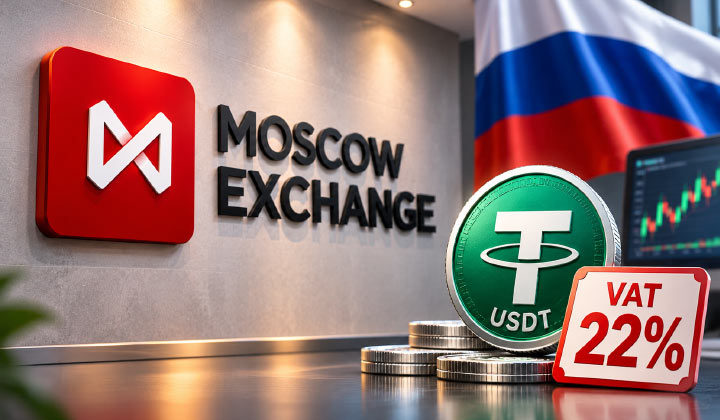
- Russia’s Moscow Exchange may charge 22% VAT on USDT purchases, sales and swaps when crypto trading begins on December 1.
- Bitcoin and Ethereum are treated differently under Russian tax rules and are exempt from this proposed VAT.
- The National Clearing Centre has withdrawn its initial announcement and is seeking clarification from tax authorities.
USDT Trading Could Become More Expensive
Russia’s Moscow Exchange may impose a 22% value added tax (VAT) on USDT trades once it launches crypto trading on December 1 2026. Originally, the National Clearing Centre (NCC), the body responsible for Moscow Exchange’s central clearing and settlement, stated that USDT trading (buying, selling and swapping) would be subject to a value added tax from December 1 to December 31.
This tax would be in addition to the value of the trade and so traders could incur extra costs regardless of whether they are profitable. But the NCC then retracted this information and consulted both Russia’s Federal Tax Service and Ministry of Finance. As such, further guidance is still awaited and it remains unclear what the tax implications for USDT will be.
Russia’s Largest Stock Exchange, Moscow Exchange (MOEX), to Launch Crypto Trading on December 1
According to Bits media, Moscow Exchange (MOEX) is set to launch crypto trading on December 1 (offering BTC, ETH, and USDT with an annual limit of 300,000 rubles per intermediary), but briefly announced on November 24 that December USDT trades would incur an extra 22% value-added tax (VAT) before deleting the notice hours later. Russia’s National Clearing Center explained that while issuerless BTC and ETH qualify as VAT-exempt “digital currencies,” Tether-issued USDT is classified as a “foreign digital instrument” lacking VAT exemption—exposing corporate entities to an additional 25% profit tax on gains—as Tax Code amendments to waive the VAT have so far passed only their first reading.
— Wu Blockchain (@WuBlockchain) November 25, 2026
Russia recognises various types of cryptocurrency and assigns differing tax statuses to them. Both Bitcoin and Ethereum are recognised as digital currency and are therefore VAT free. However, USDT has been recognised as a foreign digital tool.
Why Russia Treats USDT Differently
Primarily, the method of production of these crypto tools differs. Whilst neither Bitcoin nor Ethereum is produced by a single firm, USDT is produced by Tether, a private enterprise. Consequently, the NCC has assigned USDT to a distinct status within Russia’s legal system.
Whilst the present legislation does not evidently extend the same VAT-free status to foreign digital tools, based upon its own understanding the NCC originally suggested that USDT should be subject to a 22% VAT. As noted above, this would apply to buying, selling and swapping, and is not confined to profitable trading.
USDT buyers on Moscow Exchange will pay 22% VAT in December
$BTC and $ETH won’t
same screen
same trader
same ideaone legal classification makes the dollar token 22% more expensive
— Dylan (@DylanTeil) November 25, 2026
In addition, there are potential alterations to current legislation. Amendments to Russia’s Tax Code suggest that some foreign digital property transactions may be tax free. Again, these may affect USDT as well as other stablecoins. To date however, these amendments have only been subjected to the first reading in the State Duma and need to undergo further stages of legislative consideration.
Further still, a local report indicates that companies may be liable to pay a 25% corporate income tax on profits from crypto trading. Again, this differs from the aforementioned 22% VAT as it targets income rather than trading.
Russia Prepares For Regulated Crypto Trading
The taxation debate occurs alongside Russia’s move to further develop crypto trading via financial institutions. Moscow Exchange intends to start trading Bitcoin, Ethereum and USDT on the Ethereum blockchain from December 1. Potential trading pairs are BTC/RUB, ETH/RUB and USDT/RUB. Further pairings of BTC/USDX and USDT/USDX are also planned.
On September 1, Russia launched fresh legislation governing crypto markets. This addresses areas including crypto exchanges, digital stores and further firms involved in providing crypto services.
Furthermore, from November 17, the Bank of Russia permitted unqualified investors to buy Bitcoin, Ethereum and USDT via regulated middlemen. Yet, individual investors are required to undertake a suitability check and are restricted to an annual spending cap of 300,000 rubles via each middleman. Those who are qualified investors can invest in a greater selection of digital tools and are not subject to such an annual spending cap.
For the time being, it is still unclear how USDT will be taxed. This will hinge upon official guidance and any future developments to Russia’s tax legislation. Should a 22% VAT be imposed then USDT trading may prove more costly than Bitcoin or Ethereum trading on Russia’s regulated markets.
Stay informed with the latest trends in Web3, blockchain innovation, and cybersecurity updates at 3verseTV
You need to login in order to Like
















Leave a comment