

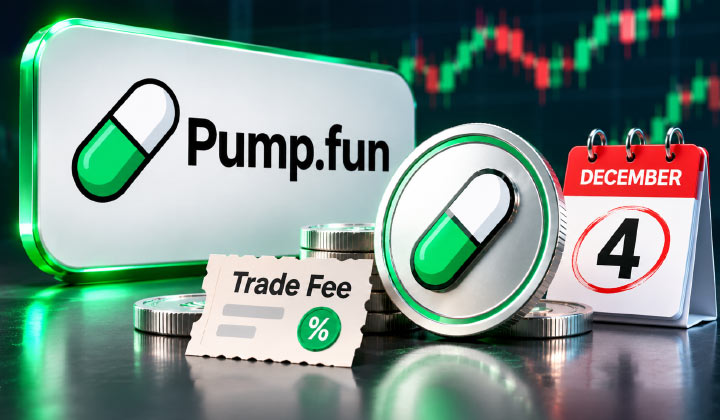
- Pump.fun will charge a fee on buys and sells made in the same Solana block in which a new coin is created, starting December 4.
- The move aims to discourage creators from using multiple wallets to buy large amounts of their own tokens at launch without making their total holdings clear.
- Half of the fees will fund ecosystem programmes, while the remaining half will support programmatic buybacks and burns of the PUMP token.
Solana-based memecoins launch platform Pump.fun is set to charge a flat rate transaction fee for all block0 transactions (transactions occurring in the same block that a token is launched) from December 4. It hopes this will prevent individuals launching tokens from purchasing large volumes of the new token using a number of different wallets.
This is known as token ‘bundling’ and can cause confusion over what proportion of a token is actually owned by its launch team. Pump.fun claims that those using a dev wallet to launch and trade tokens will continue to avoid the new transaction fee.
How Pump.fun’s block0 Trading Fee Will Work
News of the new Pump.fun feature was shared on X on November 25, 2026 and co-founder Alon Cohen also provided further information about it.
On December 4th, we’re rolling out a block0 fee on all Pumpfun launches.
The first seconds after a coin launches decide whether it gets a fair start. Right now, block0 bundlers buy in before any other trader has a chance.
We’re introducing a block0 fee to help level the playing field between regular traders and coin creators who use sophisticated tooling 👇
— Pump.fun (@Pumpfun) November 25, 2026
Transactions to buy or sell a token which are within the same block as that relating to its launch will incur a flat rate transaction fee. Details of the precise rate have yet to be shared. However, Pump.fun claims that initially it will be a low rate and that this may then be reviewed and altered based on market and user data.
On the Solana blockchain, each block is generated approximately every 400 milliseconds. Thus block0 refers to an incredibly brief window soon after a token is launched.
Whilst those using a dev wallet to both launch and subsequently trade tokens do not incur the new transaction fee, the tokens held in a dev wallet are still viewable by other traders. Pump.fun hopes that this will persuade teams to openly state how much of a token they hold rather than distributing this between seemingly unconnected wallets.
Pump.fun claims that the typical trader is unlikely to be impacted by the new transaction fee as it is anticipated that it will primarily affect a select number of more advanced traders and teams.
Why block0 Bundling Has Become A Concern
As noted above, block0 is the first block during which a token is launched and so as the launch team is responsible for this, they are typically the only ones who can trade in this block.
Nevertheless, as Cohen explained, some launch teams use seemingly unrelated secondary wallets to also purchase tokens shortly after a token has been launched. This helps to disguise the overall amount of tokens that they own. It can then prove challenging for traders to recognise where true market interest is sitting alongside what seems to be launch team interest.
This can lead to inequity. Regular traders might even be prevented from participating in block0 trading. Furthermore, teams can amass a high degree of a tokens supply whilst using numerous wallets, ahead of wider trading commencing.
Poorer market sentiment has also played a part in stimulating more trading in block0, as traders continue to seek out ever increasing levels of risk, Cohen added.
Although the new transaction fee is hoped to dissuade people from trading in block0, it may not wholly prevent bundling as teams are free to continue to use a range of wallets to buy tokens in block0, although they would then have to pay the fee.
How The Fees Will Be Used
Pump.fun has stated how it plans to utilise the funds gained from the new transaction fee. Fifty percent will be allocated to various Pump.fun ecosystem initiatives. These include the Callout Rewards scheme and other Pump.fun launchpad, app and Terminal competitions.
The other 50 percent will be directed towards Pump.fun’s PUMP token’s automated buy-back and burn function. Therefore, alongside funding Pump.fun’s ecosystem, the fees will also contribute towards a process designed to decrease the availability of PUMP tokens.
It should also be noted that funds will not be passed back to the specific tokens from which they were received. As Cohen pointed out, were this to occur it could enable traders involved in block0 trading to effectively get their transaction fees back. This would undermine the aim of the new fee.
Those wishing to continue to buy tokens using multiple wallets but avoid the block0 transaction fee can defer their purchases to subsequent blocks. Nevertheless, they will then need to compete with other on-chain traders for tokens. Furthermore, Pump.fun has suggested that it may in future decide to impose a similar transaction fee for block1 and block2. Again, this has not yet been confirmed.
Pump.fun claims that it is sharing news of the new fee early so that relevant trading terminals, apps and traders can adequately adapt prior to December 4. Only after implementation however, and subsequent analysis of trading behaviour, will it be possible to properly assess the effects of the new fee.
Stay informed with the latest trends in Web3, blockchain innovation, and cybersecurity updates at 3verseTV
You need to login in order to Like










Leave a comment