


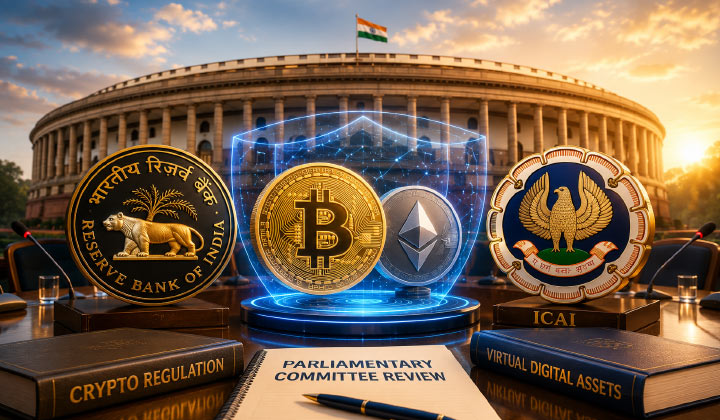
India’s Parliamentary Standing Committee on Finance on Thursday reviewed the country’s regulatory approach towards Virtual Digital Assets (VDAs), with representatives from the Reserve Bank of India (RBI) and the Institute of Chartered Accountants of India (ICAI) presenting their views on cryptocurrencies and the way forward.
The meeting focused on financial stability, taxation, accounting standards, investor protection and the need for a comprehensive regulatory framework for digital assets. Members of the Committee also held internal deliberations after hearing the presentations, as Parliament continues to examine possible policy measures for India’s evolving crypto ecosystem.
The meeting took place at the Parliament House Annexe in New Delhi and focused on “A Study on Virtual Digital Assets (VDAs) and Way Forward.” It was split into three sessions.
In the first session, RBI officials shared the central bank’s views on virtual digital assets. They discussed topics like financial stability, monetary policy, money laundering risks, investor protection, and the need for proper regulations. The RBI has often raised concerns about private cryptocurrencies but supports developing India’s Central Bank Digital Currency (CBDC).
In the second session, representatives from the Institute of Chartered Accountants of India talked about how to tax virtual digital assets, handle crypto holdings in accounting, audit practices, and what companies and individuals must disclose when dealing with digital assets. ICAI has been preparing guidance on crypto transactions since the 30% tax on VDA gains and the 1% TDS on transfers were introduced in 2022.
After the presentations, the Standing Committee met privately to review what was shared and discuss possible recommendations for India’s digital asset sector. These recommendations may guide future policy talks, but they are not binding on the government.
The Standing Committee on Finance reviews policies connected to the Ministry of Finance, the RBI, financial regulators, banking, taxes, and insurance. Its recommendations often shape future laws and regulations on key financial issues.
India now taxes gains from virtual digital assets at 30% and charges a 1% TDS on transfers. Still, there is no complete law covering crypto trading, exchanges, custody, licensing, or investor protection. The Committee’s review shows Parliament is still gathering expert advice before deciding on the next steps for crypto regulation.
Having both the RBI and ICAI involved shows the government is trying to balance financial stability with the rise of digital assets. The RBI remains cautious about private cryptocurrencies, while industry players want clearer rules that support innovation and protect investors. The crypto industry is watching the Committee’s discussions closely, but no new policy decisions have been made yet.
On the subject ‘A Study on Virtual Digital Assets (VDAs) and Way Forward’, the Standing Committee on Finance, Chaired by Shri Bhartruhari Mahtab, MP, took oral evidence from representatives of the Reserve Bank of India (RBI) and held discussions with representatives of the… pic.twitter.com/mq2xt57Q4U
— LOK SABHA (@LokSabhaSectt) July 2, 2026
Stay informed with the latest trends in Web3, blockchain innovation, and cybersecurity updates at 3verseTV
You need to login in order to Like

















Leave a comment