


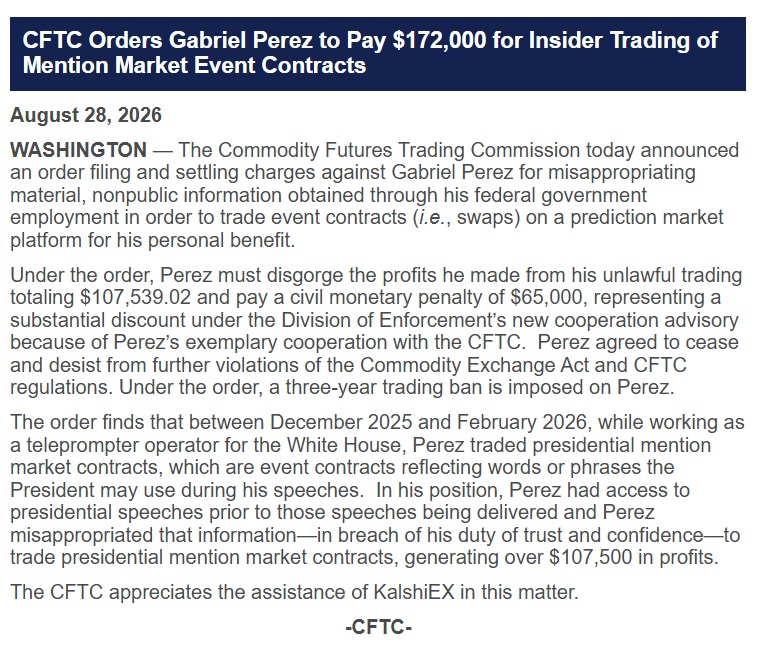
The U.S. Commodity Futures Trading Commission (CFTC) has ordered former White House teleprompter operator Gabriel Perez to pay more than $172,000 after finding that he used advance access to President Donald Trump’s speeches to make profitable trades on Kalshi’s prediction-market “mention markets.” Perez must repay $107,539.02 in trading profits and pay a $65,000 civil penalty. He has also been barred from trading on any CFTC-registered entity for three years.
According to the CFTC order, Perez opened his Kalshi account on December 8, 2025, and traded on the platform between December 2025 and March 2026. As a White House teleprompter operator, he allegedly had access to Trump’s prepared remarks about an hour before the president delivered his speeches.
Source: cftc.gov
That advance information proved valuable in Kalshi’s mention markets. These contracts allow traders to predict whether a particular person will use specific words or phrases during a speech or other public appearance. Because Perez could see the prepared remarks before the speeches were delivered, the CFTC said he was able to trade using information that was not publicly available.
The regulator said Perez consented to the settlement without admitting or denying its findings. His civil penalty was reduced by about 40% because of what the CFTC described as his “exemplary cooperation”. Perez voluntarily sat for an interview and accepted responsibility during the investigation.
A Kalshi surveillance investigation caught a White House staffer engaging in prohibited trading activity. Today this individual was subjected to penalties by the CFTC and by our exchange.
It doesn’t matter who you are: violate our rules or federal law and you will face the… pic.twitter.com/fyKFEzcXAv
— robertjdenault (@robertjdenault) August 29, 2026
Kalshi also played a role in bringing the activity to the regulator’s attention. The CFTC credited KalshiEX for its assistance, while Kalshi’s head of enforcement, Robert DeNault, said the platform’s surveillance team detected the unusual trading activity.
The case highlights growing concerns about insider trading as prediction markets become more popular. It is also the second recent CFTC enforcement action involving Kalshi contracts. In July, former U.S. congressman George Santos agreed to pay about $35,000 over trades linked to a contract about who would attend the State of the Union address. That case involved alleged manipulation, while Perez’s case centred on the use of confidential information.
Prediction markets have faced other insider-trading concerns as their popularity has grown. In May, federal prosecutors charged Google engineer Michele Spagnuolo with allegedly using internal search data to make about $1.2 million through Polymarket trades. The CFTC also filed a related civil complaint.
U.S. lawmakers have taken notice as well. House Oversight Committee Chairman James Comer opened an investigation into insider-trading controls at Kalshi and Polymarket, seeking information about user identification, geoblocking and systems used to detect suspicious trading.
Both platforms tightened their controls in March by introducing additional screening measures and updating their trading rules.
For Kalshi, the CFTC action comes at an important time. The platform is rapidly expanding its presence in sports and other prediction markets while simultaneously facing legal challenges from state gambling regulators. On Friday, the Ninth Circuit Court of Appeals ruled against Kalshi in its dispute with Nevada, adding another layer of uncertainty to the company’s regulatory battle.
The Perez case, meanwhile, sends a straightforward message: having access to confidential information does not give prediction-market traders a free pass to profit from it.
Stay informed with the latest trends in Web3, blockchain innovation, and cybersecurity updates at 3verseTV
You need to login in order to Like
















Leave a comment