



Michael Selig, chairman of the U.S. Commodity Futures Trading Commission, a federal regulator overseeing derivatives and commodity markets, told attendees at the US Treasury Market Conference that American financial markets should brace for what he called “mass tokenization” as regulators work to adapt existing rules for blockchain, artificial intelligence, and onchain trading systems.
Selig’s Tuesday remarks arrived together with parallel movement from the Securities and Exchange Commission, which is distinctly advancing tokenized stock trading initiatives. Both agencies are persistent forward on these fronts even after the Senate failed to advance the CLARITY Act on September 15, a delay that has pushed regulators to lean more profoundly on their existing authority rather than wait for fresh legislation.
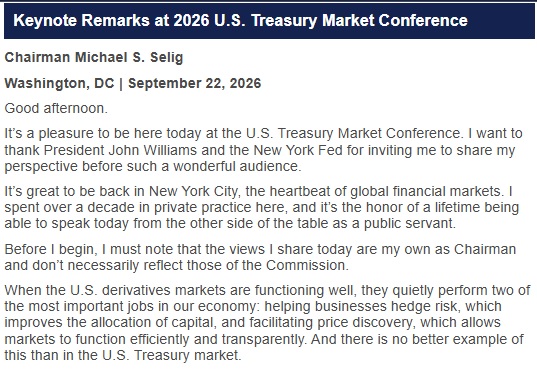
Source: cftc.gov
Selig Frames Tokenization As Market Infrastructure Upgrade
In his Tuesday address, Selig argued that tokenizing real-world assets could ultimately form the backbone of a far more efficient financial system, one capable of delivering near-instant settlement and real-time collateral movement between clearinghouses, intermediaries, and end users.
The new frontier of finance isn’t on the horizon. It’s here.
As our markets evolve at warp speed, the @CFTC is upgrading its rules and regulations to prepare for the era of onchain systems, mass tokenization, 24/7 trading, and agentic finance. pic.twitter.com/om6XmfycIZ
— Mike Selig (@ChairmanSelig) September 23, 2026
He drew a direct comparison to an earlier era of market evolution, suggesting tokenization could transform every asset class much the way the shift from hand signals to electronic trading once reshaped the broader financial system. Selig added that the CFTC intends to pursue principles-based rulemaking as tokenization and onchain finance continue maturing.
This isn’t a sudden pivot either; Selig had already signaled back in August that the CFTC would move forward with crypto-specific rules under its existing regulatory authority if Congress failed to pass the CLARITY Act, a prediction that proved accurate once the Senate vote collapsed.
On September 17, the agency went a step further, submitting a regulatory action covering crypto asset transactions and markets for White House review. That filing remains at what’s known as the “prerule” stage, meaning specific regulatory details haven’t yet been spelled out.
SEC Officials Push Back Against Politicizing Onchain Markets
The SEC has been moving on a parallel track of its own. Jamie Selway, who directs the SEC’s Division of Trading and Markets, told Bloomberg TV that tokenization and crypto more broadly have recently become caught up in political debate, even though he doesn’t believe that’s their natural role.
Jamie Selway (SEC Director, Division of Trading & Markets) on @BloombergTV
“Tokenization & crypto have been politicized recently. But it’s not naturally a politicized function . . . Success of the country in terms of developing these markets should have good bipartisan support.” pic.twitter.com/zeFtQbI6wb
— U.S. Securities and Exchange Commission (@SECGov) September 22, 2026
Selway argued that American success in building out these markets deserves support across party lines rather than becoming a partisan issue. Backing up that sentiment with concrete action, the SEC granted a temporary “Innovation Exemption” on September 17 specifically for tokenized U.S. stock trading, a move that allows certain qualifying platforms to trade digital versions of U.S.-listed stocks under defined conditions.
SEC Chair Paul Atkins had previously suggested back in February that such an exemption could help facilitate onchain trading activity while regulators continue developing more permanent, longer-term rules for the space.
Stay informed with the latest trends in Web3, blockchain innovation, and cybersecurity updates at 3verseTV
You need to login in order to Like
















Leave a comment